
How to Monitor Creative Fatigue at Scale Across Meta and TikTok


TL;DR
At Deepsolv, we diagnose creative fatigue at scale through persistent, asset-level attention decline confirmed by cost or conversion deterioration, not a universal frequency trigger. We show teams how to normalize Meta and TikTok variants to their own baselines, filter delivery and audience false alarms, build actionable alerts, and route each diagnosis to a refresh, pause, redistribution, or monitoring decision.
A 5.8 billion impressions study of online display campaigns found that more frequent, closely spaced exposure was associated with lower click-through rates, with results varying by campaign diversity, spend, and industry.
Creative fatigue at scale means comparing every Meta and TikTok asset with its own stable launch baseline, then testing whether attention decline persists alongside worse cost or conversion efficiency. We treat frequency, reach, delivery changes, audience overlap, and category activity as diagnostic context, so teams refresh creative only when the evidence points to creative decay.
This guide covers the asset-level metrics, baseline method, false-alarm filters, dashboard design, and alert actions needed when dozens of variants run at once.
What Does Creative Fatigue at Scale Actually Mean?
Creative fatigue is not simply a low CTR, a high frequency number, or an ad that has been live for several weeks. It is a pattern: an asset that began with viable performance loses attention over time, and that attention loss is later confirmed by weaker efficiency. The key distinction is that the pattern belongs to the asset, not to the campaign average.
That matters when 40 or more variants share delivery. One campaign can look healthy while a few expensive ads lose click intent, get served repeatedly to a narrowing audience, and quietly pull down blended CPA. Our cross-platform fatigue guide explains the basic diagnosis. At scale, we make that diagnosis more specific by separating four causes.
- Creative fatigue: One asset or creative family declines while comparable fresh assets remain healthy.
- Audience saturation: Multiple assets weaken as reach growth slows, repeat exposure grows, or daily new users fall.
- Delivery or auction change: Unrelated ads shift together after a budget, bid, placement, or optimization change.
- Measurement or site issue: Attention holds, but conversion rate, CPA, or ROAS changes after the click.
TikTok advises advertisers to refresh ad-group creative when results decline consistently or daily new users are low, which supports using both performance and audience context rather than one fixed exposure rule. TikTok’s guidance also recommends keeping a supply of distinct creative ready to test.
Which Metrics Move First When an Asset Starts to Fade?
When we monitor many assets, we trend the attention signals first, then use cost and conversion metrics to confirm whether the deterioration matters commercially. The exact mix depends on format and platform, but the diagnostic order should stay consistent.
Attention Metrics
For video, start with hook or hold rate, then CTR. On TikTok, calculate a rate from qualified video views and impressions so different assets can be compared consistently. TikTok defines a two-second view as a play lasting at least two seconds in an impression session, while its six-second metric measures longer early attention. Video metric definitions make clear why counts and rates should not be treated as the same signal.
For Meta, CTR is usually the most portable attention signal across placements. Pair it with the compatible video-retention measures available for the asset and placement. A falling CTR is useful because it reveals a change in response, not because any particular CTR level is universally good or bad.
Efficiency Metrics
CPC, conversion rate, CPA, and ROAS tell us whether weaker attention is becoming a business problem. CPC often rises when CTR falls, but conversion rate identifies a different failure mode: stable clicks with weaker conversion efficiency points toward the landing page, offer, tracking, or attribution before it points toward creative.
Delivery Context Metrics
Frequency, reach, spend, placement mix, audience allocation, daily new users, and edit history explain why the trend may be happening. Frequency is diagnostic context, not a verdict. A high number can be acceptable for one retargeting audience and unnecessary for a broad prospecting campaign.
| Metric | What We Trend | What It Can Signal | What Confirms It |
|---|---|---|---|
| Hook Or Hold Rate | Qualified video views divided by impressions | Early attention loss | CTR and downstream efficiency decline |
| CTR | Clicks divided by impressions | Falling click intent | CPC, CPA, or ROAS deterioration |
| CPC | Spend divided by clicks | Rising cost to acquire attention | Falling CTR or broader auction movement |
| Conversion Rate | Conversions divided by clicks | Post-click friction or intent mismatch | Stable attention with weaker outcomes |
| CPA | Spend divided by conversions | Business-outcome deterioration | Persistent attention and cost changes |
| ROAS | Attributed revenue divided by spend | Value deterioration | Attribution and conversion checks |
| Frequency | Average exposures per reached account or user | Repeat-exposure pressure | Reach growth and asset-specific decay |
| Reach And Spend | Audience headroom and signal reliability | Saturation risk or prioritization | Frequency and trend persistence |
Our angle tracking approach keeps those metrics tied to the hook, format, and message behind the asset, so a team can see whether a single execution faded or an entire creative idea needs a new test.
How Do We Calculate a Baseline for Every Variant?
Universal fatigue thresholds are tempting because they are simple. They also hide the fact that a strong video, a static prospecting ad, and a retargeting testimonial can begin from very different CTR, hold-rate, and conversion-rate levels. We calculate a baseline for each asset's own stable launch period, then compare recent rolling performance against that starting point.
The comparison must remain like for like. We keep platform, optimization event, attribution window, placement family, audience, and meaningful creative edits visible beside the performance trend. If any of those changed, a clean baseline comparison may no longer exist.
For each metric, we calculate a normalized change:
Current Rolling Metric ÷ Launch Baseline Metric − 1
That produces a relative signal instead of a misleading account average. A drop from 4% CTR to 0.8% is a substantial asset-level decline, but it still needs corroboration. If the same period includes a landing-page outage, a budget reset, or a dramatic placement shift, the diagnosis changes.
Meta says ad-set performance typically stabilizes after about 50 optimization events in a seven-day period, and material edits can return delivery to learning. Meta’s learning guidance is why we label launch and edit windows before creating a fatigue alert. Our ad stop rules also prevent teams from treating ordinary learning volatility as a reason to kill a promising asset.
How Do We Filter False Fatigue Alarms?
A useful alert does more than point at a declining metric. It explains what could have caused the decline and what evidence would rule competing explanations in or out. We filter alerts through delivery, audience, measurement, and auction checks before recommending a refresh.
Check Delivery and Auction Changes First
Review budget changes, bid strategy, optimization event, placements, audience changes, delivery status, and edit history. If several unrelated assets deteriorate at once, a campaign-level delivery or auction issue is more plausible than simultaneous creative decay.
Separate Audience Saturation from Asset Decay
Compare the declining asset with newer assets in the same audience. If the new assets are healthy while one older asset fades, fatigue is more likely. If both old and new assets weaken, while reach stalls and frequency or repeat exposure rises, audience saturation becomes the stronger diagnosis.
Our fatigue versus saturation framework helps teams avoid refreshing assets when the real constraint is distribution.
Check the Post-Click Path
Stable hold rate and CTR combined with a weaker conversion rate should trigger a site, offer, tracking, or attribution review. Creative can influence conversion quality, but it should not be the default explanation when people still engage at the same rate.
Use Category Activity as a Test Input
Category launches, new formats, and changing creative patterns can inspire a refresh brief. They do not prove why a specific asset declined. We record those observations as hypotheses for the next test, not as causal evidence.
What Should a Fatigue Monitoring Dashboard Show?
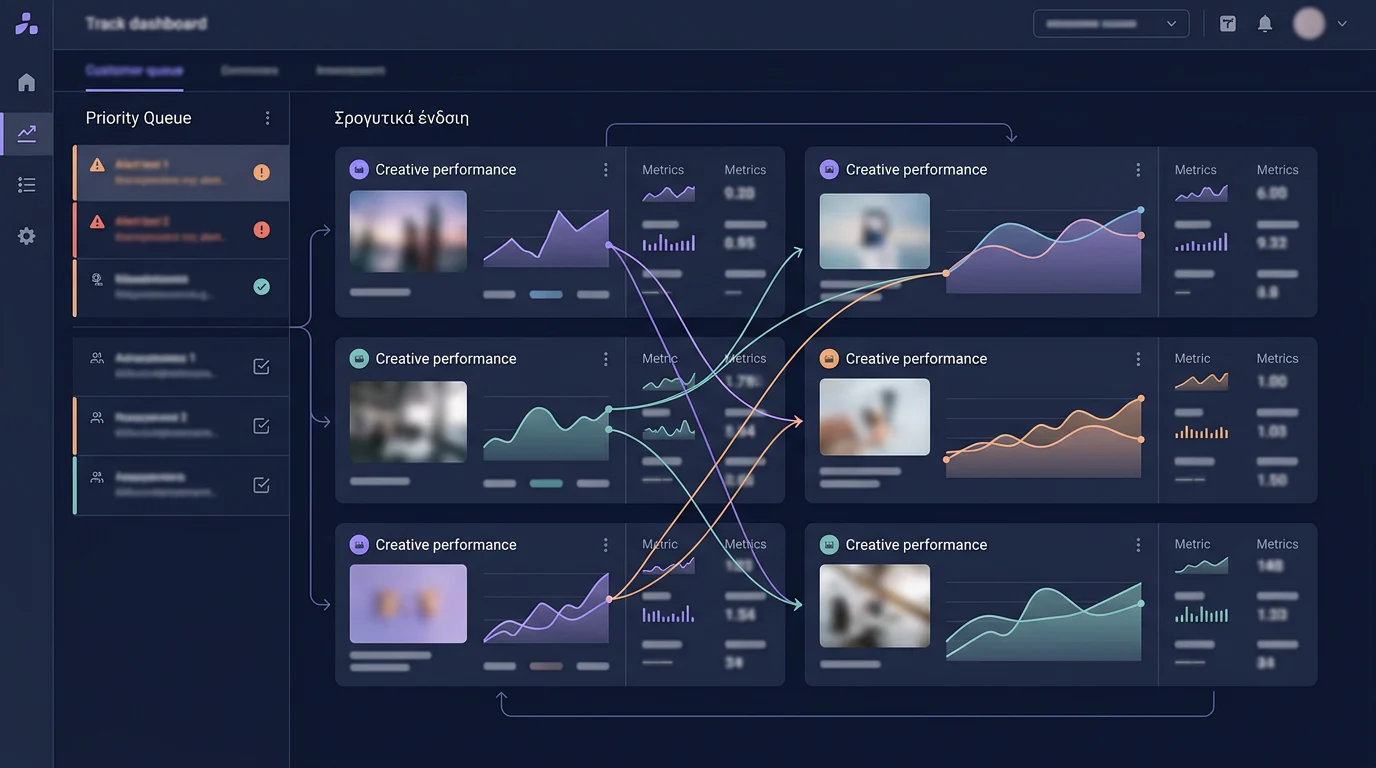
A dashboard for creative fatigue at scale should start with an exception queue, not campaign averages. The first view should identify the assets with meaningful spend, adequate observations, persistent trend deterioration, and enough corroboration to justify a human decision.
For every asset, we show the creative family and angle, launch date, last edit, platform, campaign context, spend, reach, frequency, attention metric, CTR, CPC, conversion rate, CPA, ROAS, baseline deltas, diagnostic confidence, and recommended action. That makes it possible to spot a decaying asset even when the campaign remains above target.
| Monitoring Need | Meta | TikTok |
|---|---|---|
| Primary Attention Signal | CTR plus compatible video-retention reporting | Two-second and six-second viewing, retention, and CTR |
| Delivery Context | Frequency, reach, placements, edit and learning status | Frequency controls, daily new users, ad-group delivery |
| Asset Analysis | Ad-level reporting and breakdowns | Dashboard, ad-level reports, and Video Insights |
| Automated Fatigue Status | Rules layer built from exported or connected data | Documented fatigue API and webhook capability for approved access |
TikTok's fatigue-status API can return detection results for an ad, ad group, or advertiser account, and its documentation describes webhook subscriptions. It also notes that access is allowlist-only. TikTok’s API documentation makes native automation useful where available, but teams still need their own baseline and corroboration logic.
Our cross-platform signals workflow keeps the same asset-level question visible across platforms: what changed, how confident are we, and what should happen next?
What Action Should Follow Each Diagnosis?
The best response is not always to pause. A fatigue system should route each diagnosis to a specific action, preserve what the team learned, and avoid disrupting assets that need more evidence.
| Diagnosis | Evidence Pattern | Recommended Action |
|---|---|---|
| Confirmed Creative Fatigue | Persistent attention decline plus worsening efficiency, with asset-specific exposure context | Refresh the hook, opening frame, creator, format, proof, or execution |
| Persistent Waste | Confirmed decay with material spend and a ready replacement | Pause and move budget to the replacement |
| Audience-Specific Exhaustion | Asset remains viable elsewhere but weakens in one audience or placement | Redistribute after audience and delivery review |
| Delivery Or Auction Shift | Multiple unrelated assets move together | Investigate delivery before changing creative |
| Post-Click Failure | Attention holds while conversion efficiency drops | Review landing page, offer, tracking, and attribution |
| Low Confidence | Recent edit, low delivery, or a brief anomaly | Continue monitoring |
An alert should require four gates: the asset has passed its launch or edit volatility, it has met the account's pre-set minimum spend and observations, the change persists across the chosen reporting window, and at least two signals corroborate the diagnosis. We do not recommend a generic frequency or CTR number because context determines whether the signal is meaningful.
When an asset truly fades, keep the learning. Preserve the offer or angle that worked, identify the failing element, and give the creative team a focused refresh brief. Our test prioritization process turns that record into the next set of concepts instead of repeating a broad, untraceable production cycle.
How Deepsolv Turns Signals into Decisions
Creative fatigue rarely announces itself in a single chart. It appears in the gap between the asset that is losing attention, the audience receiving it, and the next test the team should run. At Deepsolv, we help paid-social teams bring those signals into one decision workflow. We connect asset-level results to angles, hooks, audience context, and competitive observations, then make the evidence readable enough to act on. That means fewer campaign averages hiding a weak variant, fewer rushed refreshes after CPA has already moved, and a clearer record of what deserves testing next. Our goal is not to replace judgment with a generic threshold. It is to give your media buyers and creative team the same evidence, at the moment a refresh, pause, redistribution, or watch decision matters across Meta and TikTok, not the morning after performance falls. Book a Deepsolv demo
FAQs on Creative Fatigue at Scale
How Do You Monitor Creative Fatigue Across Many Ads?
We compare each asset with its stable launch baseline, require adequate delivery and a persistent change, then confirm attention decay with cost, conversion, reach, and frequency context.
Which Metrics Detect Meta Ad Fatigue Early?
We look for falling hold rate or CTR, then check CPC, conversion rate, CPA, and ROAS. Frequency and reach show whether repeat exposure contributes materially.
How Do You Track TikTok Creative Fatigue?
We use TikTok viewing and retention measures with CTR, spend, reach, and daily new users. Each asset is compared with its own early performance, not category averages.
Is a CTR Drop Enough to Prove Creative Fatigue?
A CTR decline can reflect creative decay, audience saturation, delivery changes, auction pressure, or measurement issues. We require persistence plus a downstream efficiency signal before diagnosing fatigue.
What Tools Can Monitor CTR Decay Automatically?
We use ad-level reporting and automated rules to track asset baselines. TikTok documents fatigue-status API webhooks, but says access is limited to approved accounts only.
When Should a Paid-Social Fatigue Alert Pause an Ad?
We refresh when decay is specific and confirmed, pause when waste is persistent and replacements exist, redistribute when audience evidence supports it, and continue monitoring when confidence is low.