Easter Facebook Ads: Work Back From Easter's Date, Then Test
Plan Easter Facebook ads backward from Easter's date, which moves yearly. In 2027 it falls on March 28, so a four-week lead starts February 28, and discounts should be tested, not assumed.

By Sachit Sharma, CEO & Founder · Updated 24 Nov 2026

Key takeaways
- Work back from Easter Sunday: scout four weeks out, test three weeks out, decide two weeks out, run the final offer in the last week. Easter 2027 is March 28, so scouting starts February 28.
- In the National Retail Federation's 2026 survey, 36% of Easter shoppers named sales or promotions as inspiration, so test a discount hook against a tradition or gifting hook.
- Your ceiling per purchase is your contribution margin per order before ad spend. Know it before you launch.
- Rank your first Easter tests from a log of live competitor ads, then test one change at a time.
In this article
- 1When should Easter Facebook ads start, and how does the moving date change the plan?
- 2Is a discount the right hook for Easter ads, or does tradition sell better?
- 3What can an Easter ad cost before it loses money?
- 4How do you rank Easter ad tests from what competitors already run?
- 5What do Easter Facebook ad hooks look like for tradition, gifting and discount angles?
- 6How do we plan Easter creative tests at Deepsolv?
- 7Frequently asked questions
Easter can fall anywhere from March 22 to April 25, a spread of 34 days. A media plan copied from last year can therefore start a week early or a week late.
Headline ideas are easy to find, and a section below gives sample lines for three angles. The decisions that decide whether Easter pays are harder: which week spend starts, which hook goes first, and what a purchase can cost before the ad loses money. A hook is the opening line or first visual that stops the scroll. An angle is the reason to buy that the hook expresses. In 2027, a plan keyed to a mid-March start would begin 13 days before Easter, after the scout and test phases are over.
This page is for online brands running Meta ads, meaning ads on Facebook and Instagram. Churches and local shops need a different budget logic. Below you get a date table, the shopper data behind the hook decision, a break-even cost line, a competitor log for ranking your first tests and sample hooks to write from.
When should Easter Facebook ads start, and how does the moving date change the plan?
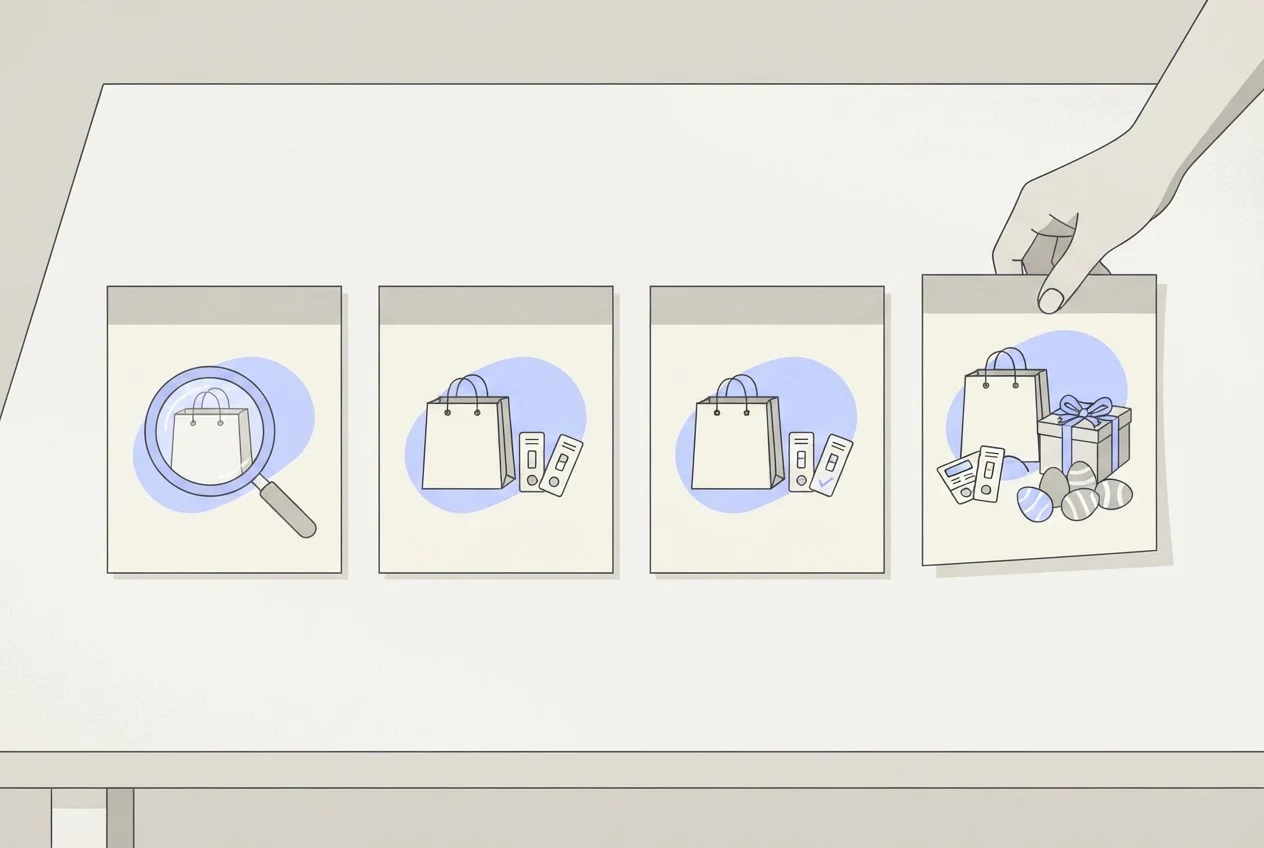
Start by counting back from Easter Sunday, not from a calendar month. Our recommended structure is four phases: scout competitors at four weeks out, test hooks at three weeks, decide at two weeks, and run the final offer in the last week. Easter's date shifts the whole schedule.
Easter is the first Sunday after the first full moon of spring, according to the Farmers' Almanac. That page gives Western Easter as March 28, 2027 and April 16, 2028. We worked out the table below by subtracting 28, 21, 14 and 7 days from those two dates.
| Phase | Easter minus | Starts in 2027 | Starts in 2028 | Job |
|---|---|---|---|---|
| Scout | 28 days | Feb 28 | Mar 19 | Log what competitors run |
| Test | 21 days | Mar 7 | Mar 26 | Run 2 to 3 hooks against each other |
| Decide | 14 days | Mar 14 | Apr 2 | Scale the winner or stop the loser |
| Final offer | 7 days | Mar 21 | Apr 9 | Run the winner's last-chance message until your last order date |
Set the final-offer end date at your last guaranteed-delivery order date, not Easter Sunday, for physical gifts. Digital or in-store-pickup offers can run to Easter. Pass test: your last order date equals your carrier's cutoff minus 1 day. Fail: the ad is still selling orders that cannot arrive in time.
The 2028 window opens 19 days after the 2027 window, because Easter itself is 19 days later. A team that starts on March 15 in 2027 "because that worked last time" launches with 13 days left, skipping the testing phase entirely.
Window length is a judgment, not a measured rule. We would test three weeks of spend against four weeks across two test cells before assuming either is right. A test cell is one ad set (Meta's budget and audience container) running one creative variation. For the wider spring calendar, see our spring sale ads page.
Is a discount the right hook for Easter ads, or does tradition sell better?
Test a discount hook against a tradition or gifting hook, and do not assume the discount wins. The National Retail Federation (NRF) found that in 2026 only 36% of Easter shoppers named sales or promotions as inspiration, against 58% for tradition.
That comes from the NRF's 2026 Easter survey, run by Prosper Insights & Analytics: 7,845 adults, March 2 to 11, 2026, with a margin of error of plus or minus 1.1 percentage points. Seasonal products and store displays each drew 27%.
The 2025 survey (7,970 adults, March 3 to 7, 2025) found the same 36% for promotions and 63% for tradition. It also found 36% of shoppers planning to buy online. That fell to 34% in 2026.
What people plan to buy in 2026, per the same NRF survey:
- Candy: 92%
- Food: 90%
- Gifts: 64%
- Decorations: 53%
- Clothing: 51%
Our inference: a discount-led ad speaks to a motive that about a third of shoppers hold, and the gifting and basket categories give you other reasons to lead with. The NRF measured shopping motives, not ad response. A discount can still win in your account, which is why it goes in a test and not a default. If urgency is part of your offer, scarcity ads covers how to test it.
What can an Easter ad cost before it loses money?
An Easter ad can cost up to your contribution margin per order. That is order revenue minus product cost, shipping, payment fees and other per-order costs, before ad spend. That figure is your break-even cost per acquisition (CPA, the ad cost of one purchase). Spend above it loses money on a first order.
Our worked example uses made-up numbers. A gift box sells for $40 and leaves $14 after product, shipping and fees. Break-even CPA is $14.
The same figure sets how much a test costs. Divide your daily budget by break-even CPA to see how many break-even purchases it can buy:
- At $10 a day, $10 / $14 = 0.71 purchases a day, or about 5 over a 7-day week.
- Five purchases is too few to separate two hooks.
Our recommendation is to fund each test cell with enough budget for roughly ten break-even purchases over the test week. In the example that is $140 a week, or $20 a day per cell. That is our model, not a Meta rule. If you cannot afford it, run one cell and change one thing at a time.
How do you rank Easter ad tests from what competitors already run?
Rank tests by logging live competitor Easter ads before the test phase starts, then let the log set the order. Use the Meta Ad Library, where Meta lists ads currently running, and log seven competitors in this layout.
| Advertiser | Angle | Offer | Format | Start date (per Meta) | Days live |
|---|---|---|---|---|---|
| Brand name | Tradition, gifting, bundle or discount | Exact offer text | Image, video or carousel | Date | Count |
Our rule for turning the log into an ordered list of tests:
- Count the discount-led ads in your seven rows. Four or more: tradition or gifting is test cell A and gets budget first, and the discount is test cell B. Three or fewer: the discount is test cell A, and tradition or gifting is test cell B.
- Choose between tradition and gifting by the longest-running ad in your log: the angle on the ad with the most days live goes first. If neither appears in the log, tradition goes first, since 58% of shoppers named it as inspiration in the NRF's 2026 survey.
- Order the remaining angles by the days live of their longest-running ad, longest first. That is your test queue.
Pass or fail for each log row: the ad has a start date and a count of days live. A row missing either fails and cannot be used to rank. Ads that have run longest are the ones their advertisers have kept paying for. Our reading of that is an inference, not a guarantee of performance.
Then write each test as a hypothesis with a stop line. Our A/B test hypothesis template gives the structure. Use this form: "If we lead with [tradition hook] instead of [discount hook] for [audience], CPA will fall below $14 because [reason]. We stop the losing cell at [spend] with no purchase."
What do Easter Facebook ad hooks look like for tradition, gifting and discount angles?
Each angle opens with a different reason to buy. Tradition names the ritual, gifting names the person receiving, and a discount names the saving and the end date. The lines below are our own sample opening lines to adapt, not tested copy.
- Tradition: "The Easter basket your family will remember"
- Gifting: "The Easter gift box, ready to give"
- Discount: "20% off Easter gift boxes through Sunday"
Put each line in its own test cell, so the test compares angles and not wording. For a physical gift, replace "Sunday" with your last order date.
How do we plan Easter creative tests at Deepsolv?
We combine ad-performance data, competitor activity, customer signals and past ad learnings into ranked weekly creative test plans and execution-ready creative briefs, with reasons for each recommendation. Our recommendations guide experiments. They do not guarantee profitable ads.
What this means for an Easter window:
- Our competitor intelligence identifies winning competitor ads and shows what makes them successful, so you can check your manual log against it.
- Brand Brain, our memory of past experiments, winning hooks and failed hypotheses, holds what you have tested before. We can import prior creative testing history, so last Easter's results are in the plan.
- Customer signals from reviews, Instagram and Facebook comments, Reddit and support tickets surface angles to test beyond the discount.
- Our Trending Ads page for beauty shows live US Meta ads ranked by performance, as an example of competitor browsing.
Our platform is built for teams spending about $50,000 a month on Meta. Onboarding takes one to two weeks, so in a 2027-style early year, book during the scout phase, not the test phase. Pricing is a monthly or yearly subscription. To see the platform on your own Easter data, book a demo with our founding team and ask us about pricing.
See your Easter creative plan on your own data
Frequently asked questions
Test it before you commit. Only 36% of shoppers named sales or promotions as Easter inspiration in the NRF's 2026 survey, against 58% for tradition. Run a discount hook against a tradition or gifting hook in your own account.
Sources
- 1.NRF: Easter Spending Expected to Reach a Record $24.9 Billion, National Retail Federation, March 24, 2026
- 2.NRF: Consumers to Spend $23.6 Billion on Easter, National Retail Federation, April 8, 2025
- 3.When Is Easter?, Farmers' Almanac