Meta Andromeda Update: What Changed and How to Check Your Account
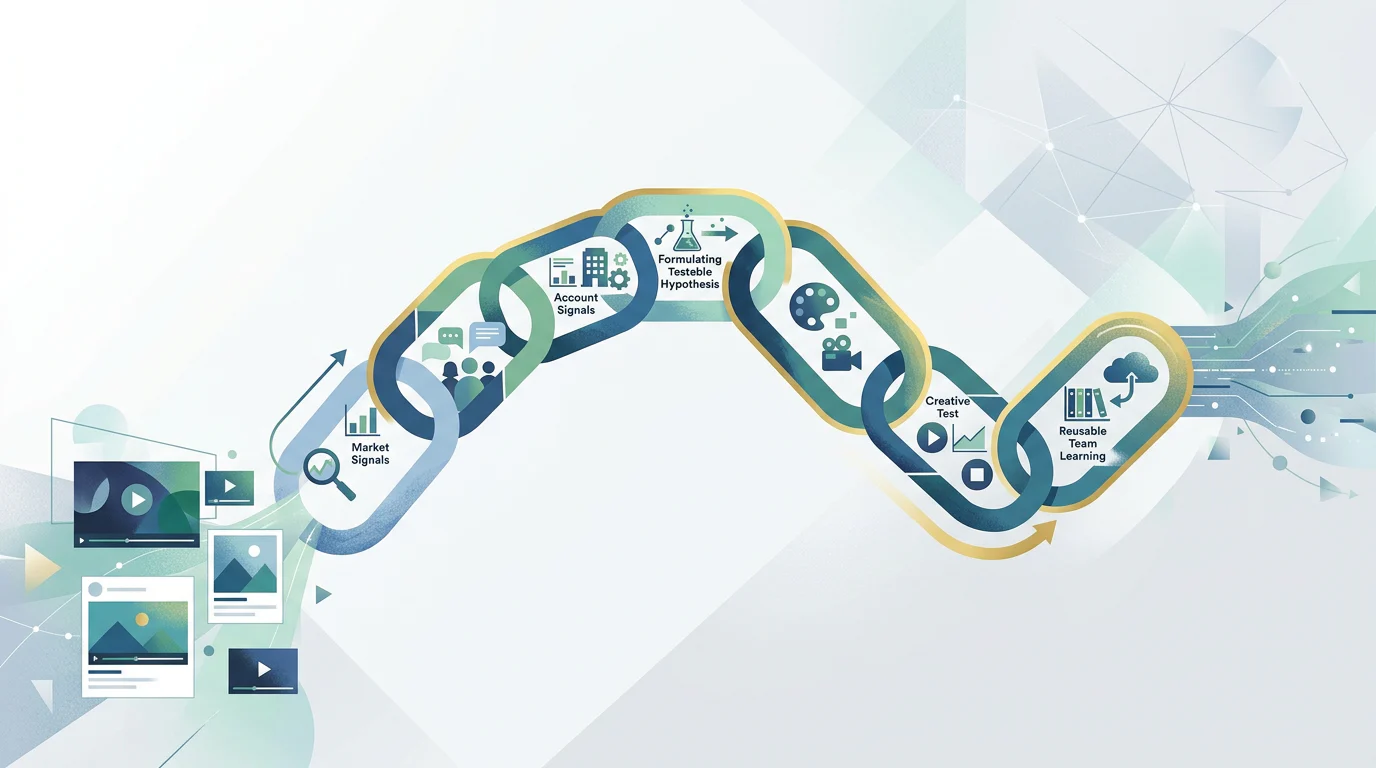
The Meta Andromeda update is not one dated switch but a series of upgrades to the stage that shortlists ads. Check your account against five tests before changing creative.

By Sachit Sharma, CEO & Founder · Updated 3 Oct 2026

Key takeaways
- 01
The Meta Andromeda update is a series of upgrades to ad retrieval, the stage that shortlists ads. Meta announced it in December 2024 and said it extended it in Q4 2025, so there is no single switch-on date.
- 02
Meta states that look-alike ads are grouped as variations of one creative. It has published no creative quota or similarity percentage, so counts such as "10 to 20 ads per ad set" are agency convention. Size your test to your budget: concepts you can judge per week = weekly budget ÷ cost per purchase ÷ 5.
- 03
Andromeda, Lattice and GEM are different systems, and none of them generates your creative.
- 04
Before you change creative, run the five account tests below. A drop in campaigns aimed at new customers with retargeting steady points at creative supply.
In this article
- 1What is the Meta Andromeda update, and when did it launch?
- 2How do Andromeda, Lattice and GEM differ, and which one affects my creative?
- 3Did the Andromeda update lower ROAS across Meta accounts?
- 4Which creative diversification advice comes from Meta, and which is agency convention?
- 5How many creative concepts can your Meta budget actually judge?
- 6Is Andromeda the reason your Meta results dropped? Five tests to run
- 7How do we plan the next Meta creative test at Deepsolv?
- 8Frequently asked questions
Most advice on the Meta Andromeda update boils down to one rule: upload many ads and let the system sort them out. Meta supports part of that rule, and agency practice adds the rest.
Andromeda is the first filter in Meta's ad system. Before any auction scoring happens, it shortlists the ads worth considering for a given person. When Meta's engineers described it in December 2024, they reported an 8% ads-quality improvement on selected segments. In January 2026 Meta said it had extended the system again.
That is why accounts feel different without a date to blame. In July 2026 Meta introduced Meta Generative Recommender, which put a first generative model into ads retrieval. Meta's call does not link it to Andromeda, so connecting the two is our inference.
Below: five tests that show whether Andromeda is your problem, and the formula for how many creative concepts your budget can judge.
What is the Meta Andromeda update, and when did it launch?
There is no single Meta Andromeda update. Meta announced Andromeda on 2 December 2024 as the ads retrieval engine behind Advantage+, its suite of automated campaign tools, and said it extended the system in Q4 2025. Retrieval narrows tens of millions of ad candidates to a few thousand. Searches for "Andromeda AI" and "Andromeda ads" point at this system.
Retrieval is the first step of a multi-stage ad system. Ranking, which scores the shortlisted ads, comes after.
| Date | What Meta reported | Source |
|---|---|---|
| 2 Dec 2024 | Andromeda introduced for Advantage+. +6% recall and +8% ads quality on selected segments, a 10,000x increase in model capacity, built on NVIDIA Grace Hopper chips and Meta's own MTIA (Meta Training and Inference Accelerator) hardware | |
| 16 Dec 2025 | In "Demystifying Creative Diversification," Meta says its ads system groups ads that share key visual and thematic attributes, and that look-alike ads are seen as variations of the same creative. It also says it is testing expanded creative insights in Ads Manager to diagnose creative fatigue and similarity | |
| 28 Jan 2026 (Q4 2025 call) | "In Q4 we extended our Andromeda ads retrieval engine" to run on Nvidia, AMD and MTIA chips, and its compute efficiency nearly tripled | |
| 29 Jul 2026 (Q2 2026 call) | Meta introduced Meta Generative Recommender, which uses large language models to reason about ad content and user preferences together. "We deployed the first generative model into our ads retrieval system and saw notable improvements in ad performance" |
Meta's July 2026 call does not mention Andromeda. Retrieval is the stage Andromeda covers, so we read the new model as related to it, but that link is our inference, not Meta's statement. For a buyer, the practical point is the same: plan for gradual shifts in delivery rather than waiting for a dated event.
How do Andromeda, Lattice and GEM differ, and which one affects my creative?
Andromeda shortlists which ads are considered. GEM, Meta's Generative Ads Recommendation Model, is a large ranking model that passes what it learns to smaller models used at serving time. Lattice merges separate models into larger shared ones. None of the three generates your creative.
Meta does not run its largest models, GEM among them, on every ad request. They transfer knowledge to lighter models that run at serving time (Meta Q4 2025 call).
| System | Stage | What Meta reported | What it means for you |
|---|---|---|---|
| Andromeda | Retrieval (shortlist) | See the timeline above | The ads you supply are the pool it draws from |
| GEM | Ranking | 5% more Instagram and 3% more Facebook Feed conversions in Q2 2025. Combined with user-understanding models, 8.3% more ad clicks and 15.7% more conversions on Facebook in Q2 2026 | Your inputs are the creative, the conversion signal and the budget |
| Lattice | Model consolidation | In Q4 2025 Meta merged Facebook Stories and other surfaces' models into its main Facebook model. With back-end improvements, that gave a 12% increase in ads quality | Fewer separate models per placement |
These are company-wide figures, not a forecast for your account. Meta's creative-generation tools, such as the Muse Image model announced on the Q2 2026 call, are separate products.
Did the Andromeda update lower ROAS across Meta accounts?
No source shows that the Andromeda update lowered ROAS across Meta accounts. One vendor study of its own customers, Confect's analysis of 3,014 ecommerce advertisers in 2025, found average return on ad spend (ROAS, revenue per dollar of ad spend) down 7%. Prospecting ROAS fell 13%. These figures are vendor-reported and show a decline in one sample, not its cause. The data is in the Confect Andromeda study.
The same study covered $834 million in spend and 1 million ads. Its other findings:
- Conversion rates fell 17%.
- Retargeting stayed relatively stable.
- The top-performing group's ROAS fell 31%, while the bottom group edged up.
Four cautions apply:
- Every advertiser in the sample uses Confect, a catalog-ads platform.
- Confect excluded 42.4% of ads for failing impression or performance thresholds, and 5.1% of advertisers as outliers.
- A strong group falling while a weak group rises is also what regression to the mean looks like (extreme results drifting back toward the average on their own). That reading is our inference.
- Do not assume your account is hit or spared. Test it.
Which creative diversification advice comes from Meta, and which is agency convention?
Meta states that look-alike ads are grouped as variations of one creative, and that it is testing creative fatigue and similarity insights in Ads Manager. It has published no similarity percentage or creative quota, so those remain agency convention. Agencies publish counts such as 10 to 20 ads per ad set, which are not Meta guidance.
As of October 2026:
| Claim | Status | Basis |
|---|---|---|
| Andromeda is the retrieval stage of Meta's ad system | Meta-stated | |
| Look-alike ads are grouped as variations of one creative, and learnings are shared at the creative level | Meta-stated | |
| Andromeda is one dated update, such as "October 2025" | Inaccurate | Announced December 2024 and extended in Q4 2025 |
| Andromeda picks the winning ad | Inaccurate | It shortlists; ranking models such as GEM score the candidates |
| GEM generates creative | Inaccurate | Meta describes GEM as an ads recommendation model |
| You need 10 to 20 creatives per ad set | Agency convention | Meta sets no creative quota |
| Ads above a similarity score (such as 60%) get collapsed | Agency convention | Meta has published no similarity percentage |
| About 50 optimization events per ad set in a 7-day period to leave the learning phase | Meta guidance |
An optimization event is the result an ad set is built to produce, usually a purchase. The learning phase is the period when Meta's delivery system is still working out who responds to an ad set. The 50-event guidance is long-standing and not specific to Andromeda. Treat the convention rows as starting points to test, not rules.
How many creative concepts can your Meta budget actually judge?
Concepts you can judge per week = weekly budget ÷ cost per purchase ÷ 5. At a $50 cost per purchase, a $50-a-day account gets about 7 purchases a week, enough to read one concept. It takes about $350 a day to read nine.
A concept is one distinct idea: a different angle, offer, creator, setting or opening. A new caption or crop of the same idea is the same concept.
Our model, at a $50 cost per purchase:

| Daily budget | Weekly budget | Purchases per week | Concepts you can read (÷5, rounded down) |
|---|---|---|---|
| $50 | $350 | 7 | 1 |
| $150 | $1,050 | 21 | 4 |
| $350 | $2,450 | 49 | 9 |
| $700 | $4,900 | 98 | 19 |
The assumptions are:
- Purchases split evenly across concepts. Delivery is uneven in practice, so treat the table as a ceiling.
- Five purchases per concept is our floor for a directional read, not statistical proof.
- Cost per purchase stays constant.
The same arithmetic applies inside one ad set, using Meta's guidance of about 50 events a week. With 10 concepts, each gets about 5 purchases. With 15, about 3.3. With 20, 2.5. To read 10 concepts at 5 purchases each, one ad set needs 50 purchases a week, which is $2,500 a week at $50 per purchase.
Below those budgets, our recommendation is to run fewer, more distinct concepts and read them on earlier signals:
- Thumb-stop rate, the share of impressions where someone pauses on a video.
- Click-through rate, clicks per impression.
- Add-to-cart rate, the share of visitors who add a product to their cart.
Is Andromeda the reason your Meta results dropped? Five tests to run
Andromeda is the likely cause only when new-customer campaigns fall while retargeting holds and your tracking and edits are clean. Run these five tests in Ads Manager, comparing the last 28 days with the prior 28 (except test 4). The thresholds are our rules of thumb, so adjust them to your account's normal volatility.
Did the drop start on one day, or drift over weeks?
A single-day fall of more than a third in daily ROAS that then holds points at your account or tracking: check edits, the conversion setup and Meta's status first. A decline spread over three or more weeks with no account change is consistent with creative supply or delivery shifts.
Pass: no single-day fall of a third or more that holds. Fail: one such fall.
Is prospecting down while retargeting holds?
Prospecting means campaigns aimed at people who have not bought; retargeting means people who have. If prospecting ROAS is down 10% or more while retargeting is within 5%, creative supply is the likely cause. The Confect sample above showed the same shape: prospecting down 13%, retargeting stable.
Pass: prospecting is down less than 10%, or retargeting fell with it. Fail: prospecting down 10% or more while retargeting is within 5%.
Is one concept taking most of your spend?
Group live ads by concept, then check the last 14 days. If one concept and its variants take more than 70% of spend, you effectively have one live ad. Add a genuinely different concept before adding more variants.
Pass: no concept above 70% of 14-day spend. Fail: one concept above 70%.
Did your CPM rise more than the market's?
CPM is the cost per 1,000 impressions. Compare your CPM for the last 28 days with the same 28 days a year earlier. Meta's global average price per ad rose 12% year over year in Q2 2026 (Meta Q2 2026 call). That is only a rough company-wide reference, because Meta publishes no CPM benchmark.
Pass: your CPM is up 12% or less year over year. Fail: your CPM is up more than 12%.
Does Meta's purchase count still match your store?
Compare Meta-reported purchases with orders in your store for the same 14 days. If the ratio moved by more than 20% against the previous 14 days, fix tracking before touching creative.
Pass: the ratio moved 20% or less. Fail: it moved more than 20%.
Reading the result. If tests 1 and 5 pass and tests 2 and 3 fail, treat it as a creative supply problem and use the capacity table to decide how many new concepts to launch. If test 1 or 5 fails, fix the account first. If test 4 fails, your costs rose faster than Meta's market-wide price per ad, so check audience, placements and seasonality before blaming Andromeda. A test 4 pass does not clear creative: rising market prices can explain part of a drop alongside weak creative supply.

How do we plan the next Meta creative test at Deepsolv?
We plan it as a weekly decision. Our Creative Intelligence platform combines your ad-performance data, competitor activity, customer signals (reviews, comments, direct messages and Reddit discussions) and past ad learnings into a ranked test plan every Monday. The plan says what to test and what to skip, and why, with execution-ready creative briefs.
Because Andromeda draws from the ads you supply, the decision that stays yours is which distinct concept to make next and how many your budget can read. Use the capacity table to choose how many items from the plan to launch. You can browse examples in our trending Meta ads by category.
Pricing is tailored to your accounts and team. Ask for it when you book a demo with our founding team.
Plan your next Meta creative test every week
Deepsolv's Creative Intelligence platform turns your ad data, competitor activity and customer signals into a ranked test plan every Monday.
Book a demoFrequently asked questions
Meta Andromeda is a real, documented system: Meta's engineering team described it in December 2024 as the retrieval stage of its ad system. The hype sits in the rules attached to it, such as exact creative counts and similarity percentages, which come from agency practice.
No. Advantage+ is Meta's suite of automated campaign tools. Andromeda is the retrieval engine behind it that shortlists ads before ranking.
Meta says [Advantage+ audience](https://www.facebook.com/business/help/273363992030035) takes your audience selections, such as a customer list, a gender or an interest, and expands beyond them to find more people likely to respond. Meta's December 2025 post adds that distinct ads widen the range of options its system can use to reach different audiences. Our recommendation: run your best audience against broad targeting in a two-week split test, with budget, creative and the conversion event identical in both arms, and keep whichever buys at the lower cost per purchase.
Meta states that look-alike ads are grouped as variations of one creative, so learnings and delivery optimizations are shared at the creative level. It has published no similarity percentage or creative quota, so those remain agency convention. Near-duplicates still waste test budget, since they split your purchases across ads that teach you the same thing. Count variants of one concept as one.
Launch only as many new concepts as your purchases can read, and retire a concept when its cost per purchase stays above target across two weekly reads. Before swapping a winner, check whether the decline is fatigue or a competitor shift, and use our free [ad attention heatmap](https://deepsolv.ai/tools/ad-attention-heatmap) to see where attention lands in a new draft.
Sources
- 1.Meta Andromeda: Supercharging Advantage+ automation with the next-gen personalized ads retrieval engine, Engineering at Meta, 2 December 2024
- 2.Demystifying Creative Diversification, Meta for Business, 16 December 2025
- 3.Creative fatigue recommendations in Ads Manager, Meta Business Help Center
- 4.Meta's Generative Ads Model (GEM): The Central Brain Accelerating Ads Recommendation AI Innovation, Engineering at Meta, 10 November 2025
- 5.Meta Platforms Q4 2025 earnings call transcript, 28 January 2026
- 6.Meta Platforms Q2 2026 earnings call transcript, 29 July 2026
- 7.About learning limited, Meta Business Help Center
- 8.About Advantage+ audience, Meta Business Help Center
- 9.Confect Andromeda Study: 3,014 ecommerce advertisers, 2025 (vendor-reported)