
Pick a Creative Intelligence Platform for Paid-Social Test Decisions
A practical category definition, category matrix and evaluation checklist for teams that need better creative decisions.
5 chapters · Updated Sep 24, 2026 · By Sachit Sharma
In brief
A creative intelligence platform should turn market observations, customer evidence and first-party performance into a prioritised, testable next decision. Research finds signals, analytics describes results, generation makes assets and automation executes campaigns, so buyers should assess each job separately before choosing a platform.
A platform earns the label when it ends in a test decision
Creative intelligence is not a generic label for any tool that touches ad creative. In paid social, the category earns its name when it brings together evidence from several sources and converts that evidence into a prioritised decision about what to test next.
Research answers, “What is visible in the market?” Analytics answers, “What happened in our account?” Generation answers, “What assets can we make?” Automation answers, “What campaign action can run?” Intelligence connects those questions into a decision record: a hypothesis, the evidence supporting it, the creative variable to change, the owner, the outcome to measure and the result to retain.
That distinction matters because a larger swipe file does not tell a team which angle deserves budget. A reporting dashboard does not necessarily explain what the creative team should produce. A generator can create many variants without proving why that variable is worth testing. A buyer should therefore ask whether the product produces a defensible test queue, rather than whether its feature list contains the word “intelligence.”
Public ad activity is useful evidence, but it is not performance proof
Meta Ad Library is a useful research input because it lets teams search currently active ads by keyword or advertiser. Meta says that new ads and updates generally appear within 24 hours, which makes the library a practical source for recording visible message changes, recurring formats and offers in a category. Meta’s Ad Library documentation also distinguishes the public creative, Page and delivery information available for commercial ads from the special transparency fields available for political, social-issue, EU and UK advertising.
That boundary should shape the workflow. Public activity can suggest that a message is worth investigating. It cannot establish another advertiser’s ROAS, conversion volume, targeting, margin or profitability. Record the source, observed date, advertiser, market, format and message pattern, then use the observation to write an original hypothesis for your own account.
Teams that need a repeatable collection method can use the Facebook Ad Library research playbook to keep public observations separate from first-party outcomes.
Map product categories by their primary job before comparing features
A buyer can reduce category confusion by assigning each product to the job it primarily serves. Several platforms cross category boundaries, but their centre of gravity still matters when the team chooses an operating workflow.
| Primary job | Typical product pattern | What the buyer should expect |
|---|---|---|
| Creative research | Ad discovery and organisation | Finding, saving, organising and tracking advertising inspiration. |
| Creative analytics | Asset-level performance analysis | Connecting creative assets with performance metrics to find patterns in account results. |
| Campaign automation | Optimisation and ad management | Automated campaign actions around paid-social advertising. |
| Creative activation | Production and distribution | Producing, adapting and activating creative across advertising channels. |
| Decision intelligence | Evidence-led test planning | Combining market activity, customer signals and historical performance into ranked test ideas and execution-ready briefs. |
The matrix is not a scorecard. A research workflow may be the right purchase when inspiration is fragmented. Analytics may be the right purchase when the account cannot identify performance patterns. Automation and activation may be the right purchase when launch or campaign management is the constraint. Decision intelligence is most relevant when the team has signals but cannot agree what to test next.
A useful recommendation keeps the signal attached to the outcome
A recommendation becomes more useful when its evidence survives the handoff from strategist to creative lead to media buyer. Start with public market activity and customer language, then join those signals to first-party performance and prior experiments. Define the creative variable before launch, such as the hook, offer, proof type, format or visual treatment. The team can then rank the hypothesis, assign an owner and specify the business outcome that will determine the next decision.
A fair comparison needs a control and a clear definition of what changes. Meta Audience Network’s testing guidance recommends keeping all other factors constant except the variable under test. That guidance is for publisher-side in-app testing, but the principle is still a useful guardrail for a paid-social decision process: avoid treating different audiences, objectives, markets or landing pages as though creative were the only changed variable.
Use a creative test control ad to make the comparison explicit before the team interprets the result.
Six signals behind a weekly test decision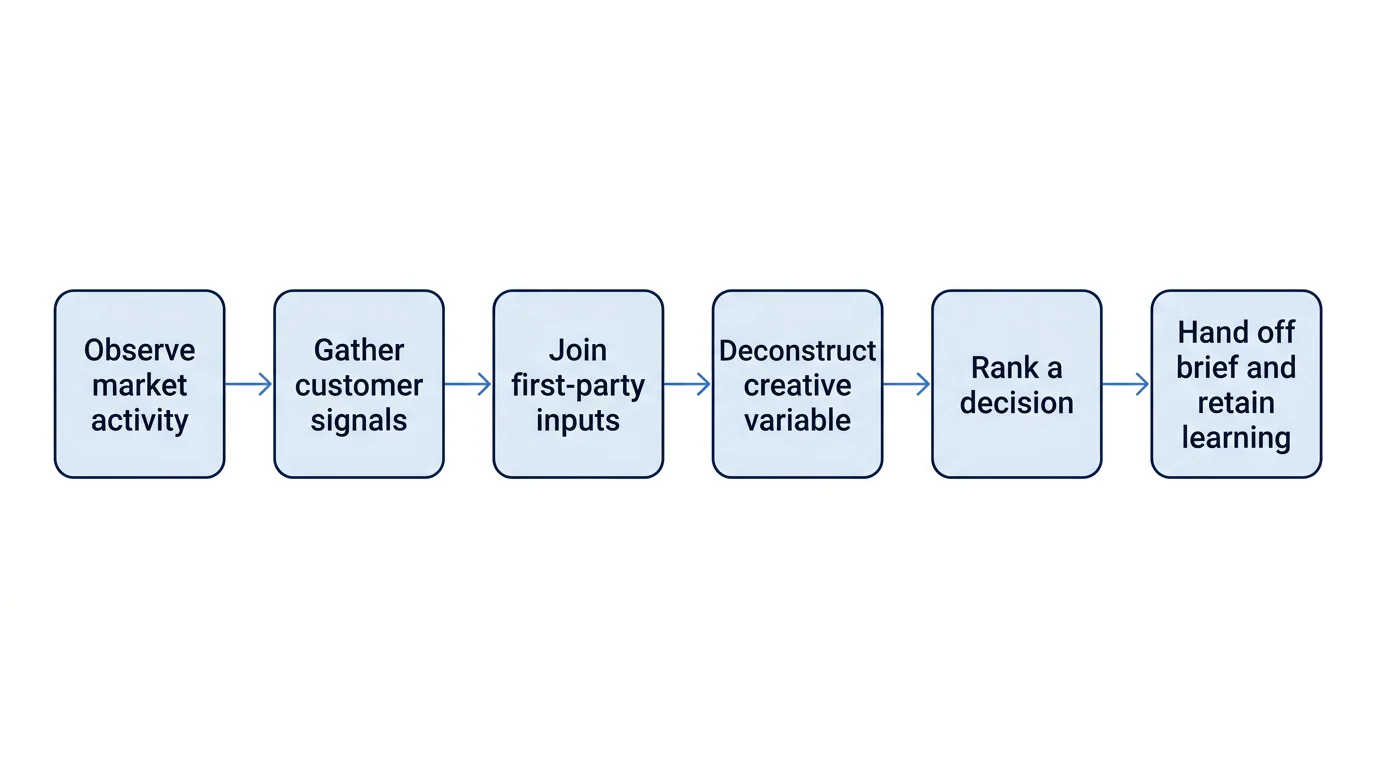
Evaluate the system around the meeting where decisions are made
Use the evaluation process to inspect the weekly or monthly meeting where creative decisions are actually made. Ask the vendor to show the exact evidence attached to a recommendation, the taxonomy used to connect assets and outcomes, and how a completed test changes the next queue. A recommendation without source context or a retained outcome is difficult to audit and easy to repeat.
The checklist should cover five areas: source coverage for market, customer and account inputs; creative taxonomy for hooks, angles, offers and formats; evidence standards that distinguish observations from outcomes; operating workflow for owners, priorities and handoff; and commercial and governance terms for accounts, users, delivery, implementation and billing units.
Agencies should additionally test client separation and whether the decision record can keep each client’s evidence, ownership and results distinct. What agencies should demand from creative intelligence provides a focused buying checklist for that multi-account workflow.
The right product is not the one with the longest feature list. It is the one whose demonstrated workflow lets the team make a better next decision with the evidence it can actually access.
Go deeper
Frequently asked
Creative analytics explains patterns in historical creative performance. A creative intelligence platform uses performance alongside market and customer evidence to prioritise a specific next test, state the reasoning behind it and preserve the result for future decisions.
Competitor ads can show visible messages, formats and changes in market activity, but they cannot prove another advertiser’s profitability or conversion results. Use public ads to form an original hypothesis, then validate that hypothesis with your own controlled test and outcome event.
A separate research tool can be useful when the team mainly needs to find, save and organise examples. A decision platform becomes more useful when the team must connect those observations to customer evidence, account performance, ownership and a repeatable test queue.
An agency should confirm client-account separation, source coverage, decision ownership, evidence links, delivery method, implementation requirements and every billing unit. The buying review should also establish how the team records outcomes and carries learning into the next client review.
See a ranked Meta test plan in context
Book a personalised walkthrough for the signals, decisions and briefs your team needs next.
Book a demo