

TL;DR
We explain how Meta creative testing tools fit distinct workflow bottlenecks, from research and variant production to controlled validation, creative analysis, and next-test planning. We also show the controls that make hook and offer comparisons fair, how to label evidence, and where Deepsolv helps teams turn results into a ranked test queue.
Which Meta Creative Testing Tool Fits Your Team’s Workflow?
Creative testing has become harder to manage as Meta advertisers work across more formats, placements, audiences, and delivery conditions. The right Meta creative testing tool depends on where the workflow is breaking.
Some platforms help teams research competitors and customer language, others generate variants or launch experiments, while others analyze live creative performance or help prioritize the next test. A tool that produces hundreds of variations cannot establish causality by itself, just as a reporting dashboard cannot tell a team which hypothesis deserves its next production sprint.
This guide breaks creative testing into its core workflow layers, explains what each type of software actually does, and shows how teams can choose tools based on the decision they need to make.
Which Workflow Decision Is Blocking Your Team?
A creative testing stack should solve a specific bottleneck rather than add another layer of software to manage. If the team cannot produce enough credible variants, better analytics will not solve the production problem. If the team produces plenty of ads but cannot determine whether the hook, offer, format, or visual caused the result, generating even more assets can increase the noise.
Start by identifying the broken handoff. Before evaluating software, establish a fair control so that the team has a meaningful baseline against which new creative can be evaluated.
Ask five questions:
-
Can the team turn market evidence into a testable hypothesis?
-
Can it produce variants that change one meaningful variable?
-
Can it launch those variants under comparable conditions?
-
Can it distinguish an observed result from a reliable learning?
-
Can it turn that learning into a ranked next test?
The first question is primarily a research problem, while the second is a production problem. The third belongs to execution, the fourth to measurement, and the fifth to planning. A useful platform should make one of these jobs materially easier and pass a clean output to the next stage.
Which Meta Creative Testing Tools Fit Each Workflow Layer?
“Creative testing tool” can describe several very different products. Treating them as interchangeable makes buying decisions harder because a research platform and an experimentation system do not solve the same problem. The more useful approach is to compare tools by the workflow decision they improve.
The pricing below reflects publicly available information checked in September 2026. Pricing, usage limits, and contract terms can change, so teams should confirm the current commercial terms before purchasing.
Workflow Layer | Primary Decision Improved | Meta Integration Depth | Public Starting Price | Team And Contract Notes | Best Fit |
Research And Briefing | What should we make or investigate? | Ad-library research and creative organization | $59/month | One-user entry tier, monthly cancellation available | Teams lacking sharper inputs |
Variant Generation And Launch | How do we create and launch more testable variants? | Asset generation, testing, and campaign support | $299/month | Public plans define test and variation allowances | High-volume production bottlenecks |
Catalog Creative Testing | Which modular static treatment should run? | Feed-connected creative and multichannel launch | Free tier, paid from $199/month | Unlimited team members on published plans | Catalog-led ecommerce |
Creative Analytics | What patterns appear across live ads? | Ad-level data import, tagging, and reporting | $750/month | Published entry tier covers up to $50,000 monthly spend | Teams with reporting overload |
Account Optimization | Which campaign actions should be automated? | Campaign control, automated rules, and reporting | Contact sales | Terms vary by plan and account setup | Meta-first media operations |
Attribution And Experimentation | Which outcome produced profitable customers? | Data connections, modeled attribution, and tests | €339/month | Unlimited users and integrations on the entry plan | Teams needing outcome quality |
AI Creative Planning | What should the team test next? | Creative analysis and planning support | Contact sales | Public price and seat terms not listed | Teams lacking decision support |
Research And Briefing
Research tools help teams collect competitive examples, identify recurring customer messages, organize creative concepts, and turn observations into stronger briefs. Their value is upstream of the experiment because they improve the quality of the question the team plans to test. They should not be treated as proof that a particular concept will generate better performance after launch.
This distinction becomes important when predictive scores or competitor patterns look convincing. A useful research system should help explain where an idea came from and what evidence supports it, while leaving live performance to actual testing.
Variant Production And Launch
Generation and launch platforms address a different bottleneck. They become useful when a team already has reasonable hypotheses but cannot produce enough structured variations or move them into campaigns efficiently. Their value is operational, particularly for teams running many creative concepts simultaneously.
The limitation is that producing more variations does not automatically make the experiment stronger. The team still needs to define what changed, what remained constant, which outcome matters, and what result would justify another iteration.
Creative Analysis And Attribution
Analytics platforms organize historical creative performance and can reveal patterns across hooks, formats, creators, offers, visual treatments, and other attributes. Attribution systems go further into business outcomes by connecting advertising activity with purchases, revenue, profit, repeat customers, or other measures. These capabilities are useful for understanding performance, but neither should automatically be interpreted as causal evidence.
We use creative analysis to understand what happened across the account and identify patterns worth investigating. The next step is still a controlled test when the team needs to establish whether changing a specific variable affected the selected outcome.
Planning The Next Test
A planning layer closes the loop between analysis and production. Instead of leaving the team with a dashboard full of observations, it should produce a practical testing queue with a hypothesis, control, variants, owner, budget guardrail, decision date, and next action.
This is where many creative workflows lose momentum. The team may know that testimonial ads performed well last month, but that observation does not automatically answer which testimonial angle should be tested next or what should remain unchanged.
How Can You Compare Hooks, Offers, Formats, And Visuals Fairly?
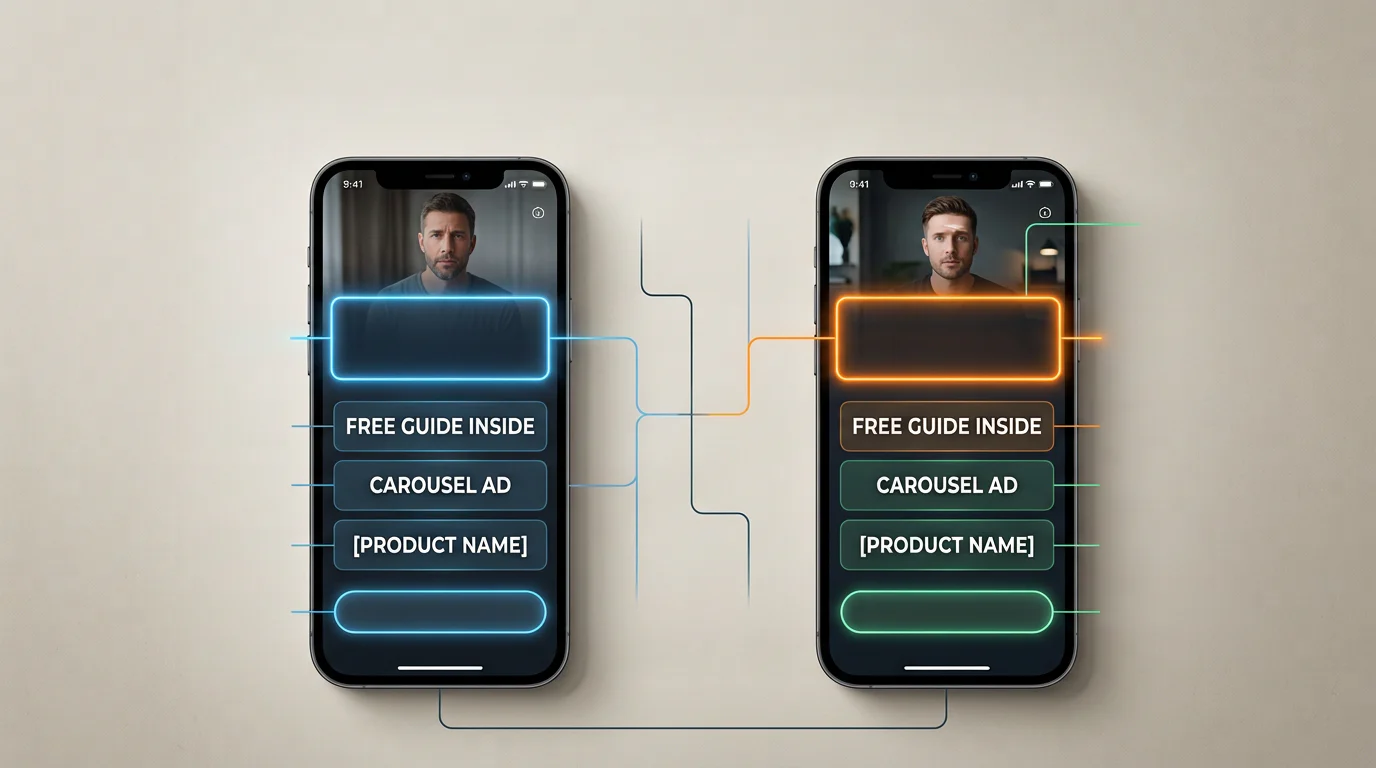
Fair creative comparison begins with experiment design, not software. A platform may tag an ad as founder-led, testimonial-led, price-led, or product-led, but those labels cannot establish which element caused the result when several variables changed at once.
Hold The Hook Accountable
A hook test should preserve the offer, creator, format, landing page, optimization event, audience, and relevant delivery conditions as consistently as possible. The team changes the opening message or first scene, records that change, and defines the primary outcome before launch.
Separate The Offer From The Creative
An offer test should not simultaneously introduce a completely different visual concept or landing-page experience. If the discount, creative, audience, and destination all change together, the team may identify a better-performing ad, but it cannot confidently isolate the effect of the offer.
Treat Format As A Distinct Variable
Vertical video, static images, carousels, and creator-led videos can behave differently across placements and delivery environments. A format comparison therefore needs comparable objectives, optimization events, audience conditions, and measurement windows before the team attributes the outcome to format alone.
For a deeper setup, use our hook testing framework to define the hypothesis and specify the conditions that would make the result inconclusive before spend begins.
What Evidence Does Each Result Actually Provide?
Creative teams often combine platform metrics, attribution models, predictive scores, and experiment results in the same reporting view. That can make different types of evidence appear more equivalent than they actually are. Each one answers a different question and should be labeled accordingly.
Platform-reported metrics describe what happened within the platform's reporting environment and attribution settings. Modeled attribution estimates contribution across touchpoints, while predictive scores rank concepts before or around delivery. A controlled experiment addresses a narrower question by evaluating whether a defined variation was associated with a meaningful difference under the specified conditions.
A strong testing record should therefore include the creative variable, control, outcome metric, attribution window, date range, and decision rule. It should also explain why the team scaled, paused, iterated, or held the result. A documented Meta stop policy can make those decisions more consistent when spend or delivery conditions change quickly.
Evidence Type | Best Question It Answers | What It Cannot Prove Alone |
Platform-Reported Delivery | How did this ad perform in the account? | That one element caused the outcome |
Modeled Attribution | Which channels or touches may have contributed? | A clean causal creative result |
Predictive Score | Which concepts deserve earlier review or testing? | In-market behavior after delivery |
Evaluated Experiment | Did this controlled variation likely change the selected outcome? | That the result will transfer to every campaign |
How Should Your Team Choose A Tool And The Next Test?
Choose software based on the most expensive recurring failure rather than the longest feature list. A team struggling to produce enough assets may need production support, while a team with hundreds of live creatives may need normalized creative history and better analysis. A strategy team that already has data but repeatedly ends meetings without a clear next experiment may need a dedicated test prioritization system.
-
Production Bottleneck: Choose software that simplifies controlled variant creation and launch, while keeping experiment validation separate.
-
Inconclusive Results: Improve the control, test design, observation period, and predefined decision rule before adding more generation.
-
Creative Fatigue: Preserve creative-level history and investigate declining performance against account and audience baselines.
-
Reporting Overload: Use analysis that groups ads by meaningful creative attributes rather than relying only on campaign structure.
-
Weak Next-Test Decisions: Require every proposed test to have a hypothesis, control, variants, owner, budget guardrail, and decision date.
Fatigue also needs diagnosis rather than an automatic replacement rule. Declining performance can come from creative wearout, audience saturation, offer changes, competitive pressure, landing-page issues, or measurement noise.
How Deepsolv Turns Creative Results Into Test Decisions
Deepsolv helps paid-social teams move from scattered creative evidence to a ranked test queue. We connect ad language, market patterns, customer signals, and performance history so strategists can identify which questions are worth testing before the next production sprint.
The goal is not to replace Meta's experimentation tools or declare an unlaunched creative a winner. Instead, Deepsolv helps preserve the hypothesis, control, evidence, and learning behind each decision so the team can see why a test was prioritized and what should happen next.
This becomes especially useful when an account already has substantial creative history but the planning process still depends on manual dashboard reviews and scattered notes. A structured testing queue gives creative strategists, media buyers, and production teams a shared starting point for the week.
If your team has plenty of data but still spends too much time deciding what to test next, see how our team can fit into your existing creative workflow.
FAQs On Meta Creative Testing Tools
Which Creative Testing Tool Is Best For Meta Teams?
Choose based on the blocked handoff: producing variants, isolating a variable, analyzing performance, monitoring fatigue, or prioritizing the next test. No single platform covers every workflow equally.
Which Platform Suits High-Volume Meta Experiments?
High-volume teams need controlled variant production, reliable launch workflows, and creative-level history. They should also maintain clear approvals, budget guardrails, ownership, and documented decision rules.
Which Ad Creative Analysis Platform Fits Meta Growth Teams?
Analysis software fits teams that have plenty of performance data but cannot explain patterns across ads. Look for creative-level tagging, historical comparisons, flexible reporting, and clear separation between observation and causation.
Which Tools Help Performance Teams Decide What Creatives To Test Next?
A planning layer helps when strategy meetings produce observations but no clear testing queue. The useful output should include a ranked hypothesis, required variants, control, owner, and decision date.