Ad Spy Tools for Meta Teams Are Signals, Not Proof
A buyer's guide to the research stack that helps Meta teams move from visible competitor ads to accountable creative tests.
5 chapters · Updated Sep 22, 2026 · By Sachit Sharma
In brief
Ad spy tools are useful for observing competitor messages, formats, offers, and launch activity, but they cannot prove a competitor's ROAS, margin, or conversion rate. Choose a tool by the job you need done, then use your own customer and account data to turn observations into a ranked test.
Buy for the research job, not the largest database
An ad spy tool can mean a public library, a saved-ad workspace, a monitoring service, a creative analytics product, or a decision system. These are different jobs. Public libraries help a team find currently visible ads. Saved-ad tools preserve references and make them searchable for a team. Monitoring tools watch selected advertisers for changes. Analytics tools interpret a team's own account results. Customer-signal overlays connect observed patterns with permitted reviews, comments, DMs, and other feedback.
Start by writing the decision the team needs to make each week. If the question is "What is this competitor running?", a first-party library may be enough. If the question is "Which of these ten ideas should enter production next?", a library alone is not the solution. Meta's Ad Library is the first-party source for ads currently running across Meta technologies, and Meta says ads and updates appear within 24 hours. Meta's Ad Library is therefore a strong observation layer, not a profitability report.
Takeaway: Name the weekly decision before evaluating search filters, archive size, or AI features.
Public libraries reveal what ran, with important limits
Use public libraries to document what is observable: creative, advertiser or Page, delivery timing, and platform placement. Meta's Ad Library API lists available creative content, associated Page information, delivery dates, and where an ad appeared. That evidence can support a concise observation such as, "Three category brands are using founder-led video this month." It cannot support, "Founder-led video is profitable for those brands."
The historical record is not uniform. Meta's API covers political and social-issue ads delivered worldwide during the prior seven years, plus all ads delivered in the EU or UK during the prior year. Meta makes spend and impression ranges additional fields for political and social-issue ads, with separate EU and UK transparency fields. Meta's API documentation does not make ordinary competitor ROAS, CPA, margin, or conversion quality public evidence.
Other first-party sources can expand the scan. LinkedIn's Ad Library supports advertiser, payer, keyword, country, and date-range searches. TikTok's Top Ads collection is limited to advertiser-authorised ads, so it should be treated as inspiration rather than a complete market census.
Takeaway: Record public ads as dated observations, then separate every observed fact from every performance assumption.
Pay for workflow friction, not for the word "spy"
A paid saved-ad workflow earns its place when research disappears into screenshots, browser tabs, and private folders. A monitoring tool earns its place when the same competitors must be checked repeatedly and changes need to be reviewed as a pattern. A broad search database is useful when the team needs discovery beyond a short competitor list. None of those purchases, on their own, turn a visible ad into evidence of business performance.
Evaluate any paid product against the specific work it removes. A saved-ad workspace should make capture, tagging, searching, and sharing easier. A monitoring product should make competitor changes reviewable over time. A research database should help a team find relevant patterns without losing the source context. Creative analytics should explain results from authorised account data, not imply that public competitor activity establishes conversion performance.
Ask for a demonstration of the exact workflow your team will run: capture an observation, organise it, explain why it matters, assign a test, and retrieve the outcome later. If the product stops at discovery, budget for the hand-off process too.
Takeaway: A paid tool is justified when it removes a recurring hand-off or monitoring burden, not when it merely displays more ads.
Research becomes risky when observation turns into copying or data misuse
Use official interfaces and authorised data access. Meta defines scraping as automated collection from a website or people-facing interface, and distinguishes authorised scraping from unauthorised collection that can violate its terms. A procurement review should ask how the tool obtains data, what permissions it needs, and how the team can remove or retain records.
Customer-signal overlays need a separate standard. GDPR Article 5 requires personal data to be processed lawfully, fairly, and transparently, for specified legitimate purposes, and limited to what is necessary. Meta's customer-list terms also require advertisers to have the necessary rights, permissions, and lawful basis for hashed audience data, and to remove people who have opted out. Treat reviews, comments, and DMs as evidence to categorise, not a permission to expose or repurpose personal information.
Do not copy a competitor's creative asset or use customer testimony casually. The U.S. Copyright Office lists reproduction and derivative works among copyright owners' exclusive rights. FTC guidance requires endorsements to be truthful and non-misleading, with material connections disclosed where relevant.
Takeaway: Use public ads to generate original hypotheses, and use customer signals only within the permissions and rules that apply to the data.
The best output is a ranked test, not a larger swipe file
A practical research loop has five stages: observe public ads, classify the pattern, add permitted customer evidence, check owned performance, and rank a test. The test record should identify one hypothesis, the creative variable that will change, the intended audience, a success metric, and a scale-or-stop condition. This prevents the team from treating competitor activity as a command to imitate.
From observed ads to a test priority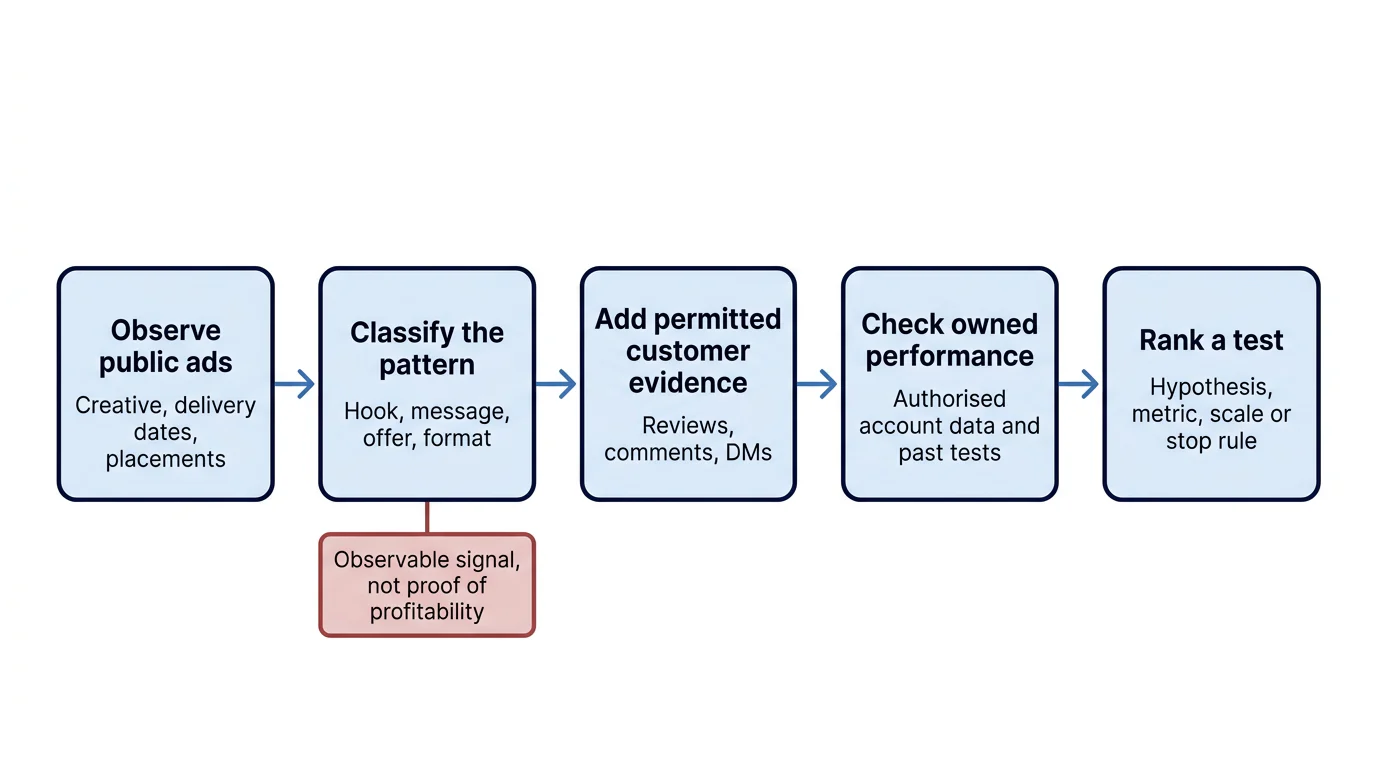
Deepsolv fits the decision layer of this workflow. It combines public competitor activity, permitted customer feedback, authorised account performance, and past experiment learnings into a ranked weekly test plan. Its role is not to replace a simple library for a quick lookup, generate high volumes of assets, or automate media buying. It is for Meta teams whose constraint is deciding which evidence-backed creative experiment deserves attention next.
A useful buying checklist therefore asks: Can we trace the observation? Can we see the customer context? Can we compare the idea with our own results? Can we assign a metric and stop rule? Can we retrieve what the team learned after the test? If any answer is no, the tool may improve discovery without improving decisions.
Takeaway: Select the stack that converts an observation into a test record your team can evaluate and remember.
Go deeper
Frequently asked
No. Public competitor ads can show observable creative, delivery dates, and placements, but they do not establish another advertiser's conversion event, margin, attribution method, customer quality, or profitability.
Not always. Start with a first-party library when you need a current competitor lookup. Pay for software only when saved references, recurring monitoring, team workflow, or wider search coverage solves a repeated research problem.
No. Longevity is an observable signal that can justify a hypothesis, not proof of profitable performance. Treat it as one input to a test rather than a reason to copy an ad or predict your result.
Use only permitted customer evidence and apply the privacy, purpose, and data-minimisation requirements that apply to your market. Customer quotes used as endorsements must also remain truthful and non-misleading.
Turn research into a prioritised Meta test plan
See how Deepsolv connects competitor activity, customer evidence, account performance, and test memory.
Book a personalised demo