
Glossary
Prospecting vs retargeting ads
Prospecting vs retargeting ads differ by audience: prospecting reaches people new to your brand, retargeting reaches people who already engaged. Each needs its own angle, metric and ranked test.

By Sachit Sharma, CEO & Founder · Updated 24 Oct 2026
Also called Prospecting vs remarketing
On this page
- 01Definition
- 02What is the difference between prospecting and retargeting ads on Meta?
- 03Why does retargeting look better than it is?
- 04How should the angle differ for cold and warm audiences?
- 05How do you rank one test for each audience?
- 06What audit should you run this week?
- 07Which related terms get confused with prospecting and retargeting?
- 08How Deepsolv handles it
- 09Example
- 10Related terms
- 11Frequently asked
What is the difference between prospecting and retargeting ads?
Prospecting ads go to cold audiences: people who have not visited, engaged with or bought from you. Retargeting ads go to warm audiences: people who have visited your site, engaged with your brand or abandoned a purchase.
Key takeaways
- Judge the two by different numbers, because platform-reported return flatters retargeting.
- Build cold angles from the problem and outcome customers describe, and warm angles from the specific hesitation that stopped them.
- Rank one test per audience by signal strength times learning gap, divided by effort, with a pool-size gate.
- Treat a winning prospecting ad as a hypothesis for warm audiences, never a result.
A retargeting campaign can report a 6x return while the business adds few new customers. That figure is a reporting artifact: it divides credited revenue by spend and never asks which of those buyers the ad actually changed.
A field experiment in the Journal of Interactive Marketing (January 2026) tested this on Google and Facebook for one brand in the bed-in-a-box mattress category. It found large, consistent returns on prospecting ads and significantly lower returns on retargeting ads.
That is one brand selling a durable good, so it does not settle your budget split. It does change the question. Instead of asking what percentage goes where, ask what each audience needs to hear and which test deserves the next slot. This entry defines both terms, shows where they get confused, and gives a sheet for ranking one test per audience.
What is the difference between prospecting and retargeting ads on Meta?
On Meta, prospecting and retargeting both describe paid social audiences.
"Warm" is a wide band. Someone who watched three seconds of a video, someone who viewed a product and someone who abandoned checkout are all retargetable, with very different intent. Customer lists are a separate case: past buyers are a retention audience, not a prospect for a first purchase. Meta's developer documentation covers a legacy existing-customer setting for Advantage+ shopping campaigns, where you define past buyers through custom audiences (audiences you build from your own data).
Why does retargeting look better than it is?
Retargeting looks better than it is because platform reporting counts conversions from people who were already close to buying; that mechanism is an inference. In a January 2026 geography-based field experiment (Larson & Dotson, Journal of Interactive Marketing), prospecting ads earned large, consistent returns on Google and Facebook while retargeting earned significantly lower returns. A separate study of 15 Facebook experiments (Gordon et al., Marketing Science, 2019) found that common observational measurement methods often fail to recover the true effect of ads.
Here is the pattern with illustrative numbers (a model, not a real account). You spend $10,000: $7,000 on prospecting and $3,000 on retargeting. The platform reports $14,000 from prospecting (2.0x) and $18,000 from retargeting (6.0x), so $32,000 in total and a blended 3.2x. Your backend orders show only $13,000 came from first-time buyers. New-customer return is $13,000 ÷ $10,000 = 1.3x.
How should the angle differ for cold and warm audiences?
Cold angles come from the problem and result customers describe in their own words. Warm angles come from the specific doubt that stopped someone close to buying. The same ad usually fails one of them: a "discover the brand" message adds nothing for a person who already knows the brand.
Cold and warm audiences need different angles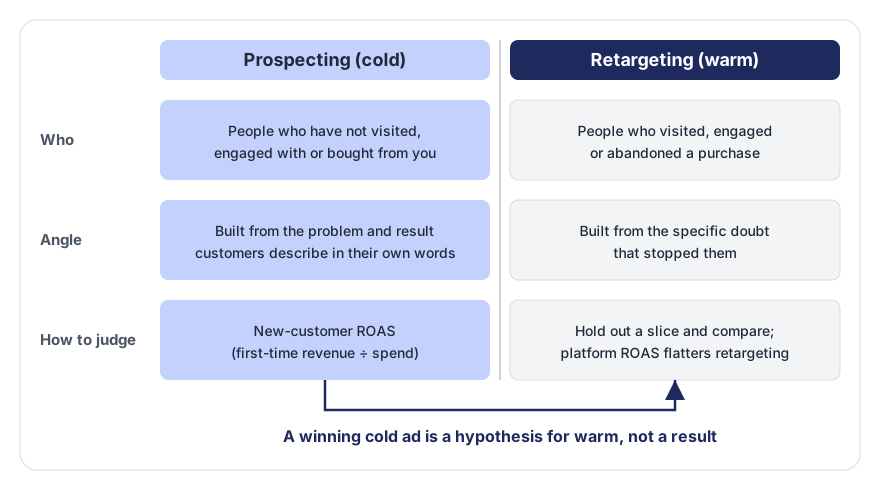
- Aspect
- Signal to read
- Cold (prospecting)
- How customers describe the problem and the result they want
- Warm (retargeting)
- The objection that stalled buyers, found in comments, direct messages (DMs) and reviews
- Aspect
- Angle to test
- Cold (prospecting)
- Problem, outcome, category proof
- Warm (retargeting)
- Objection answer, reviews, risk reversal, offer
- Aspect
- Past learnings
- Cold (prospecting)
- Winners from other cold tests
- Warm (retargeting)
- Cold winners only as hypotheses
- Aspect
- Judge by
- Cold (prospecting)
- Cost per new customer: spend ÷ first-time buyers from backend orders
- Warm (retargeting)
- Conversions against a holdout (a comparable group left unexposed)
- Aspect
- Gate
- Cold (prospecting)
- At least 50 expected purchases per ad set in 7 days
- Warm (retargeting)
- At least 50 expected purchases per ad set in 7 days
How do you rank one test for each audience?
Score each candidate test with one formula and run the highest score per audience. This is a rubric, not an industry standard.
Score = signal strength × learning gap ÷ effort, each rated 1 to 3.
- Signal strength: 1 means one source repeats the point; 3 means reviews, comments and DMs all do.
- Learning gap: 3 means never tested with this audience; 1 means it already lost.
- Effort: 1 is new copy on an existing asset; 3 is a new shoot.
Apply the gate first. A model for the test: daily budget ÷ your cost per purchase × 7 ≥ 50. Pass: expected purchases from the audience at your budget are at least 50 per ad set in 7 days. Fail: below 50, so run one test at a time rather than splitting the pool. The creative-test budget calculator helps size it.
What audit should you run this week?
Run this audit this week:
- Split the reporting. Pass: you can show platform return on ad spend (ROAS) and new-customer ROAS (first-time revenue ÷ spend) separately. Fail: you only see a blended figure.
- Exclude past buyers from the cold ad set. In Advantage+ (Meta's automated campaign type) sales campaigns, run one ad set that excludes your customer-list custom audience and a separate ad set for past buyers. Pass: past buyers appear only in the ad set meant for them.
- Hold out a slice of warm. Split by geography, as the Larson & Dotson study did, or use a Meta conversion lift test. Pass: after at least 2 weeks and at least 50 conversions in the exposed group, the exposed conversion rate beats the holdout by a margin you set in advance (for example 20% relative lift) and the gap holds in a second period. Fail: the gap is smaller or reverses.
- Score the next test for each audience with the formula. Pass: each audience has one test with a score and an owner. Fail: either audience has none.
How Deepsolv handles it
Deepsolv builds ranked weekly creative test plans and execution-ready creative briefs from ad-performance data, competitor activity, customer signals and past ad learnings. Its customer insights cover reviews, comments, DMs and Reddit discussions, where it looks for objections, desires and buying triggers. Brand Brain keeps what worked, what failed and why.
A repeated objection justifies a hypothesis, not a conclusion; review mining feeds a test, and the test decides. Deepsolv sells through a personalized demo with its founding team: book a demo.
Example
A "won't fit me" objection repeated in three sources, untested on warm audiences and answered with a new first line, scores 3 × 3 ÷ 1 = 9. An untested discount angle with one mention and a reshoot scores 1 × 3 ÷ 3 = 1.
Frequently asked
Sources
- 1.Larson & Dotson, "Prospecting Versus Retargeting: Insights from a Geography-Based Field Experiment," Journal of Interactive Marketing 61(3), online 27 January 2026
- 2.Gordon, Zettelmeyer, Bhargava & Chapsky, "A Comparison of Approaches to Advertising Measurement: Evidence from Big Field Experiments at Facebook," Marketing Science 38(2), 2019
- 3.Meta for Developers, Advantage+ shopping campaigns documentation