
Glossary
Multivariate Testing Ads
Multivariate testing ads means running every combination of several creative elements at once. On Meta, one-variable tests usually fit the budget better and leave a cleaner record of what you learned.

By Sachit Sharma, CEO & Founder · Updated 24 Oct 2026
On this page
- 01Definition
- 02Quick facts
- 03What is multivariate testing in ads?
- 04How much does a multivariate ad test cost next to a one-variable test?
- 05Why can a multivariate test on Meta fail to show which combination worked?
- 06Should you test one variable or several?
- 07Which terms get confused with multivariate testing?
- 08How Deepsolv handles it
- 09Example
- 10Related terms
- 11Frequently asked
What is multivariate testing in ads?
Multivariate testing in ads changes several creative elements, such as headline, image and call to action, at once and serves every combination to show which elements and pairings work.
Key takeaways
- At a $50 cost per purchase and a weekly test budget under $3,000, a one-variable test is usually the one you can afford and the one you can read.
- A directional read of 12 cells costs $3,000 at a $50 cost per purchase, against $750 for 3 cells.
- A 2×2 is justified only after each element has already won a one-variable test.
- Past four cells, you are placing a bet, not running a test.
Quick facts
- Combinations in a 3×2×2 test
- 12 ads
- Directional budget, 12 cells
- $3,000 at a $50 cost per purchase
- Meta learning-phase guideline
- About 50 optimization events within 7 days
- What to check
- Cells × 5 × cost per purchase against weekly test budget
A test with three headlines, two images and two buttons sounds modest. It is twelve ads, and each one needs its own share of purchases before it tells you anything. At a $50 cost per purchase, those twelve ads need about $3,000 in spend for even a rough read, against $750 for a three-ad test of one variable.
Much of the advice on multivariate testing comes from website testing, where visitors arrive whether or not you split them. On Meta every impression is bought, so the number of combinations is a cost line before it is a method.
The choice between changing one thing and changing several comes down to three questions. How much budget can each combination get? How many assets can your team produce this week? Can you write the result in one line afterward?
This entry defines the term, prices the combinations at three costs per purchase, and gives a decision test and a log template to use before you launch.
What is multivariate testing in ads?
It shows which elements matter and which pairings work together. Three headlines, two images and two buttons give 3 × 2 × 2 = 12 ads.
A full factorial test serves every combination. A fractional factorial test serves a chosen subset to cut the load, and the method is documented for marketing tests. Its limit is time: the number of combinations you can run is capped by how long it takes to collect a valid sample.
The extra value over an A/B test (two versions of one element) is the interaction: a price headline that wins only with a product image. That is the only thing a multivariate test can show that a series of one-variable tests cannot.
How much does a multivariate ad test cost next to a one-variable test?
At $50 per purchase, a 12-cell multivariate test costs $3,000 for a directional read and about $253,200 for a proof-grade read, against $750 and about $63,300 for 3 cells. Cost rises in direct proportion to the number of cells.
Twelve cells versus three: cost compared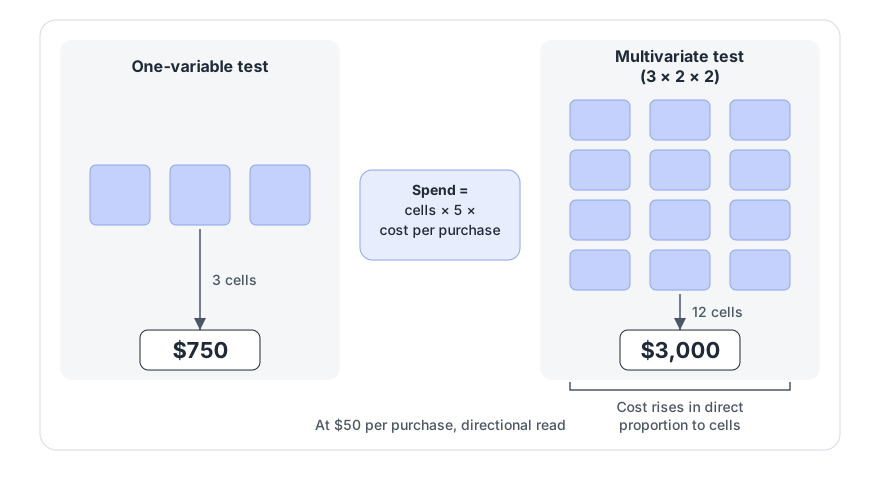
The model assumes 5 purchases per cell. Spend equals cells × 5 × cost per purchase.
For a proof-grade read, a standard two-proportion test uses a 5% chance of a false winner (significance) and an 80% chance of detecting a real lift (power). Detecting a 20% relative lift on a 2% purchase rate takes about 21,109 clicks per cell, roughly 422 purchases. At $50 per purchase, that is about $63,300 for 3 cells and $253,200 for 12 (1,266 and 5,064 purchases). A 10% lift needs roughly four times as many purchases per cell. These calculations assume a two-sided test and a 2% click-to-purchase rate chosen for illustration, with no correction for comparing many cells, so 12 cells would need more. The cost per purchase values are illustrations, not market data.
Alternatively, if each cell is its own ad set (the level of a campaign where budget and audience are set), Meta's guideline is about 50 optimization events within 7 days after the last significant edit for an ad set to exit the learning phase, the stage when delivery is still being tuned. Optimization events are the results, such as purchases, that the ad set is optimizing for. At $50 per purchase that is $2,500 per cell, as of October 2026: $7,500 for 3 cells and $30,000 for 12.
- Cells
- 3 (one variable)
- $30 per purchase
- $450
- $50 per purchase
- $750
- $75 per purchase
- $1,125
- Cells
- 4 (2×2)
- $30 per purchase
- $600
- $50 per purchase
- $1,000
- $75 per purchase
- $1,500
- Cells
- 12 (3×2×2)
- $30 per purchase
- $1,800
- $50 per purchase
- $3,000
- $75 per purchase
- $4,500
Why can a multivariate test on Meta fail to show which combination worked?
Meta does not report results by combination, apart from a manual view of top combinations by engagement, so a multi-variable setup often cannot tell you which pairing won. As of October 2026, Dynamic Creative is no longer available for Sales and App Promotion objectives (source), with Meta pointing advertisers to flexible ads.
Budget works against you too. Spread across 12 cells, spend leaves each cell too thin to read, and you end up with a winner you cannot explain.
Should you test one variable or several?
Run a multi-variable test only if all three checks below pass; otherwise test one variable. Run them before launch.
- Money. Cells × 5 × your cost per purchase must not exceed your weekly test budget. Pass: it is at or under. Fail: it is over.
- Capacity. Cells must not exceed the assets your team can make and get approved this week. Pass: at or under. Fail: over.
- Record. Before launch you can name every factor and level and state how you will read each factor's effect separately. Pass: yes, with a full grid. Fail: you could only write one combined result line.
A 2×2 is justified only when each element has already won its own one-variable test. Past four cells, treat the result as a bet.
Log every test the same way, and put the changed element in the ad name.
- One-variable log: parent ad, changed element, expected metric, read window, stop rule.
- Multi-variable log: factors and levels, cell list, spend per cell, purchases per cell, effect of each factor, and whether the interaction was readable. It is readable only if you served the full grid with enough purchases in every cell.
Which terms get confused with multivariate testing?
- A/B/n test: several versions of one variable, still one change.
- Creative iteration: a deliberate change to one element of an ad that already shows promise.
How Deepsolv handles it
Deepsolv supplies a creative intelligence platform for Meta advertising teams. It combines ad-performance data, competitor activity, customer signals and past ad learnings into ranked weekly creative test plans and execution-ready creative briefs. Whether you test one variable or several, the logs above are the record of what you learned, and its weekly test plans draw on past ad learnings.
Example
A test with three headlines, two images and two buttons gives 3 × 2 × 2 = 12 ads. At a $50 cost per purchase and 5 purchases per cell, that is 12 × 5 × $50 = $3,000 for a directional read, against 3 × 5 × $50 = $750 for a three-ad test of one variable.
Frequently asked
Sources
- 1.Multivariate testing in marketing, Wikipedia, Wikipedia
- 2.About the Learning Phase, Meta Business Help Center, Meta
- 3.A Guide to Dynamic Creative in Meta Ads Manager, Jon Loomer Digital, Jon Loomer Digital