
Glossary
Facebook ad frequency
Facebook ad frequency is the average number of times each person saw your ad, calculated as impressions divided by reach for the dates you select. It is a ratio, not a verdict.

By Sachit Sharma, CEO & Founder · Updated 23 Oct 2026
Also called Ad frequency
On this page
- 01Definition
- 02Quick facts
- 03Introduction
- 04What is Facebook ad frequency and how is it calculated?
- 05Why can an average ad frequency hide fatigued viewers?
- 06What is a good frequency for Facebook ads?
- 07Can you cap or lower frequency on Facebook ads?
- 08How do you read ad frequency on your own account?
- 09Facebook ad frequency vs reach, impressions and frequency cap
- 10What should you change when frequency and results turn the wrong way?
- 11How Deepsolv handles it
- 12Example
- 13Related terms
- 14Frequently asked
What is Facebook ad frequency?
Facebook ad frequency is the average number of times one person sees an ad, found by dividing impressions by reach for the chosen dates. Meta labels it an estimate.
Key takeaways
- Frequency is impressions divided by reach for the dates you select, so one ad set gives different numbers at 7, 14 and 30 days. Always record the window with the number.
- No single frequency is "good". Meta's 2016 effective-frequency study of 11 brand campaigns found no magic level, and published cutoffs are practitioner rules of thumb, not Meta guidance.
- Judge frequency against the ad set's own recent weeks and beside click-through rate (the share of impressions that become clicks) and cost per result (what you pay for each purchase, lead or other goal the ad set is optimized for), not against a universal cutoff.
- Ad sets optimized for clicks, leads or purchases have no frequency cap, so when the read-out points to fatigue, new creative is the lever.
Quick facts
- Formula
- Impressions divided by reach
- Depends on
- The date range you select
- Cap available on
- Reservation campaigns and auction ad sets with Reach or ThruPlay goals
- No cap on
- Ad sets optimized for clicks, leads or purchases
Introduction
Ask what a good Facebook ad frequency is and you get a number. The number is hard to use, because of what the metric is: a single division whose result depends on the dates you pick and on who is counted.
Frequency is an average, so it can read a comfortable 2.6 while a fifth of your audience has seen the ad seven times. On most campaigns optimized for sales or leads you also cannot cap it, so the number informs you but controls nothing. A cutoff borrowed from someone else's account says little about yours.
This page defines frequency, shows how an average hides heavy viewers, explains where Meta lets you cap it and where it does not, and gives a four-step read-out you can run on your own ad account. Each step has a pass and a fail, so you finish knowing whether to leave an ad alone or replace it.
What is Facebook ad frequency and how is it calculated?
Frequency is impressions divided by reach for the date range you select, and Meta labels it an estimate. Impressions count every time the ad was shown. Reach counts each account once. Meta's own example is 30,000 impressions across 10,000 accounts, a frequency of 3 (Meta Business Help Center).
The window changes the answer. In one worked example, an ad set had 119,045 impressions across 76,551 accounts, a frequency of 1.56 for the period, while a single day in the same report read 1.25 (Jon Loomer). The ad set is the same and only the window differs.
Why can an average ad frequency hide fatigued viewers?
Frequency is a mean, so it says nothing about how exposure is spread across people. Meta's own example is a 14-day reservation campaign where 44% of people saw the ad four times, with smaller shares seeing it once, twice, three, five or six times (Meta Business Help Center).
One average, three very different viewers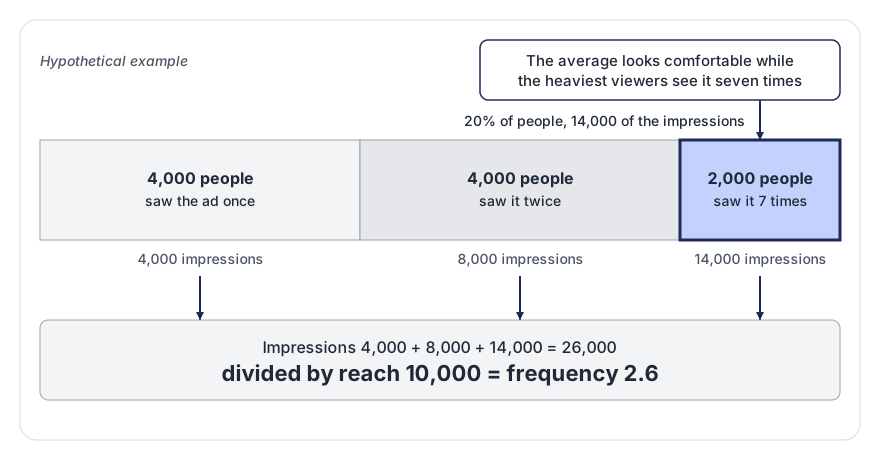
Reach counts each person once per window. A 30-day frequency is therefore not the sum or average of four weekly ones. Pull it at the window you care about.
What is a good frequency for Facebook ads?
No single figure holds. Meta's 2016 effective-frequency study covered 11 brand campaigns from January 2015 to February 2016, each running 3 to 4 weeks with reach of 4.5 million or more. Ad recall lift slowed after a cap of 1 per week and purchase intent lift slowed near 1.5 per week. A cap of 2 per week captured 95% of potential purchase intent lift. The study concluded there is "no 'magic frequency level'" (Meta).
That study covered reach-and-frequency brand buys from 2015 to 2016, and it measured brand lift, not sales or cost per result. It does not set a threshold for conversion campaigns. Cutoffs published elsewhere are practitioner rules of thumb, not Meta guidance, and they differ by audience and by window. Treat any cutoff as a rule of thumb.
A workable baseline is the ad set's own last four weekly frequencies. Look closer when this week sits above all four and results move the wrong way.
Can you cap or lower frequency on Facebook ads?
Only where Meta provides the control. As of October 2026, frequency controls exist on reservation campaigns (Meta's pre-booked reach-and-frequency buying) and on auction ad sets (bought in Meta's standard bidding auction) with Reach (showing the ad to as many different people as possible) or ThruPlay (a video view of 15 seconds or more, or to completion if shorter) performance goals. Ad sets optimized for clicks, leads or purchases have no such controls (reservation controls, auction controls).
On an ad set optimized for clicks, leads or purchases you lower frequency indirectly. Widen the audience relative to budget, exclude people who already bought, or add new creative. Once results have turned, new creative is the lever. Adding a new creative counts as a significant edit that can send the ad set back into the learning phase (Meta ads learning phase).
How do you read ad frequency on your own account?
Run these four checks in order. Each has a pass and a fail.
- Pull three windows. Take the same ad set at the last 7 days, the last 14 days and the full flight. Record impressions, reach and frequency for each. Pass: every frequency you quote comes with its window. Fail: you hold one number and cannot say which dates it covers.
- Compare with its own history. Pull the last four weekly frequencies. Pass: this week sits inside that range. Fail: this week is above the highest of the four, so continue.
- Break it out by ad. Pass: no single ad has more than half the impressions at a frequency 1.5 times the ad set average or more. Fail: one ad does (a rule of thumb), and that ad is the one to check first.
- Set it beside results. Put frequency next to click-through rate (see what a good CTR looks like) and cost per result for the same weeks. Pass: frequency is up but both are flat, so leave the ad alone. Fail: frequency is up, click-through rate is down and cost per result is up in the same weeks. To check the creative itself, use a Facebook ads creative audit scorecard.
Facebook ad frequency vs reach, impressions and frequency cap
Frequency is confused with reach, impressions and the frequency cap. A frequency cap is a limit you set on delivery, while frequency is the number Ads Manager reports back. "Facebook post frequency" means how often a page publishes and is unrelated.
The related terms that matter next are ad fatigue, which is a drop in results from repeated exposure, and creative iteration, which is how a team decides what replaces a tired ad.
- Aspect
- What it is
- Frequency
- Average views per person
- Reach
- Unique people who saw the ad
- Impressions
- Total times the ad was shown
- Frequency cap
- A limit set on delivery
- Aspect
- How it is produced
- Frequency
- Impressions divided by reach
- Reach
- Each account counted once
- Impressions
- Every showing counted
- Frequency cap
- Set by you, where Meta provides the control
- Aspect
- Where you see it
- Frequency
- Reported in Ads Manager
- Reach
- Reported in Ads Manager
- Impressions
- Reported in Ads Manager
- Frequency cap
- Chosen in campaign or ad set settings
What should you change when frequency and results turn the wrong way?
Change the idea, not only the file. When check 4 fails, people have seen the angle enough, and a recut of the same angle often repeats the problem. Detection and recovery are covered under spotting ad fatigue before cost per result rises.
How Deepsolv handles it
Deepsolv's creative intelligence platform combines ad-performance data, competitor activity, customer signals and past ad learnings into a ranked weekly creative test plan and execution-ready creative briefs. The replacement ad tests an angle you have a reason to believe in.
Example
Take 10,000 people. Of these, 4,000 see an ad once, 4,000 see it twice and 2,000 see it seven times. Impressions are 4,000 + 8,000 + 14,000 = 26,000, so frequency is 2.6. The 2,000 heaviest viewers, 20% of the people, receive 14,000 of the 26,000 impressions, about 54%.