The Monday Test Plan Behind Deepsolv’s Current Features

TL;DR
According to Deepsolv’s current product page, the platform turns competitor activity, customer signals, ad performance, and past experiments into a ranked Meta creative test plan every Monday. Its current role is decision support for consumer brands and agencies, including what to test, improve, or stop.
Current capability snapshot
The current product is a Meta-focused creative-decision workflow for consumer brands and agencies. It brings together competitor moves, customer signals, historical ad learnings, and ad-performance context to produce a ranked weekly plan for what the team should make, skip, improve, or stop. The current product page states that this plan is delivered every Monday.
| Capability | What the product uses or produces |
|---|---|
| Competitor research | Messaging, angles, offers, and formats observed across the category |
| Performance reasoning | CTR, CPC, add-to-cart rate, conversion rate, ROAS, fatigue, and audience response |
| Customer insight analysis | Reviews, comments, DMs, Reddit discussions, and audience conversations |
| Decision output | A ranked weekly plan with test, improve, or stop recommendations |
| Creative support | Drafted hooks, scripts, and statics based on the current evidence |
| Learning record | Brand Brain records what worked, failed, and why |
How the stated workflow turns signals into action
The workflow starts with observable market and account signals, then moves toward a ranked decision rather than a larger library of ideas. Public competitor activity is market context, while connected account outcomes and prior tests supply the evidence for decisions about a team’s own work. For the distinction between those evidence types, see own ad performance versus competitor ad signals.
Five steps from signals to a test decision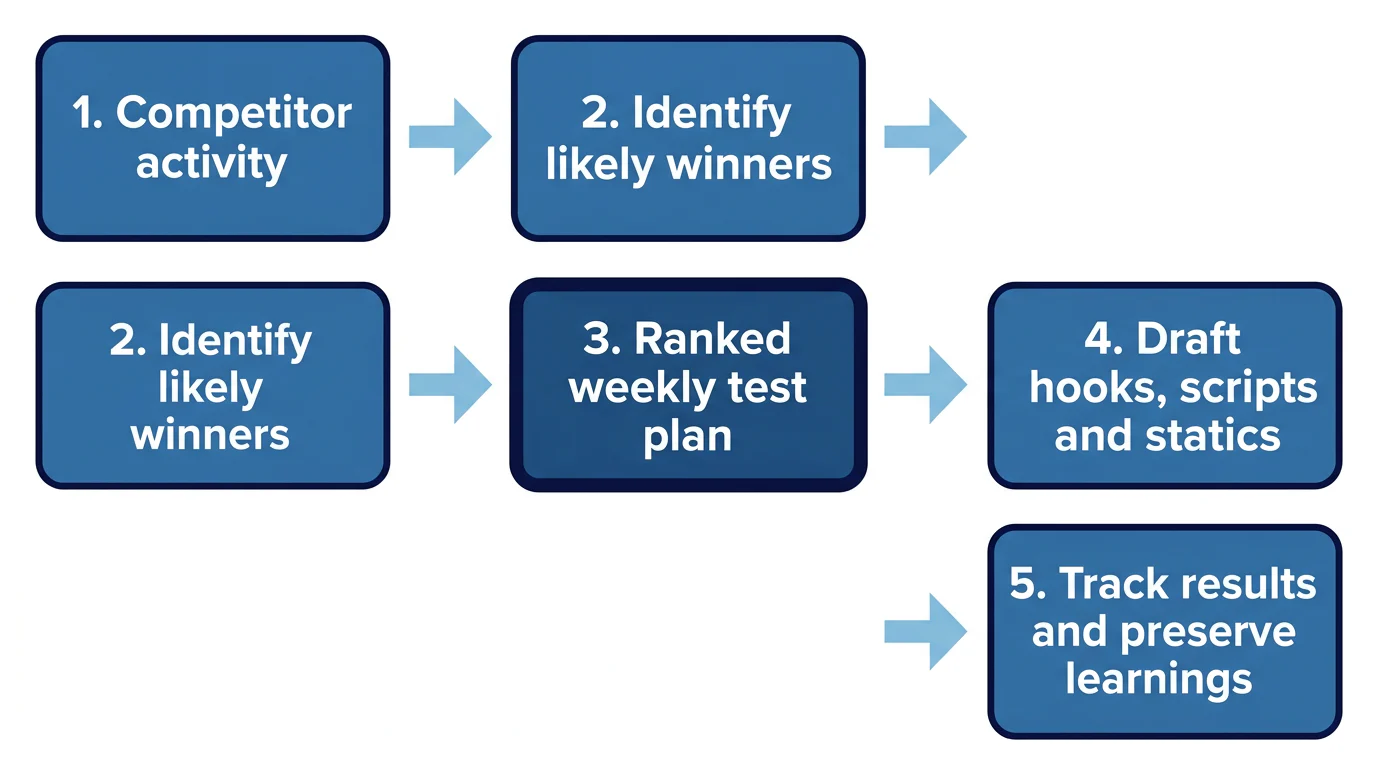
The decisions this workflow is built to support
The stated use case is not simply finding ads or generating a larger batch of assets. The workflow is designed to help a team select a next creative experiment, diagnose why an ad is or is not working, identify customer objections or desires worth addressing, and deprioritise ideas that are unlikely to improve performance.
A useful implementation check is whether the team can define the control, the creative variable, the success measure, and the condition for stopping or scaling before launch. The Meta ad creative testing framework and creative test stop rules cover that operating discipline.
Dated public record
This archive separates dated commercial and policy records from the current capability snapshot above. Each entry below describes the dated material itself, rather than assigning a feature-release date.
| Date | Record | Detail |
|---|---|---|
| May 7, 2026 | Privacy policy effective date | Customer data is retained during an active subscription and for six months after contract termination by default, unless another period is agreed. Deletion requests remove customer records from active systems within 28 days, subject to legal, contractual, and operational obligations. |
| September 2, 2026 | Pricing guide publication | Platform access is scoped through a tailored conversation for the team and workflow in scope. The guide was reviewed September 4, 2026. |
The applicable retention and deletion terms appear in Deepsolv’s privacy policy. The current commercial route is described in Pricing for Deepsolv: Current Plans and Meta-Team Fit.
What to confirm before adopting the workflow
A tailored commercial conversation should make the operating scope explicit. Confirm which accounts connect, which competitor and customer sources are covered, which implementation work is required, and how the team will use the ranked plan in its existing testing process.
| Question | Why it matters |
|---|---|
| Which account connections are in scope? | Connected performance data provides context for decisions about the team’s own ads. |
| Which customer-signal sources are included? | Reviews, comments, DMs, Reddit discussions, and audience conversations inform the objections and motivations that reach the test plan. |
| Which competitor coverage is relevant? | Competitor ads provide market context, but do not reveal another advertiser’s private sales or profitability. |
| Who owns the test decision? | A weekly ranked plan is useful only when a named team can turn it into a controlled test and record the outcome. |
Keep reading



Frequently asked
Deepsolv is positioned for Meta growth teams that need to prioritise creative work. Its stated workflow combines competitor activity, customer signals, ad-performance context, and previous experiments to recommend what to test, improve, or stop next.
No. Deepsolv is a Meta-focused creative-intelligence platform for growth teams, while Deepsolver is a separate cloud poker-solver product. Readers looking for poker software updates should use Deepsolver’s materials, not this product record.
Deepsolv scopes pricing through a tailored conversation based on the team and workflow involved. The published buying guidance says that conversation should establish account connections, source coverage, and implementation requirements before the service is contracted.
Deepsolv’s privacy policy says customer data is retained during an active subscription and for six months after contract termination by default, unless another period is agreed. It also states that deletion requests remove records from active systems within 28 days, subject to stated obligations.
See the current Meta creative-decision workflow
Discuss the signals, account connections, and implementation scope relevant to your team.
Book a demo