
When Ad Fatigue Hits: A Creative Fatigue Response Strategy to Refresh, Reangle, or Counter
Use a creative fatigue response strategy to decide whether to refresh an ad, reangle its message, or counter a market shift.
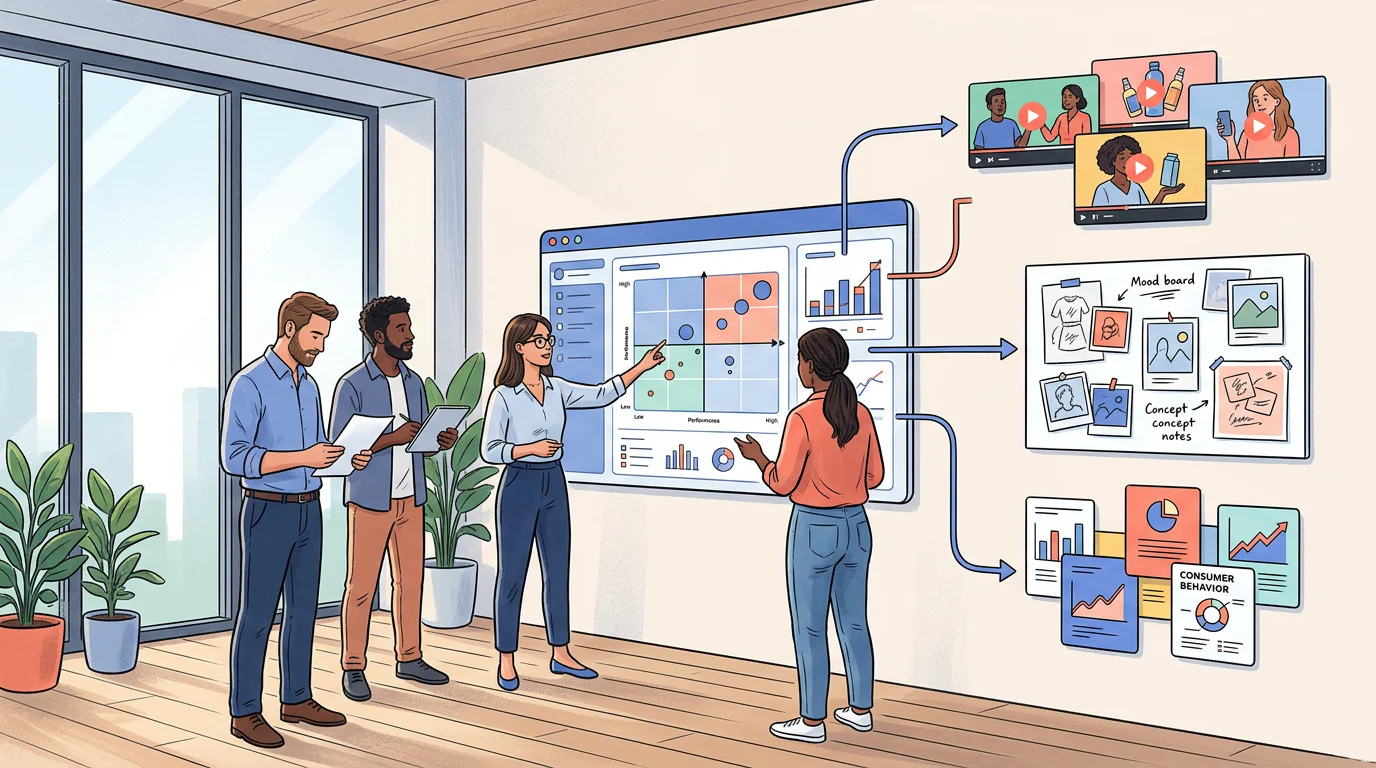
Creative decline rarely has one clean cause. In TikTok’s 2025 research with 8,000 heavy users, 51% said they prefer brands with varied content, which helps explain why a previously strong execution can lose attention without the underlying message being wrong.
Our creative fatigue response strategy is simple: refresh the execution when the same angle still converts in comparable assets, reangle when new executions of that message weaken, and investigate competitive pressure when a dated market change aligns with the decline. Make the call from creative, audience, conversion, and market signals together.
We will show how to confirm the problem, identify the failed layer, select the right intervention, and operate a pipeline that does not confuse automated alerts with final decisions.
Is This Confirmed Fatigue?
We do not call an ad fatigued just because its CPA rose. Before changing creative, we check whether the decline is isolated to an asset, shared across an audience, visible after the click, or caused by reporting and delivery changes that affect the entire account.
Start with the conversion path. If destination clicks are steady but purchase rate falls, investigate the landing page, offer, checkout, inventory, or measurement before replacing an ad. If reported conversions fall suddenly without matching site evidence, validate event setup and deduplication. TikTok’s Events Manager includes test events, diagnostics, funnel views, and change logs for exactly this kind of check.
A confirmed creative problem has a specific shape: the affected asset loses response while controls remain credible and comparable ads tell you what still works. That distinction protects teams from burning a week producing new hooks for a checkout or tracking failure.
For a fuller early-warning system, use our fatigue detection framework to document the evidence before any pause, budget change, or production request.
Which Metrics Locate the Failure in a Creative Fatigue Response Strategy?
A useful diagnosis moves from broad signals to narrow ones. We compare the same period at account, audience, angle, execution, and individual-ad level, then ask where the pattern first becomes visible. That is how a team running dozens of variants avoids treating one tired creator clip as proof that an entire message has failed.
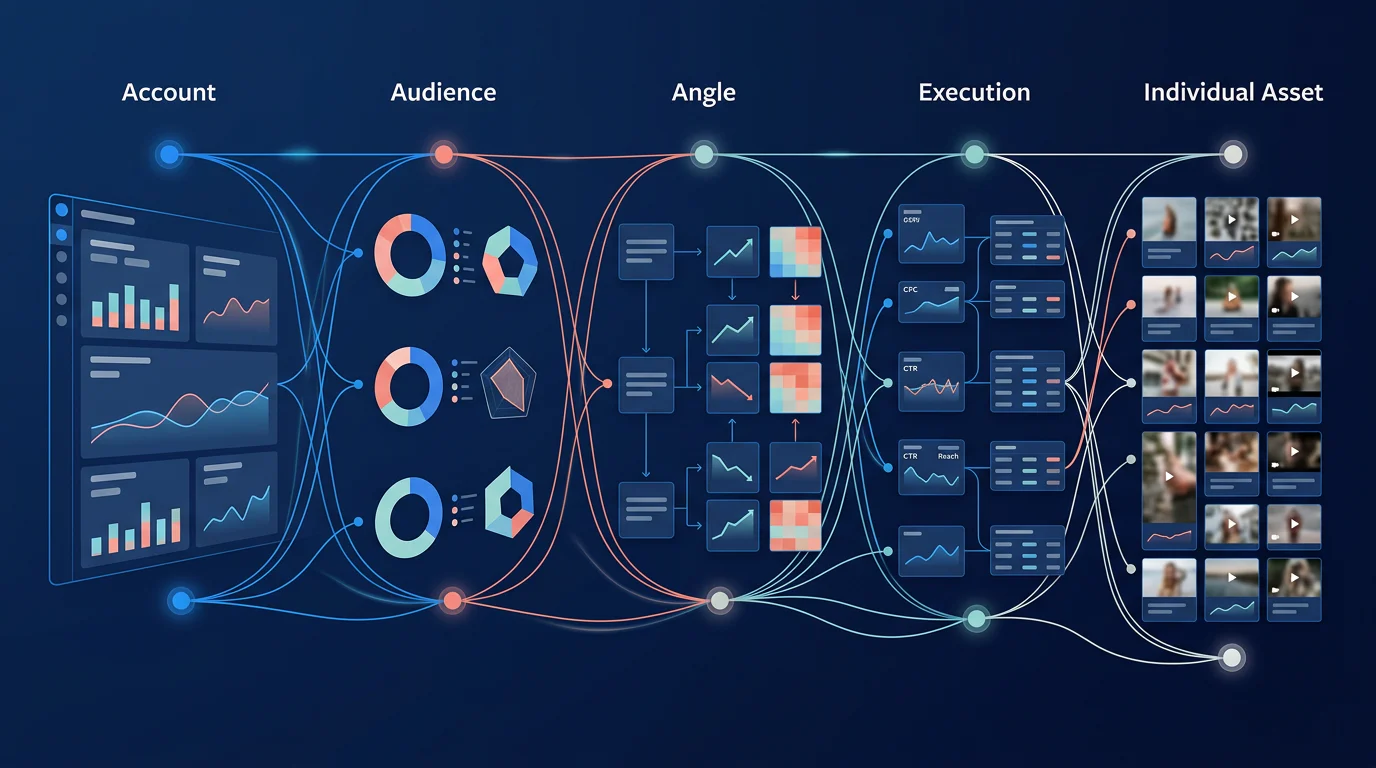
Read the Trend at Five Levels
At account level, look for broad CPM, reach, delivery, and conversion changes. At audience level, inspect whether unique reach is slowing while repeat exposure grows. At angle level, group ads by the promise or problem they express. At execution level, compare creator, opening, pacing, proof, and format. At asset level, isolate the individual ad that is losing response.
Meta’s metric definitions describe CTR as clicks divided by impressions and CPM as cost per thousand impressions. Those measures are useful together, but neither is a verdict on its own.
Use the Metric Pair That Narrows the Cause
| Pattern | Likely Failure Layer | What We Check Next |
|---|---|---|
| One asset loses CTR while comparable executions hold | Execution | Opening, pacing, format, creator, and visual repetition |
| Several fresh executions of one message weaken | Angle or offer | Angle-level CTR, click-to-conversion rate, and customer response |
| Reach slows and repeat exposure rises across many ads | Audience | Audience size, overlap, frequency trend, and delivery mix |
| CTR holds while CPA and click-to-conversion rate worsen | Post-click experience | Landing page, offer, checkout, inventory, and event health |
| CPM rises across many ads while CTR is mixed | Auction or account-wide delivery | Placement, audience mix, seasonality, and budget changes |
We set alert bands against each account’s documented performance history rather than applying a universal frequency or CTR rule. A narrow retargeting pool, a new product launch, and a broad acquisition campaign can show the same surface metric for very different reasons.
Separate Platform Signals Before Choosing a Fix
On Meta, we prioritize ad-level delivery, link CTR, placement behavior, and downstream conversion quality. On TikTok, we add early engagement and video-response signals, then compare them with reach, CPA, and conversion behavior. TikTok’s own auction guide describes a fatigue index based on day-to-day changes in CPA, reach rate, and performance, which reinforces the value of trend analysis over one isolated metric.
The next question is not simply which ad declined. It is whether the same angle retains traction somewhere else. Our angle tracking guide explains how we preserve that distinction across a large creative library.
Should You Refresh the Execution?
We refresh when the proposition remains credible but the container has become too familiar. A refresh keeps the core angle intact while changing the way it earns attention or delivers proof. It is the right response when related assets still generate efficient clicks and conversions for the same audience.
Change one meaningful executional variable at a time. That can mean a new opening visual, a different creator, revised pacing, a stronger demonstration, another proof format, or a native placement treatment. Changing every element simultaneously creates a new ad, but it does not create a learning.
Meta reports that, in a meta-analysis of 15 split tests, Reels campaigns using 9:16 video, audio, and safe-zone messaging achieved 34.5% lower cost per result than image ads. We use that result as a reason to test format fit, not as a promise that one format will win every account.
Refreshes should enter a controlled test queue with the old asset retained long enough to make the comparison meaningful. If the refreshed assets do not recover response while other angles do, the problem has moved beyond execution. Before we expand a weak hook into a larger production batch, we use our stop-hook framework to decide whether the evidence warrants another iteration.
Should You Reangle the Message?
We reangle when the response weakens across multiple fresh executions of the same core proposition. New visuals cannot revive a message that no longer feels urgent, differentiated, believable, or relevant to the audience seeing it.
An angle is more than a headline. It includes the problem being named, the desired outcome, the proof offered, the audience context, and the reason to act now. Reangling may therefore change the customer tension, evidence, offer framing, or product use case while keeping the product and conversion goal constant.
| Intervention | Choose It When | Evidence Required | Main Risk |
|---|---|---|---|
| Refresh Execution | The same angle still works in comparable ads | Affected asset declines while related executions retain response | Repeating a message that has weakened |
| Reangle Message | Several fresh executions weaken on one proposition | Angle-level decline after tracking and post-click checks | Replacing strategy when production is the real issue |
| Counter Market Shift | A dated market change aligns with internal decline | Public observation plus internal pattern, then a controlled test | Assuming correlation proves causation |
We protect the learning by testing a new message against the incumbent angle under comparable conditions where possible. That means preserving the measurement setup, recording the exact hypothesis, and resisting the urge to launch a dozen loosely related concepts with no shared logic. Our angle testing system helps teams rank the next message before production begins.
Should You Counter a Competitor?
Competitive activity can change what an audience expects, especially when a new claim, discount, bundle, creator format, or proof style becomes highly visible. It can also coincide with a performance drop for unrelated reasons. We treat it as a hypothesis to test, not an excuse to copy a rival’s campaign.
The practical move is to date the market change, compare it with the timing and audience of our decline, then determine whether our message has become less distinct. Meta’s Ad Library provides a public view of active ads, which makes it useful for observing creative and offer changes, not for inferring private targeting, spend, or conversion performance.

A counter should clarify why our offer matters, not mimic a new market claim. We may test stronger proof, a different value frame, a more specific audience problem, or an offer that changes the comparison point. If the counter does not outperform a refresh or reangle, we keep the winning path and log the market observation as context.
Our competitive-pressure guide shows how we separate observed market movement from evidence that it changed audience response.
How Should the Pipeline Run?
A scalable pipeline turns a crowded performance report into a sequence of defensible decisions. We use automation to surface patterns and route work, while marketers retain approval authority for creative claims, budget changes, market-response messaging, and brand risk.
Normalize Signals Before Alerts Fire
We collect the same core fields for every ad: launch date, spend, reach, frequency, CTR, CPM, CPA, conversion behavior, delivery status, audience, angle, execution type, and platform. We then group variants by shared message rather than leaving every creator cut and format in one flat list.
This matters most when more than 40 variants are live. Without an angle layer, the team sees individual winners and losers but misses whether the underlying customer idea is gaining or losing strength.
Route Each Alert to a Decision Owner
The first routing decision is diagnostic, not creative. Alerts go to tracking review, post-click review, audience review, execution refresh, angle replacement, or market research. A human reviews the evidence before the team pauses an ad or shifts budget.
TikTok recommends using Pixel and Events API together for a more reliable data connection, with appropriate event deduplication. Its data connection guidance is a useful reminder that a better creative decision depends on credible conversion signals.
Preserve What Each Test Teaches
Every intervention records the initial pattern, chosen path, variables changed, audience, platform, result, and final decision. That record prevents teams from repeatedly refreshing an exhausted angle or abandoning a message because one execution happened to miss.
We maintain a production queue that contains refresh candidates, net-new angles, and market-response concepts, each with a clear owner and approval step. Our scalable testing workflow helps turn those records into the next week’s priorities instead of another unranked backlog.
Work with Deepsolv
At Deepsolv, we help performance teams turn a crowded creative report into a clear next decision. We connect creative metadata, angle-level performance, audience reach, conversion behavior, and market observations so your team can see whether an execution needs a new cut, an angle needs replacing, or a market change deserves a response. Instead of handing people another dashboard full of falling lines, we organize the evidence behind each recommendation and preserve the learning after a test ends. That matters when dozens of Meta and TikTok variants are live, because the useful question is rarely which ad lost yesterday. It is what to launch, pause, protect, or investigate next. Our workflow keeps automation focused on detection and routing, while marketers retain control over claims, budget shifts, and brand judgment. If your team needs a more defensible creative fatigue response strategy, book a Deepsolv demo.
FAQs on Creative Fatigue Response Strategy
These answers address the practical decision after performance declines. We use evidence across creative, audience, conversion, and market signals before choosing an intervention.
When Should I Refresh an Ad Instead of Reangling It?
Refresh when comparable assets with the same angle still attract efficient clicks and conversions. Reangle when fresh executions weaken after measurement and landing-page checks are complete.
How Does Audience Saturation Differ from Creative Fatigue?
Audience saturation appears across active ads as reach slows and repeat exposure rises. Creative fatigue is narrower: one execution weakens while comparable alternatives retain response.
Can a Competitor Cause Creative Performance to Decline?
Counter a competitor only after a dated claim, offer, or format aligns with decline. Test a differentiated response because public ad observations cannot prove causation.
How Do We Manage Fatigue Across Many Ad Variants?
Alert on account, audience, angle, execution, and asset changes across a large variant set. Route alerts to human review before pausing ads or shifting budget.