
Which Paid Social Testing Workflow Scales?
Compare reactive requests, testing calendars, and evidence-ranked backlogs to build a scalable paid social creative testing workflow.

By Sachit Sharma, CEO & Founder · Updated 11 Oct 2026

In brief
We recommend an evidence-ranked backlog as the paid social testing workflow that scales best for teams balancing creative volume, fatigue risk, and competing requests. We show how to compare workflows, rank evidence, assign decision rights, plan weekly capacity, enforce launch quality, and turn every readout into a better next test.
In this article
- 1Which Paid Social Testing Workflow Scales with Many Stakeholders?
- 2What Evidence Belongs in the Backlog?
- 3What Is the Evidence Hierarchy?
- 4How Should Teams Use Fatigue Signals?
- 5Where Does Customer Evidence Fit?
- 6Why Are Market Observations Lower-Confidence Evidence?
- 7How Do Teams Score Tests and Plan Weekly Capacity?
- 8What Belongs on a Hypothesis Card?
- 9How Does the Weighted Scoring Worksheet Work?
- 10How Should a Weekly Capacity Board Work?
- 11When Should an Urgent Request Override the Score?
- 12Who Owns Test Decisions and Launch Quality?
- 13How Do Results Become Better Weekly Decisions?
- 14Why Use Deepsolv for Weekly Test Decisions?
- 15FAQs on Paid Social Testing Workflow
Paid social teams now have more possible creative variants than time to evaluate them. In a 2025 industry survey of more than 500 experts, only 30% had fully integrated AI across the media campaign lifecycle, which leaves many teams with more signals but no shared decision system.
An evidence-ranked paid social testing workflow scales best when multiple stakeholders and creative variants compete for budget. It records the hypothesis, evidence, expected learning, effort, dependencies, and decision rule, then refreshes the ranking as performance, fatigue, customer, and market signals change.
We compare the three operating models, then show how we turn evidence into a weekly slate, launch-ready tests, and reusable learnings.
What Evidence Belongs in the Backlog?
A backlog should combine signals without pretending they carry equal weight. A comment theme can suggest a promising objection to address. A public market observation can reveal a new angle. Neither should outrank a controlled result or repeated own-account performance simply because it is new.
We keep each observation attached to its source, date, audience context, and confidence. That prevents a team from copying a visible execution, mistaking a temporary performance swing for a creative problem, or treating a dashboard metric as final proof.
What Is the Evidence Hierarchy?
We rank controlled tests and repeated first-party results first because they best show what has worked in the account. Diagnostic performance trends come next because they identify where attention is needed. Customer evidence then improves the message, while market observations broaden the hypothesis pool.
| Evidence Tier | Inputs | Role In The Backlog | Appropriate Next Action |
|---|---|---|---|
| Direct Evidence | Controlled tests and repeated own-account outcomes | Highest confidence | Validate, extend, or scale an angle |
| Diagnostic Evidence | Delivery trends, frequency, similarity, and fatigue patterns | Defines urgency | Replace or refresh a weakening execution |
| Customer Evidence | Comments, reviews, calls, and support themes | Defines messaging | Test proof against a stated objection |
| Market Evidence | Public ads, offers, and message patterns | Creates hypotheses | Explore without assuming performance |
How Should Teams Use Fatigue Signals?
Fatigue is a reason to investigate, not an automatic verdict on an angle. We look for performance movement alongside exposure, creative similarity, audience conditions, and recent delivery changes before deciding whether to refresh the execution, rotate an angle, or investigate a different cause.
A real-world study of fatigue-aware creative selection found that repeated exposure changes creative effect, and its fatigue-aware approach improved outcomes over its baseline. Our fatigue signals workflow turns that principle into a practical replacement queue, so a team can respond before weak creative keeps absorbing spend.
A fatigue signal becomes more useful when the team can describe what may be tiring. The issue may be repeated exposure to the same execution, a cluster of similar ads, a stale proof point, or audience conditions that make a once-effective message less relevant. Recording that distinction lets the next card test a meaningful response rather than defaulting to cosmetic variation.
We also separate a creative diagnosis from a media diagnosis. A rising acquisition cost can reflect auction conditions, a changed offer, tracking issues, landing-page friction, or a genuinely weakened creative. The backlog should capture the competing explanations so the team does not waste a replacement slot solving the wrong problem.
Where Does Customer Evidence Fit?
Customer language is especially useful when a team knows a conversion rate is weakening but cannot explain why the message stopped resolving doubt. Reviews, comments, call notes, and support conversations can reveal missing proof, recurring objections, or language worth testing.
We use customer feedback to form a hypothesis such as, “Will proof about setup time outperform a broad convenience claim for this audience?” The customer signal earns a place in the backlog, but the test result decides whether it becomes a reusable creative rule.
Why Are Market Observations Lower-Confidence Evidence?
Public ads can reveal category patterns, competitor offer changes, and creative formats worth investigating. They cannot reveal the advertiser’s targeting, economics, attribution model, or true performance. Meta states that active ads and updates generally appear in its Ad Library within 24 hours, which makes the data timely but not causal.
We therefore treat market evidence as a source of novelty, not as proof of impact. The strongest next step is to compare the observation with first-party results and customer language, then define one variable the team can genuinely test.
How Do Teams Score Tests and Plan Weekly Capacity?
A score is useful only when it explains why one candidate earned a slot over another. We score hypotheses before the weekly meeting, then use the meeting to challenge evidence and dependencies instead of debating every creative idea from scratch.
The worksheet should be transparent enough that a designer can see why a fatigue replacement outranked a net-new concept, and an analyst can see why a familiar variation still deserves validation.
What Belongs on a Hypothesis Card?
Each card should identify the audience, angle, primary variable, evidence source, expected outcome, and decision rule. It should also name the owner, production dependencies, intended launch window, and the business metric that will govern the readout.
A card is not a production request. “Make three new videos” is a task. “Test whether proof-first hooks improve qualified conversion for cold audiences versus pain-first hooks” is a decision the team can learn from.
Our angle tracking helps preserve the strategic level of the result, so teams do not mistake a winning edit for proof that every version of an angle will win.
How Does the Weighted Scoring Worksheet Work?
We score impact, evidence, novelty, learning value, effort, urgency, and redundancy on a one-to-five scale. The team selects the weighting because a mature account facing fatigue should not rank work exactly like an account launching a new offer.
| Criterion | What We Assess | Direction |
|---|---|---|
| Impact | Likely business effect if the hypothesis is correct | Higher Is Better |
| Evidence | Strength and relevance of supporting signals | Higher Is Better |
| Novelty | Whether it explores a meaningful new angle | Higher Is Better |
| Learning Value | Whether the result informs future decisions | Higher Is Better |
| Effort | Production, approval, and implementation cost | Lower Is Better |
| Urgency | Risk of waiting, including fatigue exposure | Higher Is Better |
| Redundancy | Overlap with active or recently resolved tests | Lower Is Better |
Use this formula: Priority = Impact × [team-selected weight] + Evidence × [team-selected weight] + Novelty × [team-selected weight] + Learning Value × [team-selected weight] + Urgency × [team-selected weight] - Effort × [team-selected weight] - Redundancy × [team-selected weight].
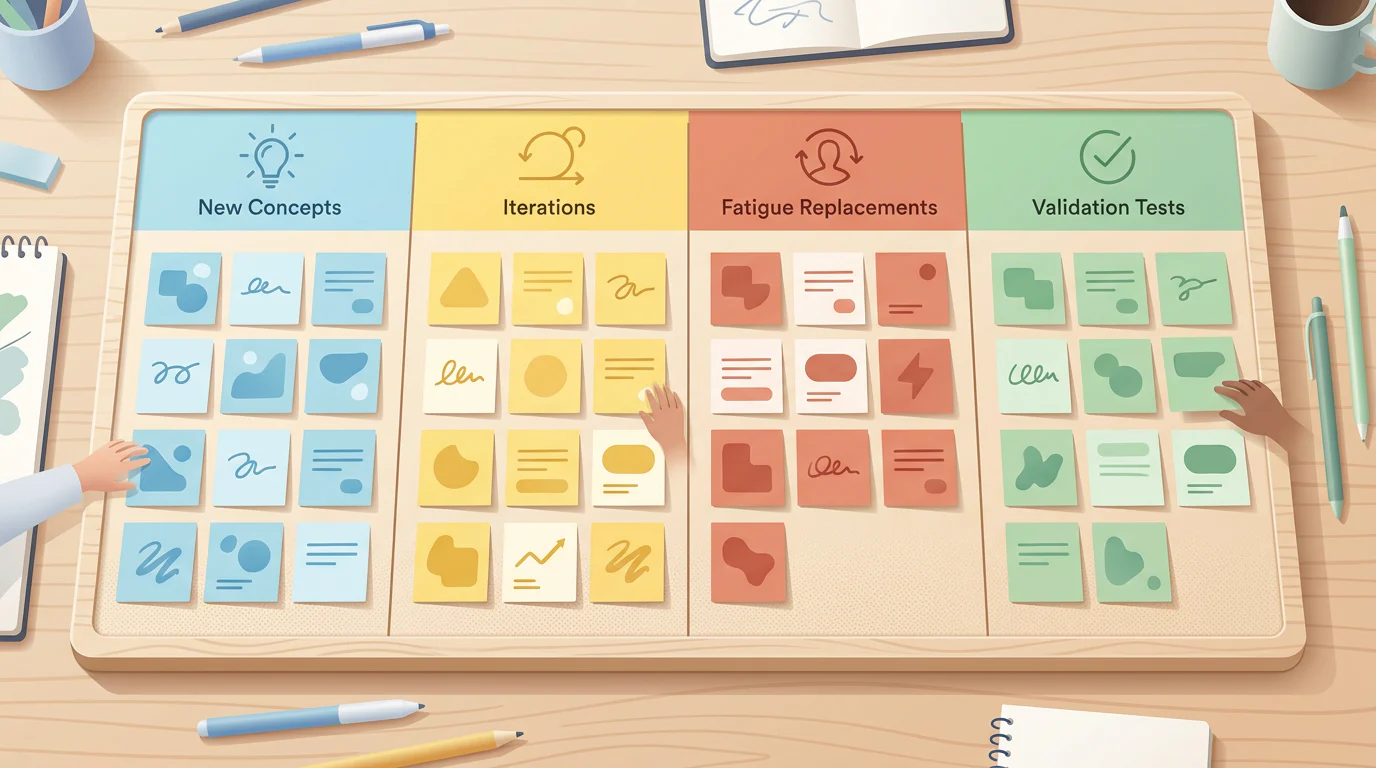
How Should a Weekly Capacity Board Work?
We reserve capacity across net-new concepts, iterations on supported angles, fatigue replacements, and validation tests. The exact mix should follow available budget, conversion volume, production capacity, and risk. It should not be copied from a universal percentage.
The board protects the work that reactive systems usually starve. A timely fatigue replacement does not have to fight a new idea for attention, and a promising result does not get abandoned because the team rushed on to the next launch. It also makes dependencies visible, including creative review windows, analytics availability, and media setup requirements.
A capacity board is a commitment device, not a prediction that every lane will produce the same number of assets. When a validation test needs more time, or a brand review changes a launch date, the team can see which lower-ranked work should move instead of silently expanding the weekly workload.
When Should an Urgent Request Override the Score?
An urgent request can override the ranking when it addresses a material delivery risk, legal or brand issue, clear fatigue exposure, or a time-sensitive business event. The override should still be logged with a reason, owner, and review date.
That record matters because overrides can expose a recurring bottleneck. If “urgent” requests keep displacing planned learning, the solution is not more meeting time. It is a better intake rule, clearer capacity allocation, or a dedicated response lane.
Our prioritization system makes those constraints visible before the slate is approved, including why one urgent action displaced another planned learning opportunity.
Who Owns Test Decisions and Launch Quality?
Testing slows down when responsibility is implied. We assign decision rights before a card reaches production, so creative teams are not waiting on ambiguous approval and media teams are not launching work without a valid readout plan.
The growth lead owns business priorities and budget trade-offs. The media buyer owns setup and live monitoring. The strategist owns hypothesis quality, while design and copy own faithful execution. Analytics owns readout integrity, and brand review owns claims and safety guardrails.
| Role | Accountable For | Can Approve | Escalates When |
|---|---|---|---|
| Growth Lead | Priority, budget, and business guardrails | Weekly slate | Goals or budget conflict |
| Media Buyer | Setup, delivery, and launch readiness | Launch QA | Delivery prevents a fair test |
| Creative Strategist | Angle and hypothesis clarity | Brief completeness | More than one strategic variable changes |
| Design And Copy | Execution quality | Asset QA | Format or claim changes the test |
| Analytics | Metric, readout, and decision validity | Result classification | Data is missing or inconclusive |
| Brand Review | Claims and brand safety | Final clearance | Risk conflicts with launch timing |
A minimum viable test has one named primary variable, a defined audience and baseline, a measurement plan, tracking QA, a decision rule, and named launch and readout owners. If any part is missing, we return the card to the backlog instead of spending to produce a result nobody can confidently use.
We also define escalation paths before launch. If delivery is unstable, tracking fails, or the test changes too many variables, the media buyer or analyst pauses the decision and records why. Clear test stop rules prevent a weak experiment from becoming a vague conclusion after spend is already committed.
How Do Results Become Better Weekly Decisions?
A dashboard reports what happened. A learning ledger records what the team can do next because of what happened. We use the ledger to connect each outcome to its audience, angle, variable, conditions, confidence, and future action.
This distinction is important because advertising measurement is noisy. A large academic review of 432 field experiments found median conversion lift of 8.1%, alongside wide variation across studies, which is why we treat inconclusive outcomes as legitimate results when the test was properly designed and documented in the field research.
After each readout, we classify the test as scale, iterate, stop, validate, or archive. We then update evidence confidence, create any follow-up card, and rescore the full backlog. That process keeps a temporary performance change from becoming a permanent rule.
We also record the conditions that made the result interpretable: audience, offer, placement, spend, duration, adjacent creative, and meaningful delivery changes. Without that context, a team may repeat a conclusion in a different setting where it no longer applies. The ledger should capture both the outcome and the limit of the outcome.
Our testing memory preserves the conditions around each result, helping us separate durable learning from a one-time pattern. The weekly review should end with a smaller set of committed tests and fewer unresolved opinions.
The final step is to convert the classified result into a concrete next action. A winner may require validation in another audience, a weak result may reveal a better angle to test, and an inconclusive readout may need a cleaner rerun. We use that decision trail to improve the next slate instead of allowing live performance data to disappear into a dashboard.
Why Use Deepsolv for Weekly Test Decisions?
At Deepsolv, we built our workflow for the moment a dashboard identifies change but the team still has to decide what deserves next week’s spend. We bring own-account performance, market observations, fatigue signals, customer feedback, and prior outcomes into one decision layer, so every proposed test carries its evidence, owner, dependency, and decision rule. That gives growth, media, creative, and analytics a shared weekly slate rather than another round of subjective requests. Our platform helps us surface patterns across active and historical creative, preserve what each result actually taught, and make the next recommendation explainable. You can keep your existing production process and media accounts while giving the team a clearer path from evidence to action. If your meetings keep producing more ideas than decisions, we can show how the workflow operates in a live account review. Book a Deepsolv demo