Comparison
Deepsolv vs Canva Grow: Who Decides the Next Ad?
Canva Grow creates, publishes and reports on ads across Meta, TikTok and LinkedIn. Meta advertisers who need a ranked weekly test plan from competitor and customer signals should choose Deepsolv.

By Sachit Sharma, CEO & Founder · Updated 9 Nov 2026
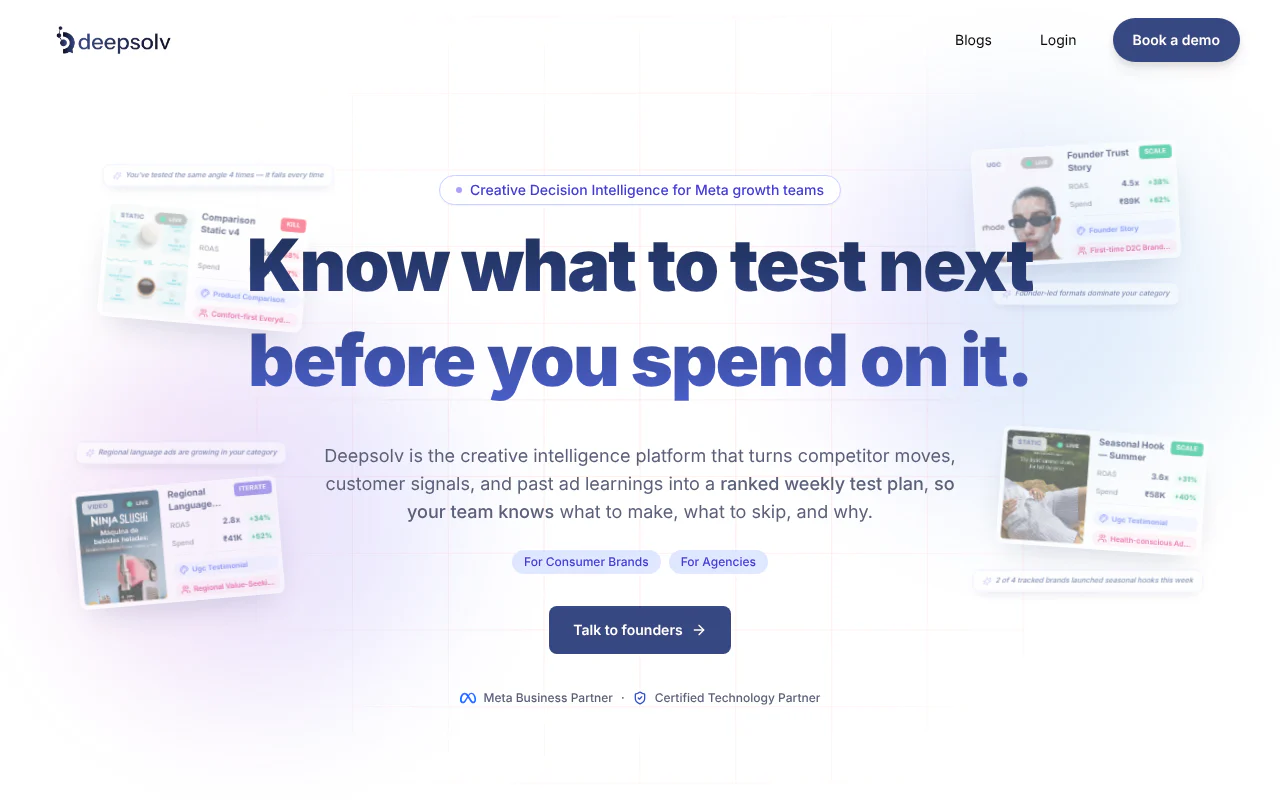
Deepsolv
Ranked weekly ad test plans and creative briefs
Best for: Meta teams deciding what to test next
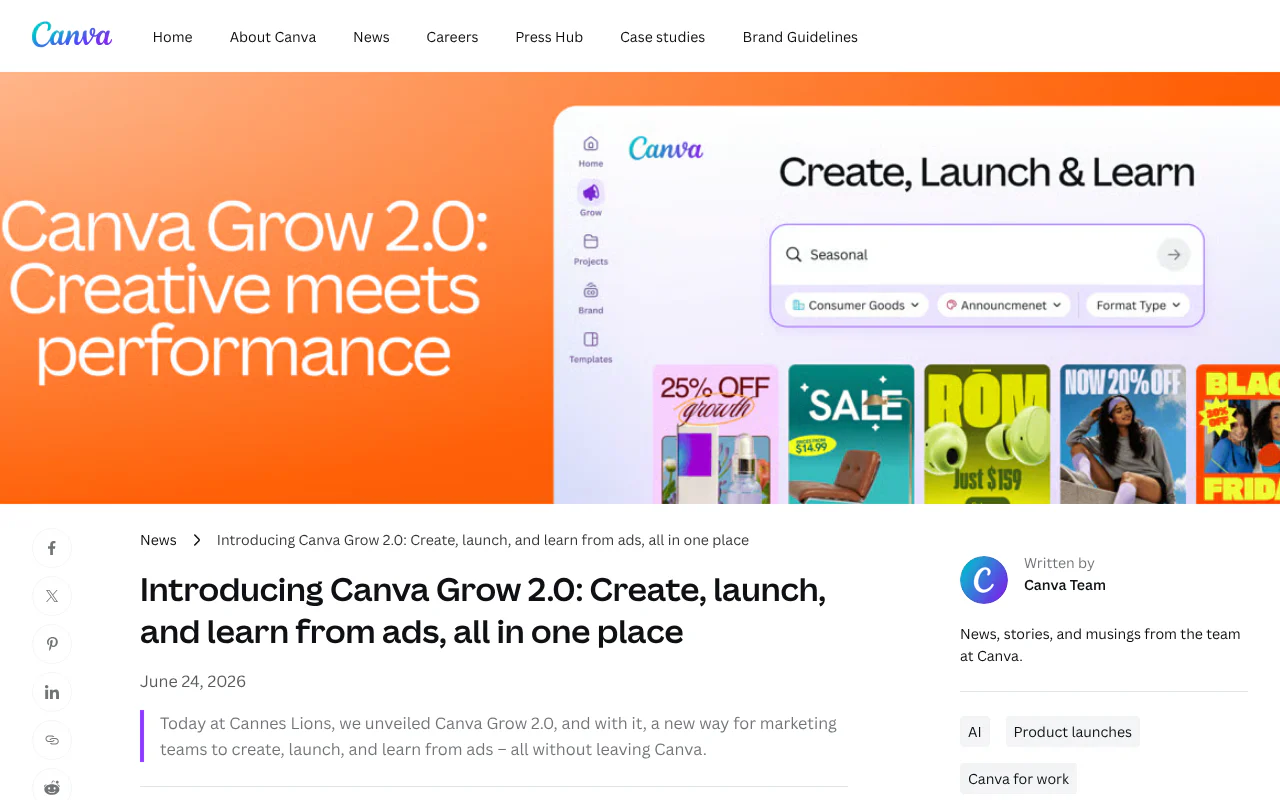
Canva Grow
Ad generation, publishing and reporting platform
Best for: Teams producing and publishing ads at volume
On this page
- 01At a glance
- 02How each looks
- 03Which to choose
- 04Detailed comparison
- 05Where each is stronger
- 06Introduction
- 07Key takeaways
- 08What is Canva Grow, and what does it do for Meta ads?
- 09When should you choose Deepsolv over Canva Grow?
- 10What does Canva Grow cover that Deepsolv does not?
- 11How do Canva Grow and Deepsolv compare on the points buyers decide on?
- 12Is deciding or producing your bottleneck? A 30-minute check
- 13How we compared
- 14Frequently asked
The short answer
Deepsolv is the stronger choice if choosing the next test is your slow step, because more finished ads do not show which one deserves the budget. Canva Grow helps make and publish ads.
At a glance
Who it is for
- Deepsolv
- Meta advertising teams deciding what to test next
- Canva Grow
- Teams producing and publishing ads
Source: Canva announcement, June 25, 2026; Deepsolv
Core job
- Deepsolv
- Rank what to test next and brief it
- Canva Grow
- Generate, publish and report on ads
Source: Canva announcement, June 25, 2026; Deepsolv
Main output
- Deepsolv
- Ranked weekly test plan and execution-ready creative briefs
- Canva Grow
- Generated static and video ads, a launch dashboard, reports
Source: Canva announcement, June 25, 2026; Deepsolv
Platforms
- Deepsolv
- Meta
- Canva Grow
- Meta, TikTok and LinkedIn
Source: Canva announcement, June 25, 2026; Deepsolv
Pricing model
- Deepsolv
- No public self-serve price; scoped to your team and workflow in a demo
- Canva Grow
- Canva subscription; price differs by plan
Source: Canva pricing page; Deepsolv
How you buy
- Deepsolv
- Personalized demo with our founding team
- Canva Grow
- Canva subscription
Source: Canva announcement, June 25, 2026; Deepsolv
How each looks
Which should you choose?
Choose Deepsolv if
- Your bottleneck is deciding what to test next on Meta
- You want a ranked weekly creative test plan with guidance on what to make, skip, improve or stop
- You want competitor ads and customer comments, DMs, reviews and Reddit threads to feed your plan
- You want past learnings, what worked, what failed and why, to carry forward so lost tests do not return
- You want execution-ready creative briefs for your designers, editors or creators
Choose Canva Grow if
- You need to generate static and video ads inside one tool
- You need to bulk publish to TikTok and LinkedIn as well as Meta
- You want performance consolidated in multi-platform reports
Deepsolv vs Canva Grow, point by point
A check marks the stronger side on that point. Points without a check are even, or depend on what you need.
| What matters | Deepsolv | Canva Grow |
|---|---|---|
| Inputs | ||
| Signals used | Stronger hereAd performance, competitor activity, past ad learnings and customer signals: comments, direct messages (DMs), reviews and Reddit | Performance data from Meta, TikTok and LinkedIn, plus brand context and audience signals used in AI ad creation |
| Memory of past ads | Stronger hereBrand Brain, our memory of past tests: what worked, what failed and why | AI Ad Tagging labels creative elements across ads (Business and Enterprise plans only) |
| Ad fatigue metrics | Analyzes click-through rate (CTR), cost per click (CPC), add to cart (ATC), return on ad spend (ROAS) and ad fatigue | Consolidates performance in multi-platform reports; Automatic Refresh Generation proposes new concepts from campaign data |
| Outputs and workflow | ||
| Deliverable | Stronger hereRanked test plan and briefs that direct whatever Canva Grow or any other editor produces | Finished ads you can open in the Canva editor |
| Publishing | Briefs go to whoever produces the ad; the test plan sits ahead of the ad set step | Stronger hereBulk publishes to Meta, TikTok and LinkedIn, with a launch dashboard |
| Next-step guidance | Guidance on what to make, skip, improve or stop | Automatic Refresh Generation proposes new concepts from campaign data |
Inputs
Signals used
- DeepsolvStronger here
- Ad performance, competitor activity, past ad learnings and customer signals: comments, direct messages (DMs), reviews and Reddit
- Canva Grow
- Performance data from Meta, TikTok and LinkedIn, plus brand context and audience signals used in AI ad creation
Memory of past ads
- DeepsolvStronger here
- Brand Brain, our memory of past tests: what worked, what failed and why
- Canva Grow
- AI Ad Tagging labels creative elements across ads (Business and Enterprise plans only)
Ad fatigue metrics
- Deepsolv
- Analyzes click-through rate (CTR), cost per click (CPC), add to cart (ATC), return on ad spend (ROAS) and ad fatigue
- Canva Grow
- Consolidates performance in multi-platform reports; Automatic Refresh Generation proposes new concepts from campaign data
Outputs and workflow
Deliverable
- DeepsolvStronger here
- Ranked test plan and briefs that direct whatever Canva Grow or any other editor produces
- Canva Grow
- Finished ads you can open in the Canva editor
Publishing
- Deepsolv
- Briefs go to whoever produces the ad; the test plan sits ahead of the ad set step
- Canva GrowStronger here
- Bulk publishes to Meta, TikTok and LinkedIn, with a launch dashboard
Next-step guidance
- Deepsolv
- Guidance on what to make, skip, improve or stop
- Canva Grow
- Automatic Refresh Generation proposes new concepts from campaign data
Where each is stronger
A ranked plan, not a pile of options
Our platform output is a ranked weekly creative test plan, with guidance on what to make, skip, improve or stop.
Competitor activity and customer words as inputs
We track competitor ads across messaging, angles, offers and formats, and read comments, DMs, reviews and Reddit for the language buyers use.
Briefs ready to execute
Each ranked test comes with an execution-ready creative brief your designers, editors or creators can start from.
Introduction
A team can produce ten polished ads a day and still guess at which ten. Canva Grow 2.0 (June 25, 2026) helps make, publish and read ads, and proposes refreshes from campaign data (Canva's announcement). Deepsolv ranks the next test using competitor and customer signals as well.
A separate decision sits upstream of making ads: which concept goes next, and why that one.
We build Deepsolv for that upstream decision. This page compares the two by the job each does. It ends with a five-question check you can run on your own ad account in about 30 minutes.
Key takeaways
- Choose Deepsolv if your bottleneck is deciding what to test next on Meta. Choose Canva Grow if your bottleneck is producing and publishing the ads.
- Deepsolv turns ad-performance data, competitor activity, customer signals and past ad learnings into a ranked weekly test plan and execution-ready creative briefs.
- Canva Grow reaches Meta, TikTok and LinkedIn. Its AI Ad Tagging feature requires Canva Business or Canva Enterprise.
- A five-question check below tells you in about 30 minutes whether deciding or producing is slowing you down.
What is Canva Grow, and what does it do for Meta ads?
Canva Grow is Canva's ad platform for generating, publishing and reviewing paid ads. As of the June 25, 2026 release, it generates static and video ads, bulk publishes to Meta, TikTok and LinkedIn, shows campaigns in a launch dashboard, and consolidates performance in multi-platform reports. AI Ad Tagging labels creative elements. Automatic Refresh Generation proposes new concepts from campaign data. (Canva's announcement)
Canva began the rollout in North America, Australia and the United Kingdom on that date. AI Ad Tagging requires a Canva Business or Canva Enterprise account.
When should you choose Deepsolv over Canva Grow?
Choose Deepsolv when the question you cannot answer is "what do we test next?" Five facts about our platform decide it.
- You get a ranked plan, not a pile of options. Our platform output is a ranked weekly creative test plan, with guidance on what to make, skip, improve or stop. You open Monday with an order of work.
- Competitor activity is an input. We track competitor ads across messaging, angles, offers and formats, so your plan reflects what rivals run. Treat those ads as clues about what to test, not proof of what earns them revenue.
- Customer words feed the plan. We read comments, DMs, reviews and Reddit for the language buyers use, then turn it into angles.
- Past learnings carry forward. Brand Brain remembers what worked, what failed and why, so a test you lost in spring does not return in fall.
- The output is a brief, not a vague idea. Each ranked test comes with an execution-ready creative brief your designers, editors or creators can start from.
We also analyze the numbers that tell you when an ad is tiring: click-through rate (CTR), cost per click (CPC), add to cart (ATC), return on ad spend (ROAS) and ad fatigue.
What does Canva Grow cover that Deepsolv does not?
Canva Grow covers ad generation, bulk publishing, and TikTok and LinkedIn coverage alongside Meta. Those are production and distribution jobs; Deepsolv is built for the planning job ahead of them. Deepsolv's ranked briefs can direct whatever Canva Grow or any other editor produces.
How do Canva Grow and Deepsolv compare on the points buyers decide on?
They differ on inputs, outputs and where each sits in the workflow. Deepsolv adds competitor activity and customer comments, DMs (direct messages), reviews and Reddit threads as planning inputs.
What information goes in?
We combine four inputs: ad-performance data, competitor activity, customer signals and past ad learnings. Canva Grow's reports consolidate performance data across platforms, and its refresh feature builds new concepts from campaign data. A plan built on four inputs can disagree with your own dashboard, which is the point. Your best ad may be your best only for the audience you already reach, while customer comments and competitor angles point somewhere new.
What comes out?
A ranked weekly test plan and execution-ready briefs come out of our platform. Grow produces finished ads you can open in the Canva editor. These are different deliverables, so a team can use a brief from us to direct what Grow, or any editor, makes. Our A/B test hypothesis template shows how to write the hypothesis a brief should carry.
Where does the work sit in Meta's structure?
Meta organizes ads into campaigns, ad sets and ads, and sets audience, placements, budget and schedule at the ad set level (Meta Business Help Center). Our recommendation: decide the concept first, then place it in an ad set you can fund. Our test plan sits ahead of that step, and its briefs go to whoever produces the ad.
How do you start and what does it cost?
Deepsolv has no public self-serve price. We scope it to your team and workflow in a personalized demo with our founding team. Canva's prices differ by plan; current prices are on Canva's pricing page as of November 2026.
Is deciding or producing your bottleneck? A 30-minute check
Run these five tests on your own account. Fail three or more and your bottleneck is deciding; our recommendation is to start with Deepsolv. Pass most and your test plan is solid. Deepsolv still ranks each week's next tests. The thresholds are our rule of thumb, not an industry standard.
- Concepts with a reason. In Ads Manager, count the distinct concepts you launched in the last 30 days (a concept is a new angle or hook, not a resize). Pass: at least half have a one-line written hypothesis. Fail: fewer.
- Next three tests. Write your next three tests, with one reason each, in five minutes. Pass: each reason cites a metric, a competitor ad or a customer quote. Fail: any reason is "it looks good" or "we always run this."
- Competitor angles. Name the main angle each of your three closest competitors runs now, using the Meta Ad Library (Meta's public database of active ads). Pass: you name all three. Fail: you name fewer than three. Our competitor ad volume guide explains what ad counts do and do not tell you.
- Customer words in live ads. Pull three phrases from reviews, comments or DMs. Pass: at least one appears word for word in a live ad. Fail: none does. Our post-purchase survey questions show one way to collect them.
- Where the days go. Take your last launched ad and count days spent choosing the concept and days spent making it. Pass: choosing took no longer than making. Fail: choosing took longer.
Related comparison: Deepsolv vs AdCreative.ai.
Our verdict
Deepsolv is the better choice for a Meta advertising team that already has production capacity and needs to choose its next tests from competitor moves, customer signals and its own history.
How we compared
We compared Deepsolv and Canva Grow on inputs, outputs, platforms covered and how each is bought. We used Canva's June 25, 2026 announcement, Canva's pricing page, MagicBrief's shutdown notice and Meta's Business Help Center as of November 2026. We did not compare prices in dollars or test either product on a live ad account.
This page is published by Deepsolv. If anything here is out of date, tell us and we will correct it.
Sources
- 1.Introducing Canva Grow 2.0, June 25, 2026, Canva
- 2.Canva pricing page, Canva
- 3.MagicBrief to join Canva, June 18, 2025, with shutdown notice for July 31, 2026, MagicBrief
- 4.What are the advertising levels in Meta Ads Manager?, Meta Business Help Center
- 5.Book a demo, Deepsolv