Deepsolv Blog
Deepsolv Blog
Backed by








Creative Decision Intelligence for Meta growth teams. Know what to test next — before you spend on it.
Follow Deepsolv on InstagramFollow Deepsolv on LinkedInFollow Deepsolv on TwitterAll rights reserved © 2026 deepsolv.ai
7 min read
Published: 4/1/2026
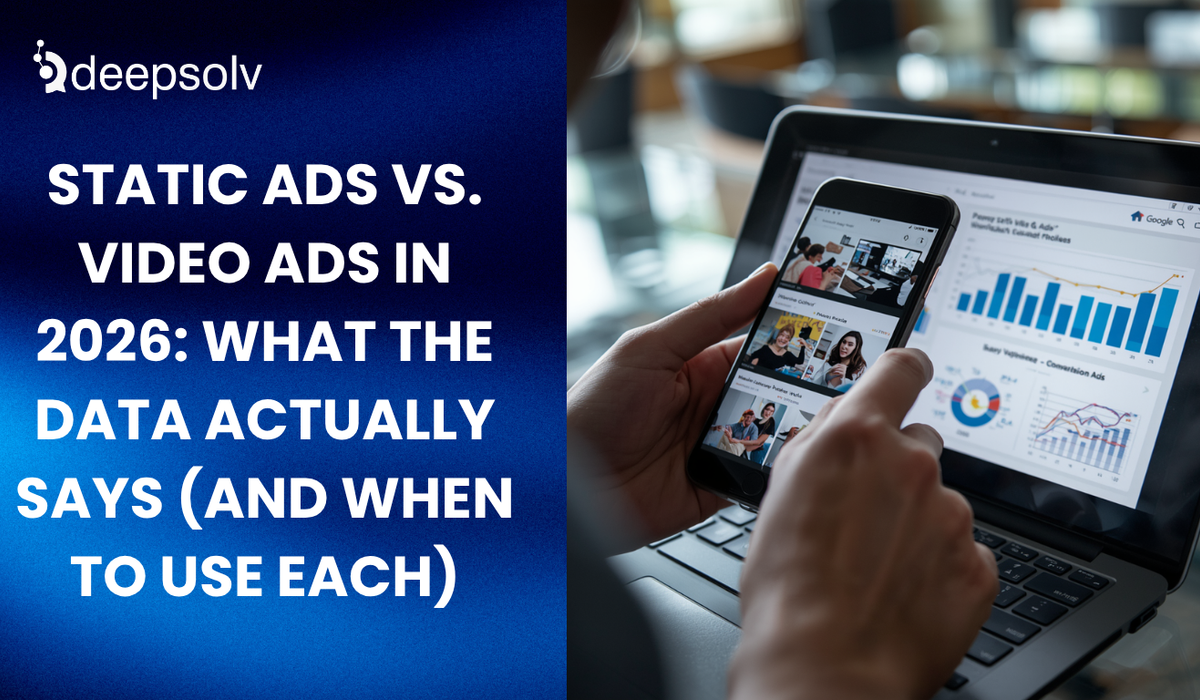
The debate between static and video ads has been running since Instagram introduced Stories. In 2026, it's still generating the same bad takes.
Team Video says: "Video drives 48% higher engagement — static is dead." Team Static says: "Static converts better and costs a fraction to produce — video is overhyped."
Both are partly right. Neither is asking the right question.
The right question isn't "which format is better?" It's "which format is right for this platform, this funnel stage, this audience, and this creative constraint?" The answer is different almost every time.
This post breaks down the actual data — benchmarks from Triple Whale, Liftoff, Nielsen, and Metricool — and gives you a working decision framework so you stop defaulting to video because it feels like the obvious choice, or defaulting to static because it's cheaper.
Let's set the context. The stats you'll see cited constantly — "video has 48% higher engagement" — are real, but they're averages across all platforms, objectives, and industries. Averages hide enormous variation. Here's what the platform-specific data actually looks like.
Meta video ads receive 52% more engagement than static ads on average. But engagement isn't conversion. Zoom in by format:
What this means in practice: On Meta, video wins for reach, recall, and top-of-funnel CTR. Static wins for direct-response retargeting and lower-CPA conversion campaigns. The format decision should track the funnel stage, not a universal preference.
On TikTok, the debate is almost moot. Video is mandatory. Static ads exist but see a fraction of the performance. TikTok rewards content that looks native to the platform: raw, fast-paced, with hooks in the first 2-3 seconds. Polished brand content typically underperforms.
The nuance on TikTok isn't static vs. video — it's produced video vs. native video:
The practical implication: if you're on TikTok and can't sustain high-volume video production, you'll burn through creative faster than you can replace it. The bottleneck isn't distribution — it's creative production. At $3–5 CPM, you can reach 100,000 people for $300–500. The expensive part is creating the 20–30 video variations you need to find winners.
Video ads across all platforms see 48% higher engagement rate than static image posts — but this aggregate hides the fact that engagement and conversion are different metrics on different platforms.
Video ads generate 42% higher ROAS than image ads — again, in aggregate. This figure is pulled toward the positive by TikTok's heavy video skew. On Meta specifically, particularly in retargeting, the picture is more complex.
The honest summary: Video wins on reach and engagement metrics. Static wins on cost efficiency and direct-response ROAS, particularly in retargeting. Neither dominates across all situations.
This is the calculation most format debates skip entirely.
A high-quality video ad might cost between $3,000 and $15,000 to produce through an agency. A static ad or UGC brief can produce 10–15 assets at a fraction of that cost. The question isn't just "does video outperform static?" It's "does video outperform static by enough to justify the production cost differential?"
For most DTC brands at sub-$50K/month ad spend: often no. The production economics don't support spending $10K on a single video when:
Per AppsFlyer's 2026 State of Creative Optimization report, 78% of campaigns that maintain top-quartile performance refresh creatives at least weekly, compared to just 41% in 2024.
Weekly refresh on produced video is not economically viable for most teams. This is exactly why the conversation is shifting toward creative velocity over creative quality — and why AI-assisted brief and asset generation tools are changing the economics of the game.
Related: How a 3-Person Team Produced 40 Ad Variations a Month Using an AI Creative Strategist — a walkthrough of the exact workflow that makes high-volume creative production possible without an agency retainer.
Stop making format decisions at the campaign level. Make them at the funnel stage level. Here's how the data stacks up:
Winner: Video — specifically native, UGC-style short-form
Recommended approach: Invest in 5–10 short-form video variations per campaign. Test hooks aggressively — this is where hook variation has the highest performance impact. Keep videos under 30 seconds. Build for sound-off viewing with captions.
Winner: Depends on creative content, not format
At mid-funnel, you're talking to people who know you exist. The format matters less than the message. Static ads with strong social proof (review screenshots, before/after results, specific numbers) can outperform video here because:
Static ads can work well at the bottom of the funnel if your audience trusts your offer.
Winner: Static (in most cases)
There's a third option that the static/video binary misses entirely: animated statics, UGC-style slideshow content, and text-motion ads.
These formats blur the line deliberately. A static image with animated text overlay performs like a video on TikTok's algorithm because it contains motion — but takes a fraction of the production time of a true video. On Meta, slideshow ads using 3–5 product images with pacing and music outperform both pure static and expensive produced video in many DTC verticals.
If your team is debating "static or video" and the answer is determined by production budget alone, hybrid formats are worth testing before you commit to either.
The practical take from all of this:
If you're below $30K/month ad spend: Prioritise static and UGC-style video. The production economics of polished video don't work at this scale. Use AI creative tools to generate brief variations and test hooks quickly across static formats. Add native TikTok video as you build creator relationships.
If you're at $30K–$150K/month: Run a mixed format strategy deliberately by funnel stage. Prospect with video; retarget with static. Invest in 10–15 video variations per quarter, not one hero asset. Treat creative refresh as an operations problem, not a creative problem.
If you're above $150K/month: Format is table stakes. The competitive advantage at this spend level is creative intelligence — how quickly you can identify winning angles from competitor data and customer signals, and how rapidly you can translate those into brief, asset, and published ad. That's what Adam is built for.
The static vs. video debate is ultimately a proxy debate for a more important question: "Are we doing enough creative testing, fast enough, to find what actually works?"
The brands that win the paid social game in 2026 are not the ones with the best production value or the biggest creative teams. They're the ones with the fastest creative learning loops — the tightest distance between "what's working in the market" and "live creative in our account."
Format is an input variable. Velocity is the competitive advantage.
Build a faster creative loop with Adam. Competitor tracking, trend alerts, AI-generated briefs, and campaign planning in one platform. Start your free trial.