Deepsolv Blog
Deepsolv Blog
Backed by




Creative Decision Intelligence for Meta growth teams. Know what to test next — before you spend on it.
Follow Deepsolv on InstagramFollow Deepsolv on LinkedInFollow Deepsolv on TwitterAll rights reserved © 2026 deepsolv.ai
7 min read
Published: 4/7/2026
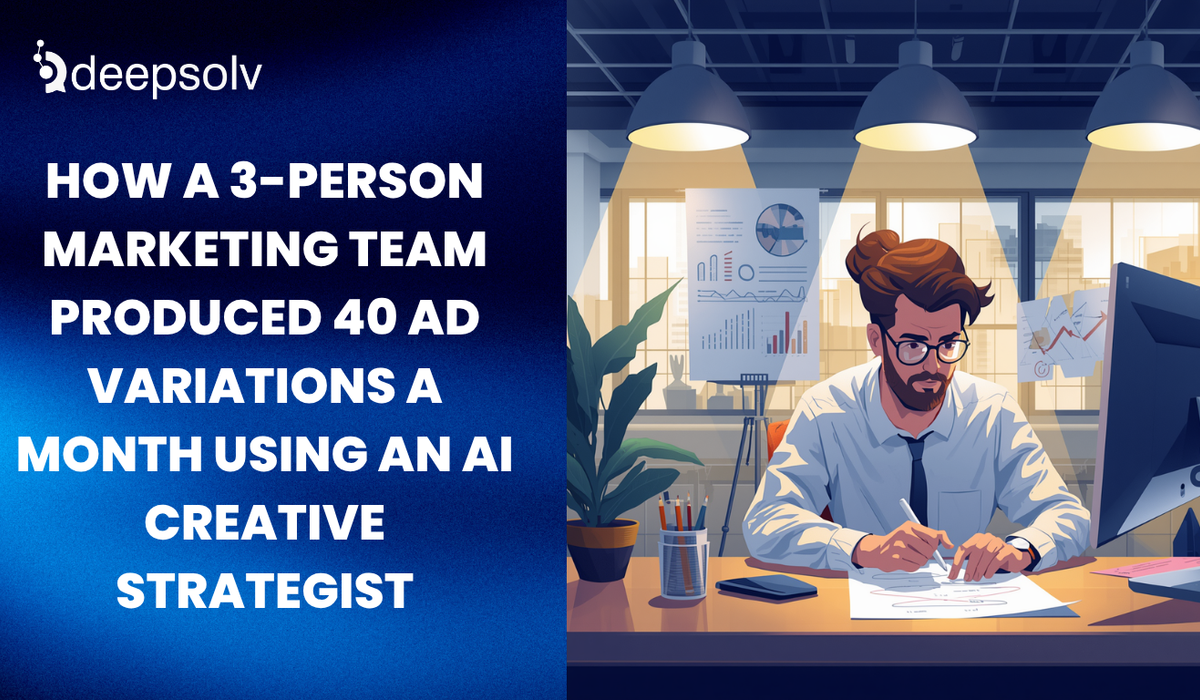
The creative velocity problem isn't talked about honestly enough.
Most performance marketing content talks about what to test: hooks, formats, angles, CTAs. Almost none of it talks about the operational reality of producing enough creative to test meaningfully, without burning out a small team or depleting a budget on agency retainers.
This post is about the operational reality.
It's a walkthrough of the actual workflow a 3-person DTC marketing team used to go from producing roughly 8 ad variations per month to 40 without adding a single headcount, without an agency, and without sacrificing the strategic quality of what they were putting out.
The short version: they stopped treating creative production as a creative problem and started treating it as an intelligence + systems problem.
Let's be specific about the challenge. At $40K/month in ad spend, this team was burning through creative fast. Their data showed the average ad started fatiguing within 10–14 days, a finding consistent with recent benchmark data from AppsFlyer, which reports that 78% of campaigns maintaining top-quartile ROAS in 2026 refresh creatives at least weekly.
Their original process looked like this:
Total time from brief to live: 7–10 days. Total monthly output: 8–10 variations.
The fundamental bottleneck wasn't the designer. It wasn't the budget. It was the brief-writing stage specifically, the amount of strategic thinking that had to happen upstream before a single brief could be written.
Before you write a brief, you need to know:
When those questions sit unanswered, creative meetings turn into opinion sessions. Briefs become vague. Production rounds lengthen. Output suffers.
The team's reframe: great creative is downstream of great intelligence. You can't shortcut the creative, you can shortcut the intelligence gathering that enables the creative.
Their new workflow had three stages:
Here's what each looked like in practice.
Previously, competitive research was done ad-hoc — someone would manually check the Meta Ad Library for 30–45 minutes, screenshot a few things, and share them in Slack. By the time anyone acted on the insight, the trend had moved.
The new approach used a centralised competitor tracking layer — in their case, Adam by Deepsolv — to monitor what competitors were running across Meta, TikTok, and YouTube simultaneously.
The weekly competitor intelligence ritual became:
Monday morning, 20 minutes:
This produced a standing document — a live "what's working in the market" brief — that fed directly into the brief-generation stage. Rather than starting from a blank page each week, the team started from a market-informed position.
The key insight: long-running competitor ads are your most reliable creative intelligence signal. A brand doesn't keep spending money on an ad that isn't working. If the same creative has been live for three weeks, it's working. That's not inspiration to copy — it's a validated angle worth building your own version of.
This is where the biggest time saving happened.
Previously, writing one brief took 2–3 hours. The process involved: summarising the competitive context, defining the audience moment, choosing a psychological angle, writing the hook, structuring the narrative, and specifying production details. One person doing all of that, from scratch, every time, for every variation.
The new process used AI to compress the brief-generation stage dramatically, while improving the strategic quality of the output.
The workflow:
Step 1: Input the competitive intelligence. The team fed last week's competitor insights into Adam: which angles competitors were running, which formats were being scaled, what hooks were appearing repeatedly across the category.
Step 2: Define the angle matrix. Rather than choosing one angle per brief, the team used AI to generate an angle matrix, typically 8–10 distinct angles for the same product and objective, each built around a different psychological trigger (curiosity, loss aversion, social proof, identity, etc.).
Step 3: Brief selection and calibration. The performance marketer reviewed the angle matrix and selected the 5–8 most promising angles. The AI generated a full brief for each: hook options (typically 3 per brief), body narrative structure, CTA, production notes, and brand voice calibration.
Total time: 45–60 minutes for 8 production-ready briefs. Down from 2–3 hours per brief.
The quality difference from the old process: briefs were now grounded in competitive intelligence and built around explicit psychological frameworks, rather than emerging from a meeting discussion and being sanitised into a document.
The improved brief quality had a second-order effect the team didn't fully anticipate: production rounds shortened significantly.
When a brief says "hook variant A: open with the specific frustration of checking the Meta Ad Library for 45 minutes and finding nothing actionable — this is the quiet cost the audience doesn't name but immediately recognises," the designer and videographer know exactly what to make. There's no ambiguity. There's no back-and-forth about what the "vibe" should be.
The team also introduced a pre-approved production framework — a set of defined asset types with established parameters:
Each type had a pre-agreed set of dimensions, font treatments, and production notes. This meant the designer wasn't starting from scratch for each asset — they were filling a known format with brief-specific content.
Result: 8–10 briefs producing 4–5 assets each = 40+ ad variations per month. Two batch production rounds of 3 days each, with a day of review and revisions built in.
The team's performance metrics over the first three months of this workflow:
The key driver wasn't any single creative that worked better than before. It was the volume of testing producing more signal, faster which compressed the time between "we have a hypothesis" and "we have a confirmed winner."
The point is consistent with what AppsFlyer's 2026 research found across the industry: teams that refresh creatives at least weekly maintain top-quartile ROAS at significantly higher rates than teams that don't. The bottleneck to weekly refresh, for most small teams, is brief production, not budget, not production capability, not strategic ideas.
What it requires:
What it doesn't require:
The hardest part of this workflow isn't the tools. It's the mindset shift from "creative direction comes from inspiration and meetings" to "creative direction comes from market intelligence and structured briefs." The former feels more creative. The latter produces better creative, faster, with more consistency.
Yes — and the constraint when it scales is almost never the brief-generation stage. It's the production stage.
At 40 variations per month, a 3-person team with one part-time designer can manage the production load if the production framework is tight. Beyond 40–50 variations, you either need additional production capacity (another designer, a video editor, more UGC creators on retainer) or you shift more production to AI-generated assets.
The creative intelligence layer: competitive tracking, brief generation, angle development can scale to 100+ briefs per month without significant additional time investment. It's the last-mile production that creates the ceiling.
For teams at that scale, the AI asset generation capabilities within Adam, going from brief to image and video assets become the next leverage point.
The 3-person team in this case study didn't get better at being creative. They got better at being systematic about the inputs that produce great creative.
They stopped asking "what should we make?" and started asking "what does the market tell us we should test?" That shift, from creative intuition to creative intelligence is what changes the output.
The tools that enable this shift now exist and are accessible to teams of any size. The advantage goes to the teams that adopt the workflow, not the ones that wait for a bigger budget or a bigger headcount.
Adam by Deepsolv is the AI creative strategist that combines competitor tracking, trend intelligence, and AI-powered brief generation in one platform. Start a 7-day free trial — no credit card required.