
Paid Social Test Prioritization Methods Compared
Compare six paid social test prioritization methods and build a risk-aware weekly creative backlog that protects budget and compounds learning.

Random creative testing gets expensive when every promising idea competes on opinion. Current experiment guidance will not calculate conversion-metric differences until an arm records at least 100 conversions, which makes weak test selection especially costly.
Paid social teams should use paid social test prioritization methods that score expected impact, evidence strength, learning value, production effort, feasibility, and downside risk. We use competitor patterns to generate hypotheses, account and customer signals to set confidence, and stop rules to contain losses. Then we reserve weekly slots across concept, iteration, and fatigue-replacement work.
This comparison explains which method fits each maturity level, how to score a backlog, and how to govern a weekly plan without letting the easiest variation win by default.
Why Do Paid Social Teams Keep Testing the Wrong Ideas?
The problem is rarely a shortage of creative ideas. It is a shortage of shared rules for deciding which idea deserves limited budget, production capacity, and audience exposure first. Without those rules, teams often mistake activity for learning: they launch multiple unrelated variants, find a temporary winner, and cannot explain why it won.
We separate proposals into three levels before they enter the queue. A concept test examines a strategic creative belief, such as a new customer problem, promise, objection, or proof mechanism. An execution test changes how a validated concept is delivered, such as its hook or format. A cosmetic variant changes a low-learning detail and should not take a protected testing slot unless it answers a specific hypothesis.
Every intake needs a causal hypothesis, a named audience, a control, a primary metric, a guardrail, and a decision that will change if the result is positive or negative. That record gives us a cleaner basis for angle tracking than a dashboard full of ad-level outcomes.
Which Paid Social Test Prioritization Methods Fit Enterprise Teams?
No single framework is wrong. The best choice depends on whether a team is still creating basic testing discipline or already managing enough spend, evidence, and production dependencies that raw impact scores are not sufficient.
| Method | Inputs | Strength | Failure Mode | Best Fit |
|---|---|---|---|---|
| ICE | Impact, confidence, ease | Fast triage for a new backlog | Ease can favor cosmetic changes | Early testing programs |
| RICE | Reach, impact, confidence, effort | Makes affected audience explicit | Reach estimates can become speculative | Growing programs |
| Impact-Confidence-Effort | Expected impact, confidence, effort | Simple executive alignment | Does not protect portfolio balance | Developing teams |
| Evidence-Weighted | Evidence quality, impact, novelty, effort | Rewards account-specific proof | Can underfund exploration | Mature teams |
| Risk-Adjusted | Expected value, evidence, effort, downside risk | Protects budget and active winners | Requires agreed guardrails | Mature teams |
| Portfolio-Based | Score plus funnel and hypothesis mix | Prevents a narrow learning queue | Requires weekly governance | Enterprise teams |
How Do ICE and Impact-Confidence-Effort Work?
ICE is useful when a team needs to replace open debate with a repeatable first pass. It asks whether an idea could matter, how confident the team is, and how easy it is to launch. Impact-confidence-effort uses nearly the same logic but makes production burden more visible.
Both methods should be treated as triage, not truth. They help us reject unready ideas and identify candidates for deeper review, but neither tells us whether a test threatens an active winner or duplicates a concept already in market.
When Does RICE Add Useful Discipline?
RICE adds reach, which is valuable when two hypotheses may have similar impact but apply to very different amounts of spend or audience. Its familiar formula is reach multiplied by impact and confidence, divided by effort. The original RICE framework also emphasizes using real measures of reach rather than guesses.
For paid social, reach should mean eligible exposure within the proposed test window, not an account-wide audience estimate. A high-reach concept with too little budget or an audience too narrow for clean measurement is still not launch-ready.
Why Do Evidence-Weighted and Risk-Adjusted Methods Matter?
Evidence-weighted scoring improves on generic confidence by asking where confidence came from and how recent it is. A repeated account result should count more than a single stakeholder opinion. Repeated public-market patterns can inform a hypothesis, but they cannot prove that the pattern will work in our account.
Risk-adjusted scoring adds the cost of being wrong. That includes displacing a profitable ad, consuming scarce production time, exposing a small audience too quickly, or running a test that cannot collect enough useful evidence. We use competitor research as one input to this process, never as a shortcut around account-specific validation.
Why Is Portfolio-Based Prioritization Different?
Portfolio-based prioritization is not a new score. It is a constraint on the queue. It stops us from filling every slot with bottom-funnel iterations just because they are easy to justify, while neglecting new concepts, audience gaps, or urgent fatigue replacements.
That distinction matters because an enterprise program needs both near-term efficiency and future creative options. A backlog that only optimizes existing winners eventually runs out of new places to learn.
What Evidence Should Change a Test’s Rank?
A useful scoring system makes confidence inspectable. We do not accept “high confidence” as a conclusion. We ask what evidence supports it, whether that evidence applies to the proposed audience and objective, and what past tests say about the same creative territory.
What Counts as Strong Evidence?
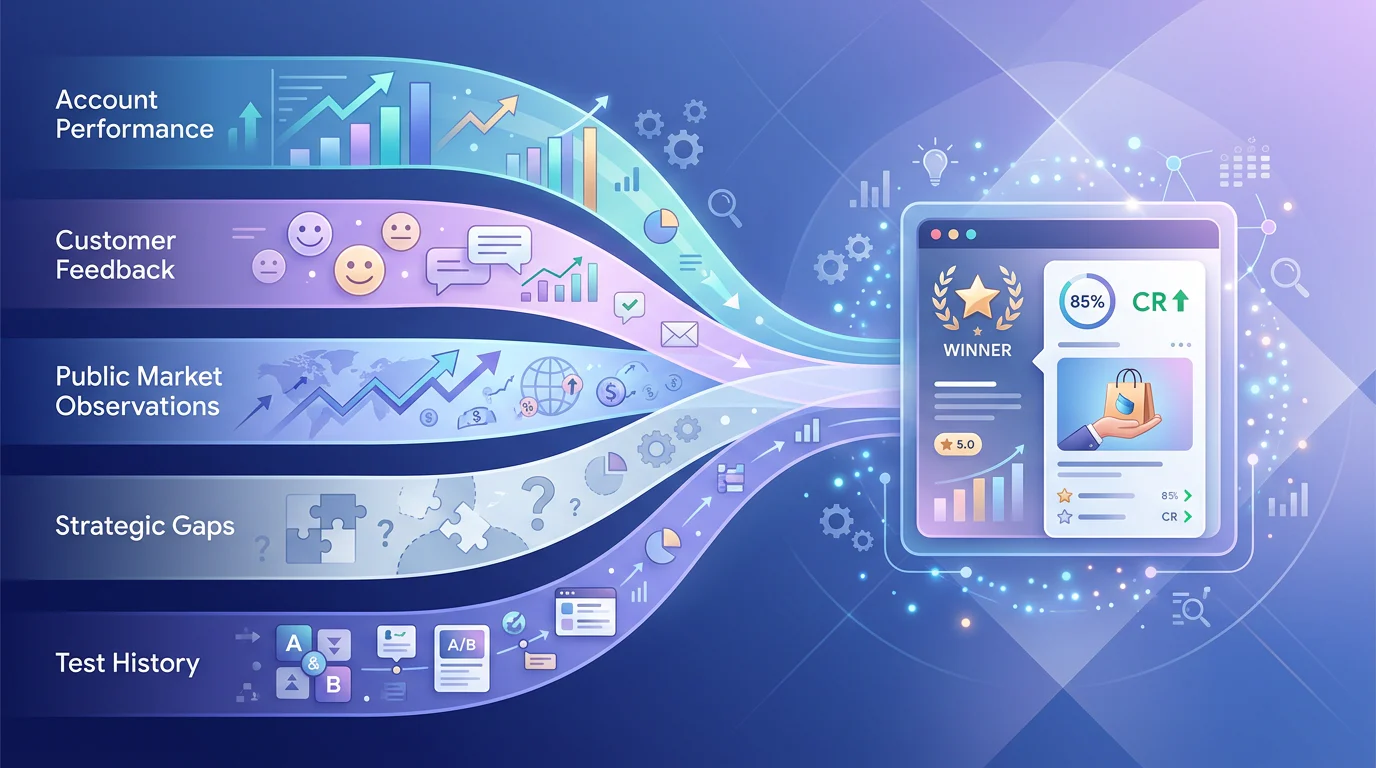
The strongest input is replicated, comparable account-level performance. Next comes current performance by concept, angle, audience, funnel stage, and creative age. Direct customer language, including repeated objections and recurring comment themes, can raise confidence when it supports a defined creative belief.
Publicly visible ads are useful for observing patterns in active market messaging, formats, and claims. The Ad Library makes that research possible, but visibility does not reveal profitability, conversion quality, or incrementality. We treat it as a hypothesis source, not performance proof.
How Should Customer Evidence Be Used?
Customer evidence should be specific, repeated, and linked to a proposed message. A single comment may inspire exploration, but a recurring phrase across sales calls, support conversations, and comments is more useful because it identifies a real decision barrier or desired outcome.
We connect that qualitative material with customer evidence, then check whether the account has already tested the angle, audience, or proof type. That prevents teams from relaunching a failed hypothesis under new visual styling.
What Should Lower Confidence?
Confidence falls when the proposal lacks a clean control, needs an unapproved claim, depends on unavailable production capacity, or targets an audience too small for the intended metric. It also falls when past tests showed the same concept repeatedly underperformed under comparable conditions.
A failed test should not disappear from the system. It should record whether the hypothesis lost, the execution failed, measurement was invalid, or the result was inconclusive. Those distinctions make the next decision better.
How Should You Score a Creative Testing Backlog?
A backlog score should make tradeoffs visible, not create a false sense of mathematical certainty. We use a weighted rubric, then apply feasibility gates before a proposal can enter the launch queue. A maintained test memory helps us compare new proposals with past hypotheses, outcomes, and conditions.
| Criterion | What It Measures | Minimum Evidence |
|---|---|---|
| Expected Impact | Potential movement in the chosen business outcome | Baseline and affected audience or spend |
| Evidence Strength | Quality, recency, and agreement of supporting signals | Linked performance, customer, or market records |
| Learning Value | Whether either result changes the next decision | Clear actions for positive and negative outcomes |
| Novelty | Whether the test closes a strategic gap | Backlog coverage review |
| Production Effort | Creative, review, and launch burden | Capacity estimate and timing |
| Feasibility | Audience, budget, measurement, and approval readiness | Launch-readiness check |
| Downside Risk | Spend at risk and active-winner displacement | Guardrail and stop-rule owner |
Score Concepts Before Executions
Concept tests usually earn more learning value because they can open or close an entire creative direction. Execution tests can rank highly when they extend a validated concept into a new audience or format. Cosmetic variants should rank low unless the account has a precise reason to believe the detail is causal.
This protects production capacity from becoming the primary ranking factor. The fastest asset to make is not necessarily the most valuable asset to test.
Apply a Feasibility Gate Before Ranking
A proposal cannot outrank launch-ready work if it cannot obtain a clean comparison, enough budget, an eligible audience, or a meaningful observation window. The gate also checks whether the team has a control, tracking, review approval, and a replacement plan if performance deteriorates.
We monitor fatigue tracking alongside the score because a deteriorating active creative can legitimately move a replacement above a higher-learning but lower-urgency concept test.
Use Test Memory to Break Close Scores
When two ideas score similarly, prioritize the one that fills a portfolio gap, has lower downside risk, or will produce the more reusable answer. The tie should never be broken by job title or who argued hardest in the room.
Test memory makes those decisions easier because it preserves which concepts, hooks, proof types, audiences, and formats have already been tested and what they taught us.
How Does a Weekly Test Plan Turn Scores into Learning?
Weekly governance is where prioritization becomes an operating system rather than a worksheet. The score establishes a starting order. The team then protects that order with portfolio limits, named owners, and a documented way to handle urgent changes.
| Portfolio Lane | Purpose | Weekly Share |
|---|---|---|
| Fatigue Replacements | Protect active performance when risk triggers fire | Team-defined |
| Proven-Concept Iterations | Improve validated creative territory | Team-defined |
| Concept Exploration | Test new problems, promises, objections, or proof | Team-defined |
| Funnel Or Audience Gaps | Correct under-tested stages and segments | Team-defined |
| Strategic Bets | Support time-bound launches or major shifts | Team-defined |
We use stop rules to establish who can pause a test, what guardrail triggers that decision, and which replacement creative can take its place.
A seven-step cadence keeps handoffs explicit:
- Intake: The channel lead submits the hypothesis, evidence, capacity request, budget need, and intended decision.
- Scoring: The performance analyst validates baselines, evidence quality, risk, and feasibility.
- Challenge: The creative strategist checks for duplication, weak causality, and low-learning variants.
- Approval: The paid-social lead locks rank, control, primary metric, guardrails, and test budget.
- Production: Creative operations assigns assets, review time, and required adaptations.
- Launch: The media buyer validates tracking, audience conditions, naming, and the no-change window.
- Readout And Archive: The analyst and strategist classify the result, record the learning, and update the next queue.
Current platform reporting treats inadequate data as a distinct outcome and recommends allowing more time when results remain undecided. We mirror that discipline: scale, iterate, stop, archive as inconclusive, or archive as invalid are different decisions.
Ties go first to learning value, then lower downside risk, then the portfolio gap. Executive requests use the same intake fields and visibly displace a lower-ranked item. Urgent fatigue replacements use a protected lane and preapproved creative. Incomplete proposals go to research first, not directly into a paid slot.
Build a Better Test Queue with Deepsolv
At Deepsolv, we help paid social teams turn scattered observations into a decision-ready creative queue. Our workflow brings competitor-ad patterns, customer feedback, account-level performance, fatigue signals, and test history into one place, then ties each recommendation to the evidence behind it. That gives media buyers a defensible weekly order, creative teams clearer briefs, and leaders a record of why budget moved.
We also make the handoff practical: find the next concept to test, separate it from low-learning variations, see the risk of keeping a tired ad live, and preserve the resulting lesson for the next planning cycle. The goal is not to automate judgment. It is to give judgment the evidence, constraints, and operating rhythm it needs when decisions are moving fast. Teams can use it to test harder questions while keeping approvals, production capacity, measurement rules, and replacement plans connected to the budget decision. Book a Demo
FAQs on Paid Social Test Prioritization Methods
What Are Paid Social Test Prioritization Methods?
Paid social test prioritization methods rank creative hypotheses by expected impact, evidence, effort, learning value, feasibility, and downside risk before teams commit testing budget and resources.
How Do Performance Teams Prioritize Creative Tests?
Performance teams start with a single causal hypothesis, score it against account and customer evidence, then reserve slots for exploration, validated iterations, and urgent fatigue replacements.
How Do You Rank an Ad Testing Backlog?
Rank each proposal with a consistent rubric, remove ideas lacking measurement or production readiness, then use learning value, risk, and portfolio gaps to break close scores.
When Should a Paid Social Team Stop a Creative Test?
Stop or pause a test when a predeclared guardrail breaches, delivery becomes invalid, or the test cannot answer its hypothesis within its approved budget and observation window.
Does Customer Feedback Replace Performance Data?
Customer feedback raises confidence when repeated, specific language supports a defined message hypothesis. It does not replace account performance, a clean test design, or predetermined decision rules.