
AI Creative-Testing Alternatives with Stop-Test Recommendations
Compare AI creative-testing alternatives by generation, conversion evidence, test memory, competitor context, and stop-test recommendations.
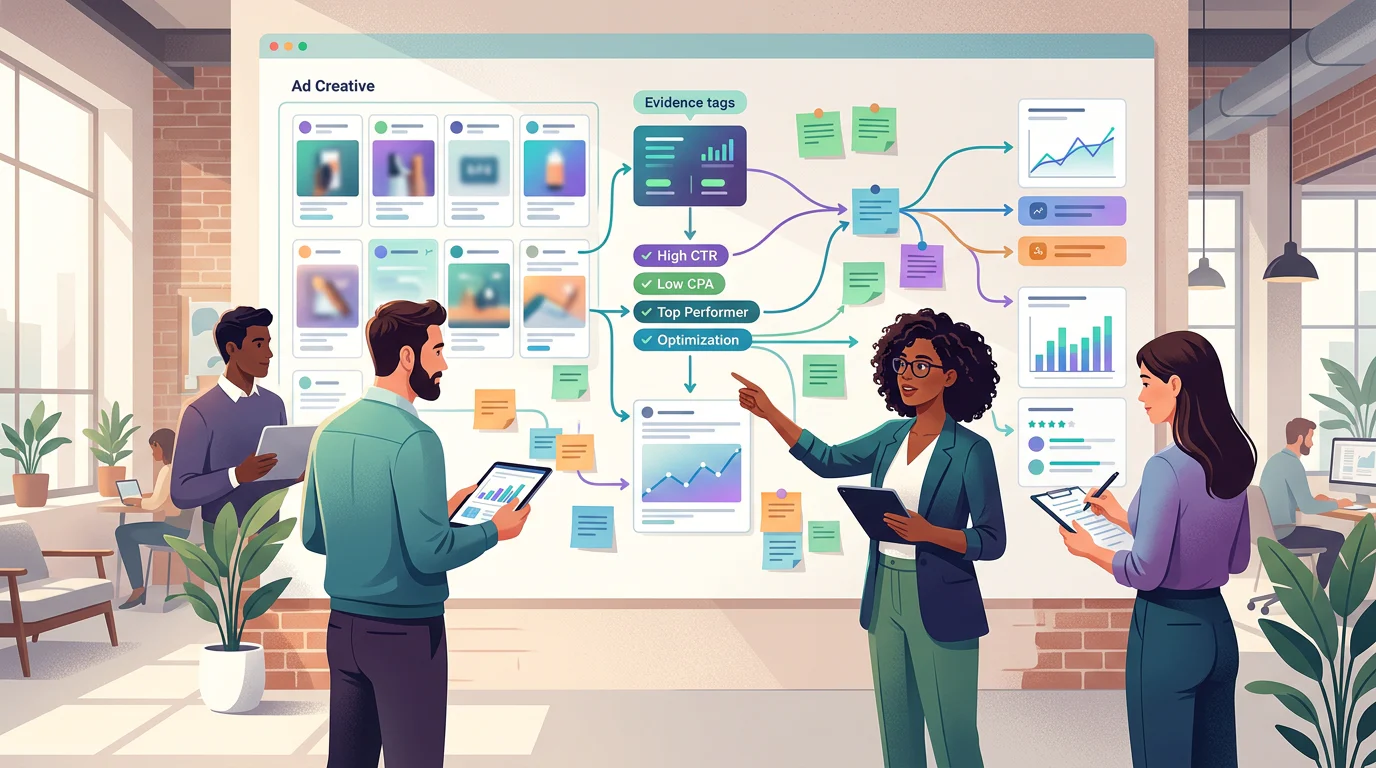
Creative testing is difficult because early delivery can be noisy, not because teams lack ideas. TikTok says performance volatility often declines after about 25 results or seven days, a useful reminder that an early dip is not automatically a failed creative direction.
AI creative-testing alternatives with stop-test recommendations differ in whether they generate assets, estimate potential, analyze live outcomes, or preserve test history. Teams that want to stop repeating losers should favor connected conversion evidence, element-level memory, explicit safeguards, and clear stop or pivot outputs over creative volume alone.
This comparison explains what each product category can prove, what it cannot prove, and how to choose a workflow that produces a defensible weekly test plan.
What Should a Stop-Testing Buyer Choose First?
The first choice is not “which tool has the most features?” It is whether your bottleneck is asset production or decision quality. A system that produces many new variants can be valuable, but it will not prevent a team from returning to the same failed hook, offer, or format unless someone records and applies the learning.
For teams with ad fatigue and an overloaded production queue, the useful output is a decision: test, continue, pivot, defer, or stop. That requires a testing memory that stores the creative context and its outcome, not just a gallery of finished ads.
| Buyer Need | Generation-First System | Prediction-First System | Analytics-First System | Decision-Intelligence System |
|---|---|---|---|---|
| Main Output | New variants | Pre-launch score or rank | Reporting and patterns | Ranked next action |
| Primary Evidence | Prompts, templates, brand assets | Model estimate, sometimes account history | Connected account metrics | Outcomes, memory, and market context |
| Can Prevent Repeat Failures? | Manually | Sometimes | Requires analyst interpretation | Yes, when failure evidence is retained |
| Appropriate Claim | Creates options | Estimates relative potential | Shows observed performance | Recommends a next move with stated evidence |
| Best Fit | Production bottleneck | Creative triage | Reporting bottleneck | Stop-testing and weekly planning bottleneck |
A good comparison starts by matching the tool to the decision your team cannot currently make. If the question is “what else can we create?”, generation may be enough. If the question is “which direction should never consume another week?”, the system needs a durable record of failure.
How Do the Main Product Types Compare?
Most platforms fall into four useful categories: generation-first, prediction-first, analytics-first, and decision-intelligence systems. Some span more than one category, but buyers should evaluate the evidence behind the output rather than relying on a broad feature label.
The matrix below is deliberately strict. “Not publicly documented” does not mean a capability is absent. It means a buyer should request proof in a demo, including the data source, recommendation logic, and any safeguard that prevents a premature stop decision.
| Capability | Generation-And-Prediction Systems | Analytics-And-Tagging Systems | Catalog Experimentation Systems | Decision-Intelligence Systems |
|---|---|---|---|---|
| Asset Types | Image, video, and variation generation | Connected creative previews and video analysis | Feed-based images, templates, and product video | Briefs, test concepts, and creative directions |
| Predictive Scores | Common | Sometimes available as proprietary metrics | Usually relies on live results | Should not be framed as conversion proof |
| Live-Account Data | Often connected | Central capability | Used for live testing | Central capability |
| Competitor Inputs | Varies | Often public-ad research | Usually limited | Public market observations paired with first-party data |
| Element Tagging | Basic to advanced | Often strong | Variables such as CTA and offer | Hooks, angles, formats, offers, and outcomes |
| Test Memory | Often asset history | Historical reporting and tags | Test-result records | Explicit “worked, failed, and why” record |
| Stop Outputs | Rarely explicit | Usually analyst-led | Usually analyst-led | Explicit stop, pivot, improve, or test-next output |
| Weekly Ranking | Rarely core | Often report-oriented | Review-oriented | Core planning output |
| Integrations | Ad accounts and creative tools | Social platforms and attribution tools | Catalog and ad channels | Account, feedback, and market-signal workflows |
| Pricing Check | Review credits and usage limits | Review data or spend limits | Review catalog and service limits | Review decision scope and data access |
A score can be useful when it helps a creative team prioritize review. It becomes risky when it is presented as proof that a new asset will generate purchases. Our prediction guide explains why a pre-launch estimate and an observed conversion result answer different questions.
A dashboard can surface useful trends without producing a recommendation. Teams should ask whether the system can turn performance patterns into a queue that names the next test, its evidence, the expected learning value, and the related direction to avoid. That distinction matters most when creative volume is already high and the real constraint is deciding which work deserves another round.
How Should Teams Decide Whether to Stop, Pivot, or Continue?
A stop recommendation must be more rigorous than “this ad has a weak metric today.” Delivery, attribution, audience mix, placement mix, and optimization phase can all change what a result means. The decision should be tied to a pre-set rule and enough evidence to apply that rule fairly.
Set a Minimum Evidence Rule
Set the threshold before launch. It might combine spend, conversions, time in market, and a comparison against the account’s normal CPA or ROAS range. The exact threshold is account-specific, because a high-volume store and a low-volume lead-generation business cannot use the same rule.
The rule should also define the comparison conditions. A creative has not cleanly lost if it received materially less delivery, ran against a different audience, or carried a different optimization event than its control.
Check Attribution Delay Before Calling a Loss
Downstream outcomes can arrive after the first click or impression. TikTok’s attribution analytics can show time to conversion, assisted conversions, and performance across attribution windows, which illustrates why teams should not judge every test from same-day results alone.
A strong operating rule states when results are mature enough to evaluate. It also records the attribution window used, so a future reviewer understands why an ad was stopped, continued, or revisited.
Separate a Failed Element from a Failed Ad
One underperforming execution does not necessarily disprove the broader angle. Tag the hook, offer, visual treatment, format, audience, placement, and landing-page context separately. That lets a team stop repeating a weak opening while preserving an angle that may work with a different proof point or format.
Use hook stop rules to define what has actually failed. A weak result can reflect a poor combination of audience, offer, timing, and delivery rather than the hook alone. When those conditions are stored with the test, future teams can reuse the useful learning without treating one result as a universal verdict. The record should distinguish a failed element from an inconclusive test, a fatigued winner, and an execution that needs revision before another round.
The review should also account for the purpose of the test. A prospecting ad built to introduce a new category may need different success criteria from a retargeting ad designed to convert existing demand. The same applies to formats, because a short video and a static product image can create different paths to conversion. Teams should document the original hypothesis, the primary metric, the fallback diagnostic metrics, and the time horizon before interpreting the result. This creates an audit trail that prevents a later reviewer from seeing only a weak metric without the context needed to explain it.
A consistent review process also prevents teams from moving the goalposts after launch. It asks whether the test had a comparable control, enough evidence, stable delivery, and adequate time for its chosen attribution window. Account-level Meta stop rules make those decision criteria explicit before the next production sprint begins.
What Evidence Can Competitor Benchmarking Actually Provide?
Competitor observation is valuable when it produces better hypotheses, not when it pretends to reveal another advertiser’s private economics. Public creative can show visible formats, claims, offers, calls to action, and whether an ad remains observable over time. It cannot reveal the business result behind that activity.
Meta’s public Ad Library says commercial ads appear within 24 hours of a first impression or update. That makes it useful for tracking current market activity, but not for inferring private ROAS, conversion rate, spend, targeting, or experiment design.
Use Public Signals as Context
A repeated competitor format may be worth researching, especially if it appears across a narrow vertical. It is still a market signal, not proof of performance. We recommend pairing observable activity with your own historical outcomes before deciding whether the pattern deserves a test.
Our signal comparison separates what teams can observe from what only first-party performance data can establish.
Apply One Taxonomy to Both Sources
Use the same labels for public and private creative: hook, angle, offer, format, proof type, CTA, creator style, and visual treatment. A shared taxonomy makes it possible to ask a useful question: “Have we already tested a similar direction, and what happened?”
That approach is more durable than saving inspiration in a folder. Teams should also record the observed date, market, platform, placement, and visible creative change, because public activity can change quickly. The goal is to build a trail of hypotheses that can be checked against your own outcomes, not to turn a competitor feed into an assumed performance leaderboard.
When one pattern keeps appearing, use it to form a testable question. Then compare the candidate concept with related historical tests in your account, identify the variables that differ, and state the evidence needed before deciding it is worth scaling. Continuous tracking supports that discipline by keeping observation separate from proof.
Grade the Evidence Before Acting
| Evidence Tier | Evidence Available | Safe Conclusion |
|---|---|---|
| Strong | Comparable delivery and attributed downstream conversions | The result was observed in this tested account context |
| Directional | Connected performance data with material confounders | The pattern warrants follow-up, not certainty |
| Diagnostic | CTR, retention, comments, or tagged elements | The creative needs investigation |
| Hypothesis | Predictive score or public competitor observation | The idea may deserve a controlled test |
The practical objective is not to eliminate judgment. It is to make judgment inspectable, so a team can explain why it stopped a direction and avoid restarting the same experiment six weeks later.
How Can Deepsolv Help Your Team Stop Repeating Losers?
At Deepsolv, we built the workflow for paid-social teams that have more ideas than clean decisions. We connect your creative history, account results, customer feedback, and observable market activity in one working record. Our system labels the evidence behind each recommendation, preserves failed hooks and formats, and ranks the next tests by confidence, expected learning value, and likely business impact. That gives creative and media teams a shared answer to two questions: what should we make next, and what should we leave alone?
We do not treat a public competitor ad, a high click-through rate, or a model score as proof of a conversion outcome. Instead, we keep those signals in context and help teams set explicit continue, pivot, and stop rules. If your weekly review still ends in more variations without a clear no-go list, we can help turn it into a durable decision system. Start a Deepsolv demo.
FAQs on AI Creative-Testing Alternatives with Stop-Test Recommendations
These answers address the evidence standards behind a responsible stop recommendation. They are designed for teams deciding whether to generate another variation, change direction, or preserve a lesson for future planning.
Can a Creative Score Prove an Ad Will Convert?
No. A score can prioritize review or launch order, but it cannot establish incremental conversions. Treat it as a hypothesis until comparable, attributed outcomes accumulate.
What Evidence Should Trigger a Stop Recommendation?
Stop only after delivery is comparable, the pre-set evidence threshold is met, attribution delay has been considered, and the outcome remains below the account-specific bar.
Can Public Competitor Ads Reveal Competitor Performance?
Public ads can show visible messages, formats, offers, and current activity. They cannot reliably reveal private spend, targeting, conversion rate, CPA, ROAS, or experimental design.
How Should Teams Record Failed Ad Formats?
Record the element, context, audience, placement, objective, delivery conditions, attribution window, evidence threshold, and result. Mark it as failed, inconclusive, fatigued, or promising for reuse.