
Competitor Messaging Tracking Alternatives Beyond Swipe Files
Competitor messaging tracking alternatives that log hook and offer changes, apply customer language, and prioritize tests with account data.

Public ad research changes quickly. Meta says ad changes can appear in its library within 24 hours, which makes a one-time screenshot a weak record of a messaging strategy.
Competitor messaging tracking alternatives are useful when they move past a saved-ad gallery: the strongest workflow preserves versioned competitor observations, groups hooks and offers, connects permitted customer language, and prioritizes your next test with authorized account results. Public activity can reveal a market pattern, but it cannot verify another advertiser’s spend, revenue, or conversions.
We compare the evidence each workflow can supply, show how to document messaging changes over time, and explain how to turn observations into testable creative decisions.
What Do Competitor Messaging Tracking Alternatives Need to Prove?
A basic archive solves a real problem: it stops useful references disappearing into bookmarks, chat threads, and screenshots. The incumbent workflow in this category supports saving, organizing, monitoring, and analyzing ads, but those activities answer different questions. Saving an ad helps a team retrieve inspiration. It does not establish whether the hook changed, whether an offer replaced another offer, or whether the pattern deserves budget.
That is the dividing line for competitor messaging tracking alternatives. We look for an evidence trail that starts with a visible creative observation and ends with a documented hypothesis for our own account. For teams moving beyond collections, our saved-ad guide explains why retrieval alone is not a creative decision system.
| Capability | Archive Workspace | Change-Monitoring Workspace | Own-Account Analytics Workspace | Deepsolv |
|---|---|---|---|---|
| Save and organize references | Core use | Useful secondary feature | Limited | Supported |
| Retain historical versions | Only if manually captured | Core requirement | Not a competitor-data function | Supported |
| Detect hook or offer changes | Manual comparison | Requires dated snapshots | Only for our ads | Supported |
| Analyze authorized account outcomes | No | No | Core use | Supported |
| Use permitted customer language | Usually manual | Usually manual | Usually separate | Supported |
| Draft hooks, scripts, or tests | Varies | Varies | Varies | Supported |
| Verified pricing, September 2, 2026 | Public vendor price only | Public vendor price only | Spend or quote terms vary | Demo or quote terms vary |
Public ad dashboards can still be valuable research inputs. TikTok’s Creative Center, for example, lets users sort curated ads by metrics including CTR and CVR, but its frame-level view uses an indexed 0 to 100 scale, not a competitor’s raw revenue or purchase data.
How Do You Track Hook and Offer Evolution over Time?
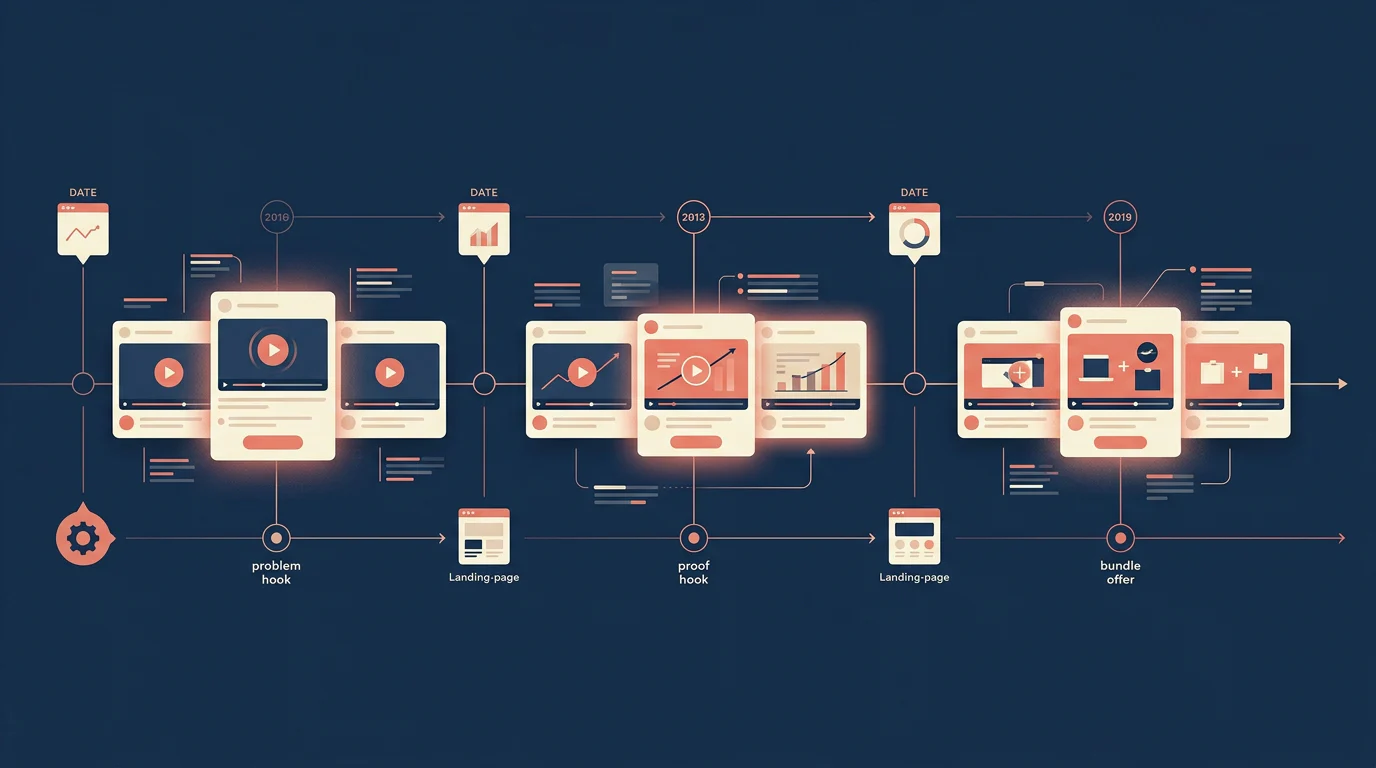
Messaging evolution is not a library of isolated ads. It is a sequence: a new problem statement appears, proof moves earlier in the video, a bundle replaces a discount, a landing page changes, then an earlier version disappears. A monitoring workflow needs to preserve those transitions so a team can distinguish a fresh launch from a genuine change.
What Should Every Snapshot Record?
Record the public source URL, capture time, first-seen date, last-seen date, ad or library ID, placement, format, hook transcript, offer wording, CTA, landing-page URL, and visual variant. The record should also identify who captured it and whether the landing page was available at the time.
That detail turns a vague observation into usable evidence. A team following a tracking workflow can compare successive captures without assuming that an active-status label explains why an advertiser kept a creative live.
How Should You Classify a Change?
Use a shared taxonomy. Hook types can include problem-first, proof-first, identity, mechanism, contrast, and offer-first. Offer types can include discount, bundle, guarantee, trial, shipping, urgency, and price anchor. Then classify the event itself: launch, removal, text edit, creative variant, offer change, landing-page change, or relaunch.
The taxonomy matters because it keeps a team from treating a new thumbnail as a new strategy. One new visual may carry the same underlying promise, while a small line of copy can signal an entirely different customer objection.
What Does a Messaging Timeline Look Like?
The timeline below is illustrative. It shows what a record should support, not what any advertiser’s activity proves.
| Week | Observed Event | Recorded Change | Required Evidence | Supported Conclusion |
|---|---|---|---|---|
| 1 | New ad appears | Problem-first hook | Snapshot and timestamp | A message entered the visible market |
| 2 | Variant appears | Proof moves into opening | Side-by-side captures | The hook structure changed |
| 3 | Offer changes | Bundle replaces standalone product | Ad and landing-page capture | The offer framing changed |
| 4 | Earlier version disappears | Removal or rotation | Last-seen timestamp | The version is no longer observable |
Which Gaps Should Trigger a Review?
A missing version can mean an ad was removed, hidden by geography, changed, or simply missed by the capture schedule. That is why we document uncertainty instead of making performance claims from longevity alone. When a visible change coincides with our own declining results, use a creative-fatigue analysis to separate market pressure from an exhausted angle.
How Should Customer Language and Account Results Shape the Next Test?
Competitor observations tell us what changed in the market. Customer language tells us how people describe the problem, desired outcome, or objection. Our own authorized account data tells us whether a creative decision produced a meaningful outcome. Keeping those three sources separate is the discipline that prevents an engaging public ad from becoming an unsupported conversion claim.
Which Customer Signals Belong in the Record?
Useful inputs include reviews, public comments, permitted DMs, surveys, support tickets, and sales transcripts. Each entry needs a source type, date, relevant excerpt, theme, frequency, permission or access basis, and a link to the hypothesis it informs.
We should also preserve context. A recurring phrase in support tickets may identify a friction point, while a single comment may simply suggest language to explore. Our feedback workflow turns that distinction into a repeatable handoff for creative teams.
How Do You Keep Language Separate from Proof?
Customer language can shape a hook, proof cue, script, or offer framing. It cannot prove that the resulting creative will convert. We use the language to write a hypothesis, then evaluate that hypothesis against an agreed metric contract in our own account.
There is also a compliance reason to retain provenance. The FTC’s consumer-review rule became effective on October 21, 2024, and it addresses deceptive practices involving reviews and testimonials. A source record protects both creative quality and review integrity.
What Belongs in a Test Brief?
A decision-ready brief has seven parts: the observed market change, the customer-language theme, the relevant past account learning, a proposed hook, the proof asset, the offer framing, and a success metric with a stop rule. The brief should identify its control, so the team knows what changed and what stayed constant.
That structure makes writing assistance useful rather than decorative. A drafted script should inherit the evidence behind the test, then feed its outcome into angle performance tracking after launch.
Which Workflow Fits Your Creative Decision?
No single source can answer every question. Public activity is useful for discovering patterns, customer feedback is useful for explaining language, and account data is useful for judging results. The right fit depends on the output a team needs next, not on how many ads a tool can display.
| Decision Needed | Best Evidence Source | Useful Output | Evidence Boundary |
|---|---|---|---|
| Save reference ads | Public creative observation | Searchable board or archive | Inspiration is not performance proof |
| Detect competitor change | Timestamped snapshots | Version timeline and alerts | Does not reveal spend or revenue |
| Understand audience wording | Permitted customer signals | Objection and language themes | Does not establish causality |
| Rank our next tests | Authorized account outcomes plus context | Prioritized test plan | Applies only to our account |
-
Deepsolv: Best for teams that need market observation, customer language, past learnings, and authorized account outcomes connected in one decision workflow. Evidence stays attached to the recommendation, while migration starts by mapping saved references and test history into a shared taxonomy.
-
Archive-First Workspace: Best for fast saving, tagging, sharing, and retrieving examples. Its drawback is that a large collection can still leave the team without version history or a reason to test one idea before another.
-
Monitoring-First Workspace: Best for dated records of launches, removals, edits, offer changes, and landing-page changes. Its drawback is that public monitoring cannot establish a competitor’s downstream results.
-
Own-Account Analytics Workspace: Best for analyzing our creative patterns against our authorized performance data. Its drawback is that it cannot explain the competitor move that created the initial hypothesis.
The essential distinction is outcome evidence. Our performance evidence guide shows why an observed competitor pattern and an account-level conversion result should be adjacent in a workflow, never confused as the same thing. Once the evidence is separated, use a structured prioritization method to decide what enters the next creative sprint.
Why Deepsolv Connects the Evidence
At Deepsolv, we built our platform for teams that have enough ideas but not enough defensible reasons to choose among them. We continuously observe competitor hooks, offers, and formats, bring in permitted feedback such as comments, DMs, reviews, and voice-of-customer material, and retain what your own account has already taught you. Our weekly plan turns those inputs into a focused queue: what to test, what to improve, what to stop, and why. You can keep the evidence behind each recommendation instead of asking your team to trust a black box. That matters when a visible ad is only a clue, a customer phrase is only a hypothesis, and a conversion event is the outcome that settles the question. If your team wants a repeatable, evidence-led way to turn market changes into stronger creative decisions each week with confidence, book a demo
FAQs on Competitor Messaging Tracking Alternatives
These answers clarify what public observations can establish and where authorized data becomes necessary. They also explain how to keep research, customer language, and test planning connected.
Can a Public Ad Tool Verify a Competitor’s Conversions?
No. Public libraries show visible creative, status, and sometimes dates, but only authorized first-party account data establishes purchases, CPA, ROAS, or revenue for your own account.
What Counts as Version History for a Competitor Ad?
Version history requires dated snapshots of creative, copy, offer, landing page, and status. A single activity label cannot identify what changed between two observations reliably.
Can Customer Comments Tell Us Which Hook Will Convert?
Customer comments reveal wording, objections, and desired outcomes. They create hook hypotheses, while controlled testing and authorized conversion data determine whether the creative change improved account results.
Should We Rank Ads by Longevity or Engagement?
Use longevity and engagement as research signals, not verdicts. Conversion-ranked planning requires clear metric definitions, authorized account data, and consistent attribution before teams allocate incremental budget.
Can Writing Assistance Replace a Creative Testing System?
No. Writing assistance drafts hooks, scripts, and briefs faster, but it needs tagged evidence, clear controls, and outcome feedback to produce compounding creative learning over time.