
AI Is Turning the Agency Commercial Model into Part of the Creative Brief: Automated Creative Brief Tools


TL;DR
We explain why AI is moving agency commercial logic into the creative brief, and how automated creative brief tools can connect faster production with accountable testing. We show the fields that protect measurement, governance, and budget decisions, then outline how we help paid-social teams turn evidence into the next creative action.
On 20 August 2026, LBB published a report arguing that AI is turning the agency commercial model into part of the creative brief. The timing matters because 83% in IAB research said their company had deployed AI in the creative process.
Automated creative brief tools are changing agency economics because they can turn brand inputs and performance evidence into faster, more structured test plans. The commercial value is no longer the number of assets produced or hours logged. It is the quality of the decisions, measurement, governance, and profitable actions that follow.
We separate the confirmed news event from the wider evidence behind it. We also show what a commercially useful brief needs before a paid-social team produces another variant.
What Happened on 20 August 2026
The confirmed event is the publication of the original report on 20 August. Its central framing is important: once AI reduces the effort needed to generate, adapt, and version creative, a brief cannot stop at describing what should be made.
That does not mean every agency should discard retainers, project fees, or specialist production. It means the brief now has to carry more of the commercial logic that used to sit elsewhere: the business outcome, the evidence required, the cost boundary, the decision owner, and the action that follows a result. For teams building paid-social campaigns, that change should make briefs more useful, not more bureaucratic. For more context on where AI is affecting social workflows, visit our insights.
We see this as a shift from output requests to decision requests. A request for six new videos becomes a documented choice about which angle, proof point, offer, or format deserves budget next.
Why Automated Creative Brief Tools Change the Commercial Model
The economic pressure is real, but it is not simply about producing assets at a lower cost. The IPA’s 2025 work, based on 63 qualitative interviews, found that agencies were still largely relying on time-and-resource pricing even when it no longer matched the complexity of their services. Its pricing research calls for a clearer conversation about value rather than inputs alone.
Automation raises the stakes because it can increase the number of possible creative variations without improving the quality of the choices behind them. That is why the best automated creative brief tools should not behave like an asset request form with a text generator attached. They should help a team define what it is learning, what counts as enough evidence, and what it will do with the answer. For an operating perspective on automation, read our AI agents guide.
The broader market is already moving toward more AI-supported creative production. IAB reported that 86% of digital video buyers were using or planning to use generative AI for video creative, while buyers expected AI-involved creative to make up 40% of ads in 2026 in its video study. That makes disciplined testing and durable creative memory more valuable, not less.
For paid-social operators, the practical question is not whether to automate every step. It is whether the workflow helps the team make better allocation decisions. Our AI statistics hub provides additional context on how rapidly these practices are changing.
What a Commercially Accountable Brief Contains
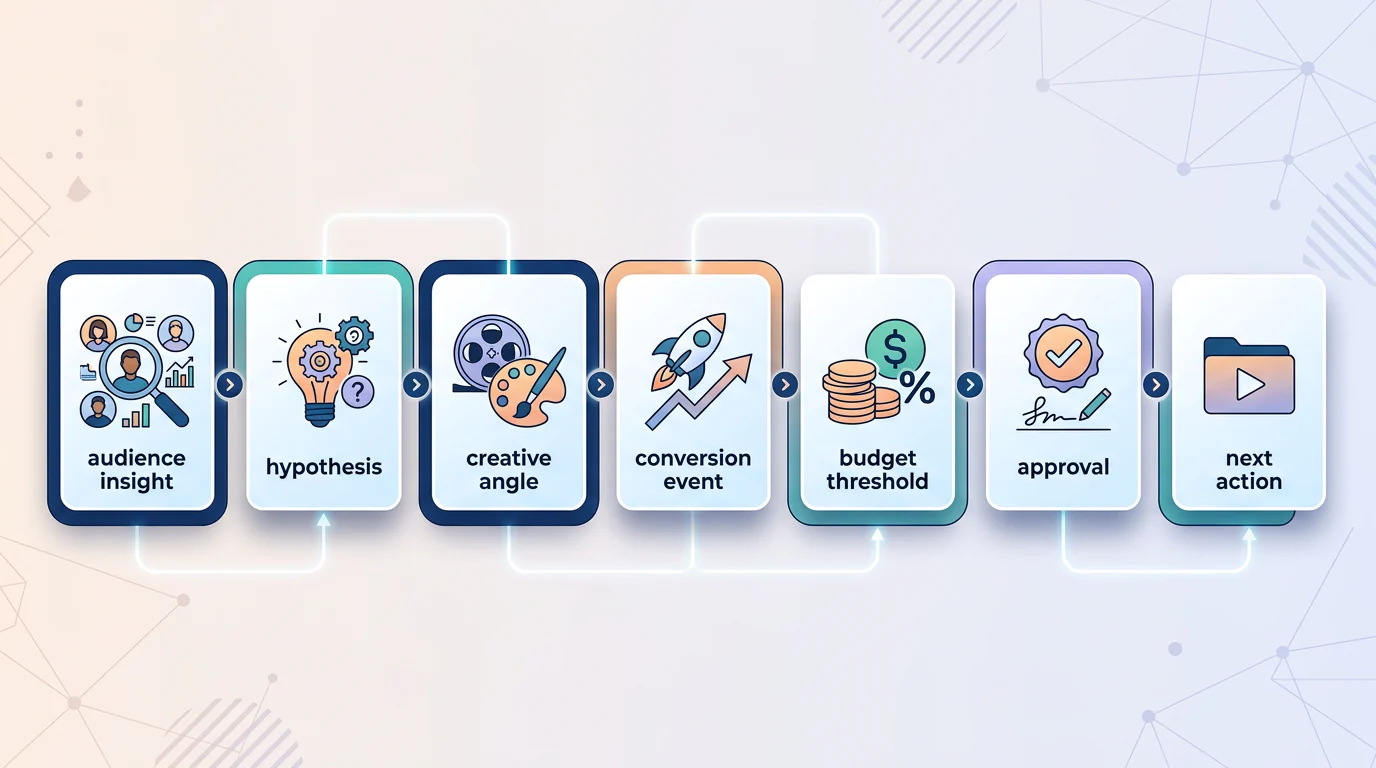
A strong brief gives creative, media, and growth teams a shared definition of value before production begins. It makes the testable commercial decision explicit, then connects the decision to a result the team can measure.
Name the Decision, Not Just the Deliverable
Start with the decision the team needs to make. It may be whether a new angle can beat the control, whether a product proof point reduces hesitation, or whether an offer deserves more spend.
A deliverable can still be part of the brief, but it should be in service of that decision. “Create three concepts” is incomplete unless the team knows which variable changes, why it matters, and which business result would support a next step. We apply this logic through our creative intelligence software.
Set the Measurement Before Production
The brief should name the conversion event, reporting window, primary metric, and limit on interpretation. A team that cannot explain how it will identify a winner should not confuse faster generation with a better testing system.
| Production-Led Brief | Commercially Accountable Brief |
|---|---|
| Requests formats and asset counts | Defines the decision to be made |
| Lists a target audience | States the hypothesis about that audience |
| Optimises for delivery speed | Sets a measurable success condition |
| Ends at asset approval | Defines the next action after a result |
| Treats each campaign as isolated | Preserves learning for future briefs |
Put Guardrails Around Budget and Governance
Include a test budget, stop rule, approver, and escalation path. These fields make the commercial agreement visible before creative work becomes live spend, and they reduce the chance that a weak signal becomes an expensive argument after launch.
Research on structured advertising inputs found that clearer fields can improve control, transparency, and brand alignment in AI-assisted creation. The structured-input study was small, involving 16 participants, but its lesson is useful: context should be captured in the workflow rather than recreated from memory.
Preserve the Learning
Every brief should record the original hypothesis, the concepts tested, the result, the confidence limit, and the next action. This creates an evidence layer that can inform the next production decision instead of rewarding the team for restarting from zero.
We recommend starting with clear test stop rules so the team knows when to pause, refine, or scale a concept. That makes the original commercial agreement practical when real campaign evidence starts arriving.
How to Use Automated Creative Brief Tools in Paid Social
Paid social is a useful proving ground because creative choices, spend, and outcomes can be connected more directly than in many other channels. The goal is not to force every brief into the same template. It is to make the commercial logic consistent enough that different teams can act on it.
A good workflow moves from signal to hypothesis, from hypothesis to a controlled test, and from the result to a documented allocation decision. Meta’s guidance similarly connects creative diversification, data quality, and test-and-learn measurement in its performance guidance.
Turn Signals into Testable Angles
Start with performance trends, audience feedback, competitor activity, customer questions, and product evidence. Then translate each signal into one variable a team can test, such as a hook, claim, visual proof, creator framing, or offer.
This protects against the common failure mode of producing many assets that all make the same argument. Our angle tracking guide can help teams separate repeated execution from genuinely different creative hypotheses.
Keep the Test Design Legible
A brief should make clear what is changing and what is being held stable. If the team changes the angle, visual treatment, offer, audience, and placement at once, the result will rarely answer a useful commercial question.
| Brief Field | Why It Matters | Example Decision |
|---|---|---|
| Test Variable | Isolates the learning | Does product proof outperform lifestyle framing? |
| Conversion Event | Connects creative to value | Does the concept improve qualified purchases? |
| Budget Boundary | Limits unproven exposure | How much spend can this test use before review? |
| Stop Rule | Prevents drift | When does the team pause a weak concept? |
| Next Action | Converts evidence into work | Scale, refine, archive, or test a follow-up angle |
Connect Creative to Reliable Outcome Data
Automation cannot compensate for weak measurement. The brief should identify the event that represents success and confirm whether the data path can support that decision. Meta describes its Conversions API as a way to improve measurement across website, app, offline, CRM, and messaging events in its API overview.
That does not make any single reported conversion definitive. It gives teams a clearer basis for comparing creative decisions, especially when the same evidence is carried into the next brief. A durable creative testing memory keeps those results available when the next hypothesis is formed.
Make the Next Action Mandatory
Every result should trigger one of four actions: scale, iterate, archive, or investigate. Requiring that choice prevents reporting from becoming a passive dashboard exercise and keeps the commercial model connected to the creative process.
Teams should document why a result led to its next action, including any limits in the evidence. That discipline keeps reporting connected to the commercial decision the brief was created to support.
Build the Evidence Layer with Deepsolv
At Deepsolv, we help paid-social teams turn scattered creative, audience feedback, and conversion evidence into a weekly, evidence-led decision system. Our work starts where production automation stops: we connect the reason a concept is being tested to the result it produces, then surface the next action for the team that owns paid spend. That makes it easier to write commercially useful briefs, distinguish a tired angle from a weak offer, and preserve what each test taught you.
We do not ask teams to treat every asset as a fresh experiment. We help them retain the context behind winners and losses, rank the tests that deserve attention, and give creative, media, and growth leaders a shared basis for action. If your briefs generate more output than learning, see how we can put evidence at the centre of every next creative decision across each weekly planning cycle with Deepsolv.
FAQs on Automated Creative Brief Tools
The questions below clarify where automation helps and where human commercial judgement remains essential. They also provide a practical standard for evaluating whether a briefing workflow is improving decisions.
What Are Automated Creative Brief Tools?
Automated creative brief tools turn approved inputs, evidence, and operating constraints into a structured brief. They help teams preserve context, but human owners still approve decisions.
Do They Replace Creative Strategy?
These tools can speed synthesis and version planning, but strategy still requires people to set commercial priorities, assess brand risk, interpret results, and make deliberate trade-offs.
What Belongs in an Automated Brief?
Include the business objective, audience, test variable, conversion event, budget boundary, timing, approval owner, success threshold, stop rule, and the action a result should trigger.
How Is Value Proven?
Value is proven when the brief links a creative decision to a measurable result, preserves the learning, and improves the next allocation of time, budget, or attention.