
AI Creative-Test Alternatives with Failed-Format Memory
Compare AI creative-test alternatives with failed-format memory, stop recommendations, next-test ranking, and benchmark evidence.
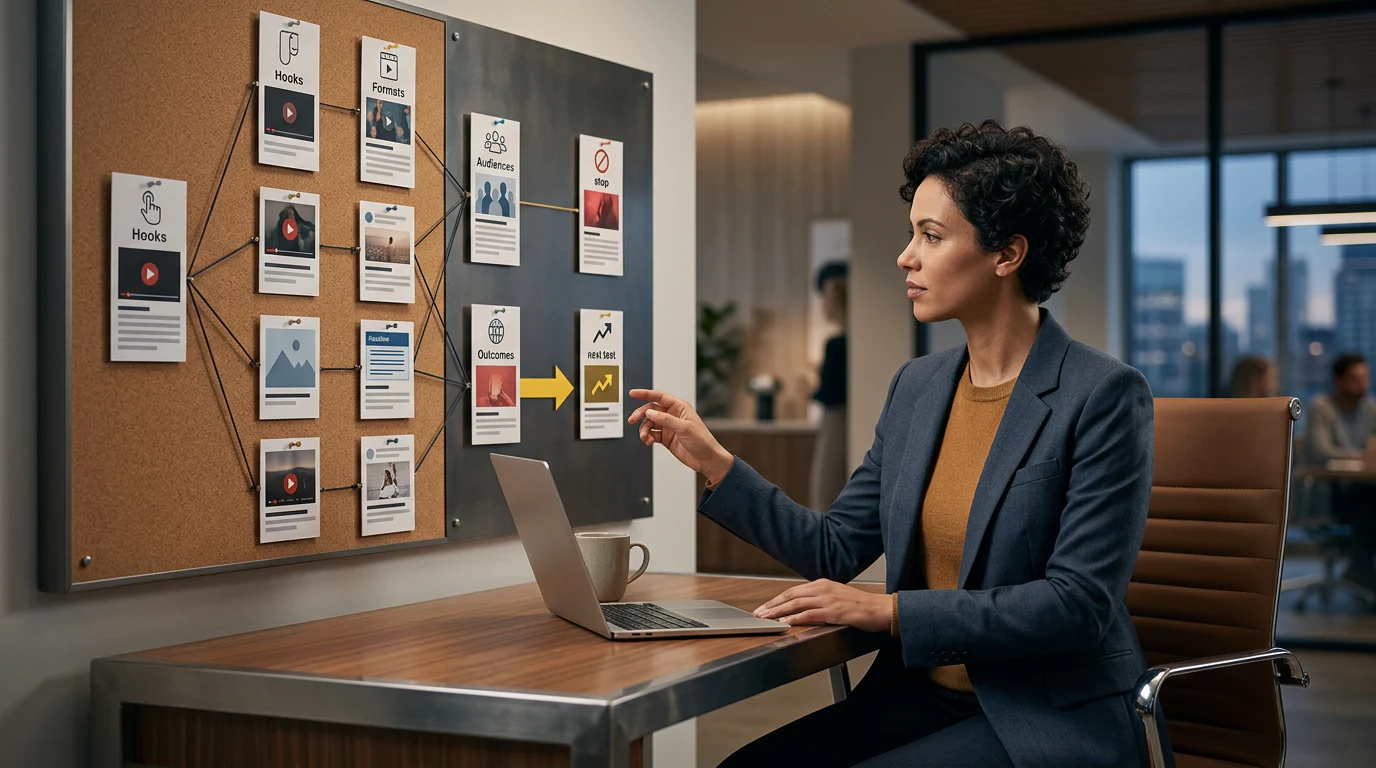
Creative testing only creates learning when a team can isolate the variable that changed. Meta’s testing guidance recommends allowing at least 14 days for sufficient data, which makes repeating an already-settled format especially expensive.
An AI creative-test alternative with failed-format memory must record what was tested, under what conditions, why it failed, and whether the result was conclusive. It should suppress unsupported repeats while allowing useful retests when the audience, offer, or execution changes. Generation volume and predictive scores alone do not prove that a system can recommend stopping or rank the next experiment.
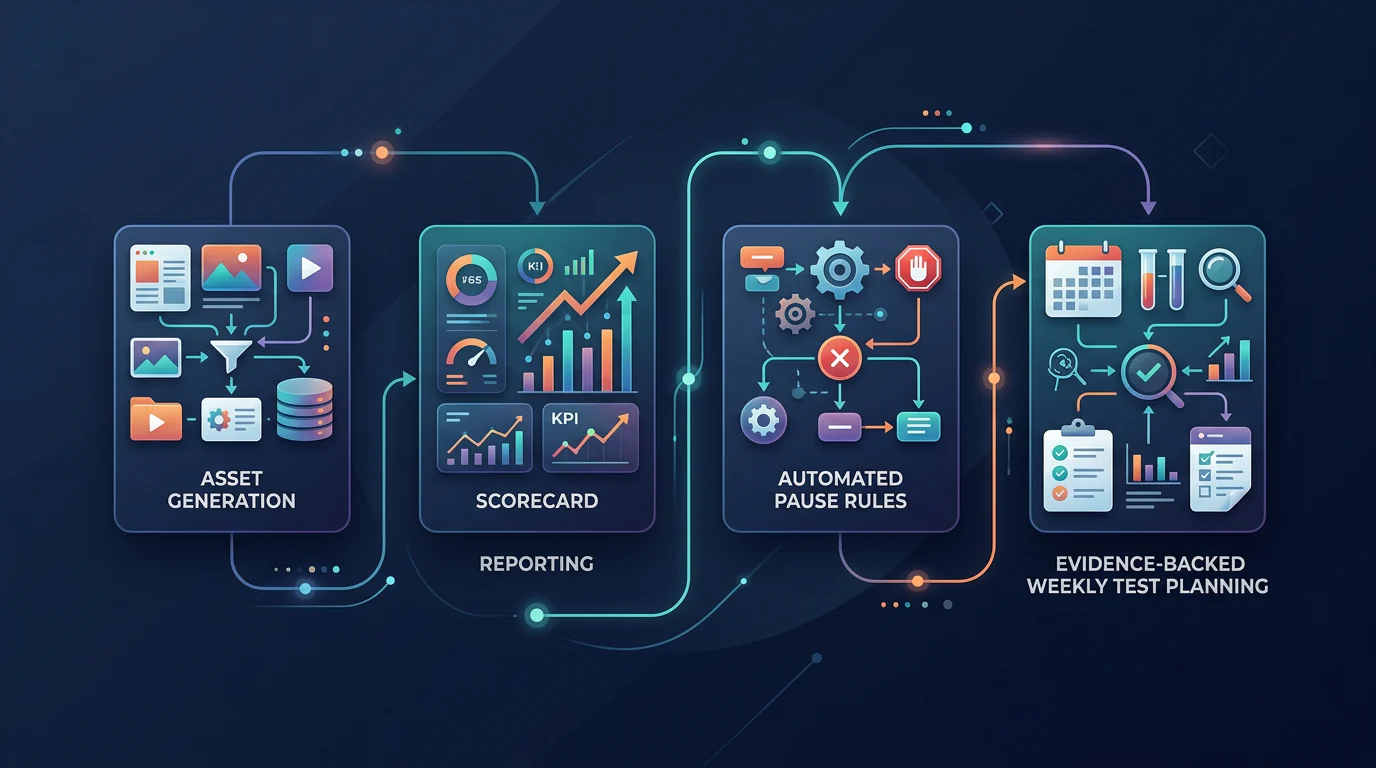
This comparison explains the difference between asset production, performance reporting, automated pausing, and a decision system that turns evidence into a ranked weekly test plan.
What the Current Generation and Scoring Workflow Covers
The incumbent generation-first workflow is capable of producing text, images, video, and ad creative, then connecting to media accounts for scores, insights, launch, and tracking. Its current plans scale monthly generation capacity, and its enterprise tier adds governance controls, bulk generation, and role-based access. That makes it a credible production and selection workflow for teams whose constraint is making more assets.
The narrower question for AI creative-test alternatives with failed-format memory is what happens after an ad loses. A score can rank variants in a batch, while a reporting view can show historical results. Neither necessarily preserves the underlying hypothesis, the delivery conditions, the audience, and the reason a format should not return. Our testing memory approach is built around that connected record, rather than a creative archive alone.
A useful evaluation asks whether the platform can answer five operational questions: What concept ran? What changed from its prior version? Did it receive a fair test? What caused the miss? What genuinely different experiment should replace it? If a tool cannot show that chain, a team still has to reconstruct it manually before deciding whether to stop.
How the Alternatives Compare on Failed-Format Decisions
A comparison should not award every “AI” feature the same value. Generation solves production capacity. Rules solve repeatable execution. A/B tests solve controlled measurement. A failed-format decision layer connects those jobs and makes the next recommendation accountable to prior evidence.
Public ad research is valuable context, but it is not a substitute for owned performance data. The Ad Library API exposes creative, advertiser identity, delivery dates, and placements, while most ordinary ads do not disclose commercial outcomes. We therefore treat observed market activity as a signal to investigate, not proof that a visible format is profitable.
| Evaluation Field | Deepsolv | Generation And Scoring Platform | Native A/B Test Workflow | Rule-Based Ad Manager |
|---|---|---|---|---|
| Memory Granularity | Concepts, hooks, offers, formats, outcomes, signals, and decisions | Assets, prompts, scores, and reports | Campaign and experiment records | Entity and metric conditions |
| Failure Diagnosis | Connects performance, fatigue, audience response, and test history | Often requires manual interpretation | Measures an isolated variable | Evaluates the configured threshold |
| Stop Recommendation | Deprioritizes repeated low-confidence ideas | Confirm during evaluation | Manual decision after review | Can pause when rules fire |
| Next-Test Ranking | Ranked weekly test plan | Usually variant selection | Team-defined | Not documented |
| Competitor Context | Public-market activity used as context | Confirm during evaluation | Public research is separate | Not primary |
| Benchmark Type | Owned results plus contextual market signals | Model score or historical comparison | Controlled account outcome | Account metric threshold |
| Generation | Decision-ready briefs, not asset generation | Core capability | Native creative tools | Not primary |
| Automation | Weekly planning and recommendation workflow | Workflow dependent | Test setup and reporting | Notifications, pauses, or budget actions |
| Verified Pricing | Tailored quote | Starts at $14 monthly for 50 generations | Platform access | Platform access |
The practical distinction is not whether a tool stores history. It is whether that history is organized into a reusable decision. Our benchmark distinction matters here: competitor activity can reveal a category pattern, while only your account data can establish whether your offer, audience, and execution converted.
Which Workflow Fits a Stop-Testing Problem?
The right alternative depends on the unresolved job. A team that needs more visual variants should not buy a decision layer instead of a production tool. A team that keeps funding recycled hooks, however, needs more than another creative score.
Generation-First Platform
A generation-first platform represents prompts, assets, formats, brand inputs, and sometimes predicted performance. It is useful when production speed is the bottleneck. Before treating it as a failed-format system, ask whether it stores a test hypothesis and whether a poor result is attributed to the concept, execution, audience, offer, or insufficient delivery.
Native Experiment Workflow
A native experiment workflow is strongest when a team can hold variables steady, define the success metric before launch, and read the outcome with discipline. It can establish causality for a specific question, but it does not automatically create a cross-campaign memory or select the next distinct hypothesis. Pair it with a stop-rule guide so the team defines what merits a pause before results arrive.
Rule-Based Ad Manager
Rule-based automation can pause an ad after an advertiser-defined condition is met. For example, official automated rules can monitor selected criteria and pause low-performing ads. That protects spend, but a threshold alone cannot tell whether a weak result reflects a dead format, a poor edit, or a test that never earned enough delivery.
Deepsolv Decision Intelligence
We built Deepsolv for the moment after a team has enough signals but not enough clarity. We connect competitor activity, customer feedback, historical ad performance, fatigue signals, and prior experiments to identify what should be tested, improved, or stopped. The output is a ranked weekly plan, with the evidence behind each recommendation visible to the people approving creative work.
How Failed-Format Memory Should Work
Failed-format memory is not a blacklist of every underperforming asset. It is a way to preserve a learning without preventing a justified retest. The workflow must distinguish a repeated concept from a genuinely different test.
Capture the Complete Test Record
Start with a single hypothesis and name the creative variables: audience, offer, hook, proof, format, visual treatment, landing-page match, metric, minimum delivery, and duration. This makes the result interpretable later. Our creative test framework helps teams avoid calling a collection of loosely related variants a test.
Classify the Result Before Calling It a Failure
A conclusive format failure has adequate delivery and clearly misses the predeclared outcome. An execution failure means the concept may still be viable, but the proof, edit, CTA, or page match was weak. A delivery failure means the test never received enough exposure. An inconclusive result means multiple variables changed or the evidence was too thin.
| Result Classification | What The Team Learns | Default Next Action |
|---|---|---|
| Conclusive Format Failure | The tested concept did not earn another similar attempt | Suppress close repeats |
| Execution Failure | The underlying idea may remain viable | Retest with one meaningful execution change |
| Delivery Failure | The result cannot answer the question | Fix setup before judging the concept |
| Inconclusive Result | The experiment did not isolate a learning | Redesign the test |
Add Stop Rules, Exceptions, and Approval
A stop recommendation should include the evidence threshold, the person who owns the decision, and the conditions for an exception. Automated pausing is appropriate only after those guardrails are agreed. We use this structure to preserve scarce testing capacity for concepts that add learning, not cosmetic variation.
Rank a Different Next Test
Once a format is suppressed, the next choice should differ in the audience tension, promise, proof type, offer, or execution mechanism. We rank ideas by evidence strength, novelty against prior tests, learning value, effort, and risk. Our concept prioritization process prevents a new headline from being mistaken for a new experiment.
How to Choose AI Creative-Test Alternatives with Failed-Format Memory
Start with the operational decision your team cannot make today. If the issue is slow asset creation, prioritize generation controls, brand safety, and production integrations. If the issue is unclear measurement, prioritize controlled testing and reporting. If the issue is repeated failed formats, prioritize memory, diagnosis, and next-test ranking.
Ask vendors to demonstrate a failed concept from end to end. Have them show the hypothesis, the relevant performance evidence, the delivery conditions, the classification of the result, the recommended action, and the specific reason the next test is meaningfully different. A polished dashboard without that trail is still a dashboard.
Also examine implementation requirements. A useful decision workflow needs access to the account outcomes, customer evidence, and market research your team already trusts. The process should make those inputs usable without claiming that external ad activity proves commercial performance.
Finally, make fatigue part of the choice. A once-successful format can decline because the market is saturated, the audience has seen it too often, or the offer no longer matches intent. Our fatigue diagnosis helps separate those causes before a team mistakenly kills a still-valid concept.
Why Teams Use Deepsolv for Weekly Test Decisions
We built Deepsolv for Meta growth teams that have no shortage of ideas, assets, dashboards, or visible competitor ads. Their constraint is deciding which work deserves the next production cycle. Our platform combines historical performance, customer comments and feedback, observed market activity, and prior experiments into a ranked weekly creative test plan. Each recommendation is designed to show what to test, what to skip, and why the evidence supports that choice.
That changes the working rhythm. Instead of asking a team to remember every failed hook across campaigns, we preserve the decision context behind it. Instead of treating a score as a verdict, we evaluate whether delivery was sufficient, whether the execution was fair, and whether a changed audience or offer justifies another attempt. We help teams reserve automated pauses for defined guardrails and reserve creative capacity for distinct tests. Talk to our team.
FAQs on AI Creative-test Alternatives with Failed-format Memory
Choose on evidence, not asset volume.
What Must a Tool Remember Before It Can Recommend Stopping a Format?
A useful record ties concept, audience, offer, format, execution, delivery, outcome, confidence, and decision together, letting future teams distinguish repetition from a justified retest clearly.
How Do We Separate a Failed Concept from Poor Execution?
Keep the concept constant, check delivery and conversion quality, then inspect proof, editing, CTA, and landing-page match before judging whether the core idea failed.
Can Public Competitor Ads Prove a Format Performs in Our Vertical?
No. Public ads reveal market activity and visible creative patterns, while controlled outcomes in your account establish whether the format works for your audience and offer.
Do Automated Pause Rules Replace Creative Test Planning?
No. Rules protect budget after thresholds fire, but they do not preserve hypothesis-level learning, diagnose a failure, or rank a distinct next experiment reliably.
What Should We Ask During a Product Demo?
Ask vendors to trace one failed test from hypothesis through delivery, diagnosis, decision, exception logic, and the next ranked concept using inspectable evidence throughout.