Which Ad-Intelligence Alternatives Fit Your Workflow?
Compare ad-intelligence alternatives for discovery, competitor strategy, messaging tracking, audience signals, and first-party creative learning.

A swipe file can accelerate creative research, but it rarely closes the loop from market observation to a valid test. TikTok’s Top Ads offers a 0-to-100 index for performance moments within a video, useful evidence but not proof that another brand can reproduce the result.
The right ad-intelligence alternatives depend on whether your bottleneck is discovery, strategic interpretation, or continuous learning. We use swipe files to collect examples, research workflows to classify hooks, offers, and objections, and longitudinal systems to preserve message changes. When recommendations matter, we connect those signals to our own test history.
This guide shows where each workflow starts and stops, how to compare their evidence, and how to choose a system without confusing a useful proxy for confirmed performance.
What Problem Are You Replacing with Ad-Intelligence Alternatives?
The first decision is not which product to buy. It is which unanswered question is slowing your creative team down. A team with too few examples has a discovery problem. A team that sees examples but cannot explain the promise, objection, or offer behind them has a strategy problem. A team that keeps repeating failed angles has a learning problem.
Those jobs overlap, but they require different evidence. Public ad sources can show what is visible. A classified research workflow can explain patterns across what is visible. First-party data can validate whether a pattern helped your account. That distinction matters because competitor activity creates hypotheses, while your account results determine whether to keep investing in them. Our guide to own performance data explains the boundary in more detail.
Use this decision tree before comparing any platform:
- Need more reference creative: Start with discovery, capture examples by category, and apply a consistent tagging system.
- Need to understand competitor strategy: Track the hook, promise, proof, objection, offer, format, and landing-page relationship over time.
- Need the next test to improve: Connect audience signals and creative observations to your own winners, failures, constraints, and account metrics.
The common mistake is treating those three jobs as interchangeable. More saved ads do not automatically produce better creative decisions. More reporting does not automatically explain what customers care about. More generated scripts do not automatically preserve what your team already learned.
What Does a Swipe-File Workflow Still Cover Well?
A swipe-file workflow is valuable when the bottleneck is retrieval. It gives a team a shared place to capture references, organize them by theme, and turn an interesting creative into a briefing input. It also reduces the cost of rediscovering examples scattered across browser tabs, messages, and personal folders.
The limitation is evidence depth. Meta makes active ads publicly visible through Meta’s library, but active status does not reveal profit, incrementality, or a brand’s internal decision rule. An ad that remains visible may be a successful control, a seasonal holdover, a regional variant, or a test that has not yet been paused.
A better research system preserves the saved creative, then adds dated observations and a reasoned classification. It should show whether the central hook changed, whether the offer was revised, whether proof moved earlier in the video, and whether the same underlying angle appeared in multiple executions. That is the difference between a reference library and continuous tracking.
Customer language adds another necessary layer. Comments, reviews, DMs, and community conversations can expose the concern an ad may be attempting to resolve, especially when the creative itself only hints at it. Our comment-analysis workflow turns those signals into testable angles without treating one comment as universal truth.
Which Ad-Intelligence Alternatives Fit Each Workflow?
Different tools can be useful, but only when their evidence inputs match the job. Public sources are strong for verifying what is currently visible. Native creative tools are useful for platform-specific inspiration. Our creative intelligence software is designed for teams that need those observations interpreted, remembered, and converted into the next creative decision.
| Workflow | Primary Evidence Input | Primary Output | First-Party Learning | Writing Support | Verified Public Price |
|---|---|---|---|---|---|
| Meta Ad Library | Active ads | Creative examples | No | No | Free |
| TikTok Creative Center | Authorized high-performing ads, trends, keywords | Platform-native inspiration | No | Native creative tools available | Free |
| Google Ads Transparency Center | Verified advertiser ads and disclosures | Advertiser and ad visibility | No | No | Free |
| Our Deepsolv Workflow | Competitor ads, audience signals, account performance, past tests | Prioritized creative decisions | Yes | Hooks, scripts, and statics | Not publicly listed |
Meta Ad Library
Best for: Verifying currently active Meta creative and building a manual reference set.
Evidence inputs: Active ads visible from advertiser pages.
Output: Ads that a team can capture, date, tag, and review.
Limitation: It does not establish a commercial ad’s profitability or remember your brand’s test outcomes.
Pricing: Free public access.
TikTok Creative Center
Best for: Finding platform-native creative inspiration, trends, keywords, and authorized high-performing examples.
Evidence inputs: Top Ads, trend data, keyword insights, and creative guidance. TikTok describes its Creative Center as a free public resource for ad examples, trends, and creative tools.
Output: Platform-specific inspiration and production inputs.
Limitation: The platform signals do not explain whether an angle fits your offer, audience, margin, or account history.
Pricing: Free public access.
Google Ads Transparency Center
Best for: Checking advertiser identity and ads across Google properties.
Evidence inputs: Verified advertiser disclosures, creative, dates, and locations.
Output: Searchable advertiser and ad visibility. Google’s advertiser policy says people can search advertisers and view information about their ads.
Limitation: It is not a creative-learning system and does not turn observations into an account-specific test plan.
Pricing: Free public access.
Our Deepsolv Workflow
Best for: Teams that need audience-driven angles, competitor-message analysis, creative test memory, and next-step recommendations.
Evidence inputs: We combine competitor ads, comments, reviews, DMs, relevant audience conversations, ad metrics, fatigue signals, and past experiments.
Output: We classify the reasons behind an angle, draft hooks and scripts, and rank what to test, improve, or stop next.
Limitation: Teams should confirm the account connections, source coverage, and implementation requirements relevant to their workflow.
Pricing: We provide pricing through a tailored conversation rather than a public self-serve price.
For teams comparing strategic workflows rather than another archive, our overview of strategic ad intelligence explains the decision layer between ad discovery and creative execution.
How Do Their Signals Compare over Time?
The strongest competitive analysis labels the certainty of every conclusion. An observation is not a verdict. Active status is observed. A recurring message theme is inferred. A profitable creative decision is validated only when your own account data supports it.
| Signal | What It Can Support | What It Cannot Confirm | Appropriate Label |
|---|---|---|---|
| Active ad | The creative was visible when checked | Profitability or scaled spend | Observed |
| Long-running ad | The same execution persisted across dated checks | Why it stayed active | Observed |
| Repeated theme | A hook, offer, or proof pattern recurs | That every variation performed well | Inferred |
| Platform-selected top ad | It met that platform’s inclusion criteria | Cross-brand profitability | Observed |
| Account result | Performance in your account and measurement setup | Universal market performance | Validated |
Active Creative
An active ad is a point-in-time observation. Capture the date, region, format, copy, destination, and creative version. Do not rename it a winner simply because it is visible.
Long-Running Creative
A long-running creative requires repeated checks, not one start date. Record first observed, last observed, and material edits. If an ad disappears, label it absent on the next check, not failed.
Scaled Theme
A scaled theme is stronger than a long-running ad because it looks for recurrence across multiple executions. We look for repeated hooks, proof devices, offers, or formats, then separate the recurring idea from individual assets. TikTok’s Top Ads guide can reveal platform-level performance moments, but those signals should remain separate from a competitor’s unknown conversion economics.
Positioning Change
Positioning changes become visible when a brand changes who it addresses, what it promises, how it proves the promise, or what risk it removes. We date-stamp each change so teams can distinguish a new campaign from a new strategy.
That history matters internally too. A useful system should preserve why a concept won or failed, not merely keep a file of assets. Our creative test memory framework focuses on keeping the hypothesis, evidence, decision, and next action together.
How Should Teams Evaluate and Choose a Workflow?
Evaluate every option with the same inputs. Choose ten direct or pattern competitors, collect the same set of ads, review the same audience conversations, and use the same date window. If one product cannot retrieve or classify the required evidence, that limitation should be visible before the buying decision, not after implementation.
Then ask each system the same questions: What are the recurring hooks? Which objection is each hook addressing? What changed in the offer or proof? Which conclusion is observed, inferred, or validated? Can the tool remember that our team already tested this angle and why we stopped?
Use One Test Brief
Require every workflow to produce the same brief, even if the final output is manual. It should include the audience signal, hypothesis, hook, proof, offer, format, success metric, and stop condition. This makes a discovery tool, research tool, and learning system comparable without pretending they do identical work.
Test Whether Learning Compounds
Ask the system to retrieve one prior winner and one prior failure, then explain how each should change the next test. If it cannot recover the reasoning behind both, it stores assets more effectively than it learns.
Match the Choice to the Bottleneck
Use public sources when discovery is the only problem. Use a classification workflow when your team needs to explain competitor hooks, offers, and objections. Use a first-party learning workflow when the costliest failure is repeating work your brand has already done. Our test prioritization process helps teams rank those hypotheses, while clear stopping criteria keep promising ideas from becoming endless tests.
How Deepsolv Turns Research into Creative Decisions
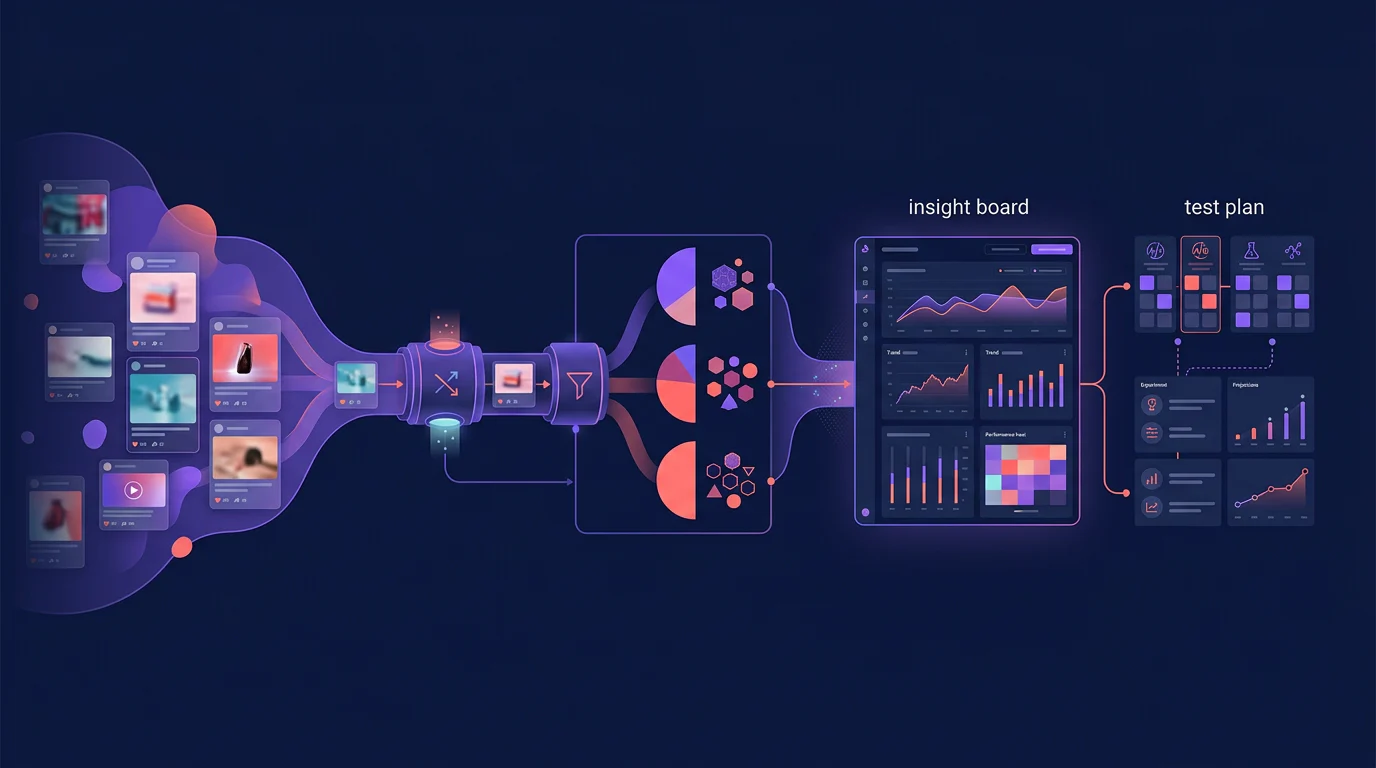
Deepsolv is for teams that want research to become a repeatable decision system. We bring together competitor creative, customer feedback, ad performance, fatigue signals, and past experiments so our recommendations begin with evidence instead of a blank prompt. Our Brand Brain records what worked, what failed, and which constraints matter, helping teams avoid rerunning a discarded angle or losing the reasoning behind a winner. We then turn those inputs into a weekly test plan, with hooks, scripts, statics, and clear reasons to test, improve, or stop a concept. The important question is not whether a dashboard contains more ads. It is whether it preserves the market context and first-party learning your team needs for the next decision. See how our workflow fits your account, research process, and creative cadence before committing to another monthly workflow when you book a demo
FAQs on Ad-intelligence Alternatives
Can Active Ads Prove a Theme Is Profitable?
No. An active creative proves visibility, not profitable scale. Treat duration, variation frequency, and platform labels as research clues until your own account data validates the hypothesis.
How Do We Identify a Long-Running Theme?
Use dated observations across several checks, then separate an individual creative’s observed lifespan from recurring hook, proof, offer, or format themes. Label the distinction clearly.
Can Audience Conversations Validate an Angle?
Audience conversations surface language, anxieties, desires, and trust gaps. They do not replace conversion evidence, so we turn them into hypotheses that require disciplined testing.
What Should a Creative Learning System Remember?
A useful system should retain both results and reasoning: audience, hook, offer, format, constraint, metric, confidence, and the next decision for future creative tests.
What Should Teams Verify Before Buying?
Check source coverage, data freshness, dates, classification logic, alert rules, account connections, export options, writing controls, and treatment of failed tests before buying.