Why Your Engagement Drops Even When Ads Perform Well (And How to Fix It in 2026)
6 min read
Published: 11/28/2025
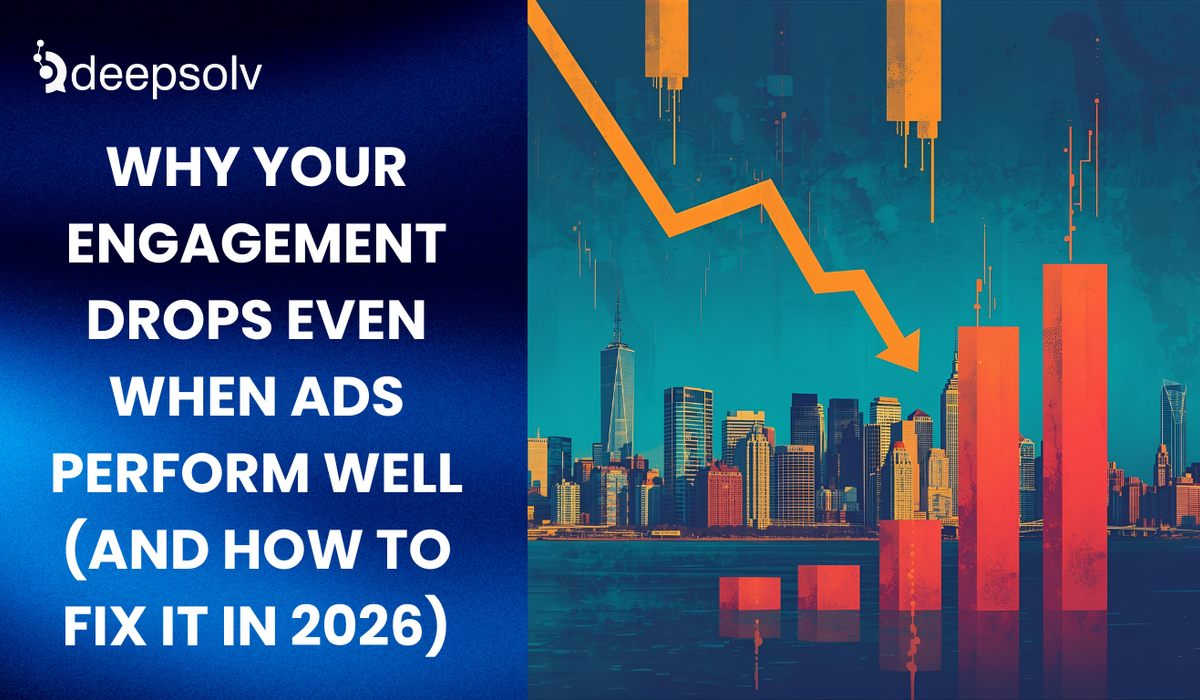
If your Instagram ads are generating clicks, leads, or even purchases, but your organic engagement is quietly declining — fewer likes, fewer comments, weaker community signals — you’re not imagining things.
This disconnect is becoming one of the most common growth problems brands face heading into 2026.
On paper, your ads look fine. In reality, your brand feels… quieter.
And that silence matters more than most marketers realize.
Because in 2026, ad performance and engagement performance are no longer separate systems. They feed each other. When one weakens, the other eventually follows.
This blog breaks down:
- Why engagement drops even when ads perform well
- The hidden signals Instagram’s ecosystem actually rewards
- And exactly how to fix low engagement on Instagram while improving ad performance, not at the expense of it
Let’s unpack what’s really happening.
The Silent Problem Most Brands Miss
Here’s the uncomfortable truth:
Ads can convert even when people don’t care about your brand.
Short-term? That’s fine. Long-term? That’s dangerous.
In 2025, many brands optimized their Meta Ads purely for:
- Lowest CPA
- Fastest conversions
- Shortest path to checkout
What they unintentionally trained the algorithm to do was:
- Show ads to people who buy, but don’t engage
- Optimize toward transactional behavior, not emotional resonance
- Strip context, story, and community out of the funnel
The result?
- Ads keep “working”
- Organic engagement declines
- Brand signals weaken
- Conversion costs slowly creep up
- Retargeting pools become colder and less responsive
If you’re trying to improve Instagram ads performance but feel like engagement is leaking somewhere in the system, this is why.
Why Engagement Drops Even When Ads Are “Successful”
Let’s break this down into the real causes brands experience.
1. Your Ads Are Optimized for Action, Not Affinity
Meta’s ad system is brutally honest.
If you tell it:
“Find me people most likely to convert”
It will do exactly that.
But those people are not always:
- Commenters
- Sharers
- Community participants
- Brand advocates
They’re often:
- Quiet buyers
- Deal-sensitive
- Comparison shoppers
- People who never follow you after purchasing
So while your ads may convert, they do not create engagement gravity.
Over time:
- Your posts reach fewer people organically
- Comments dry up
- Saves and shares drop
- Instagram’s organic distribution deprioritizes your content
This is the #1 reason brands struggle to fix low engagement on Instagram despite strong ad metrics.
2. Your Ad Creative Is Isolated from Your Content Ecosystem
Many brands treat ads as a separate universe:
- Polished
- Aggressive
- Offer-driven
- Conversion-only
While organic content is:
- Softer
- Community-led
- Educational or aesthetic
When users jump from ad → profile:
- The tone changes abruptly
- The story breaks
- The brand feels inconsistent
This kills engagement.
People might buy — but they don’t stick around.
In 2026, Instagram rewards continuity, not just performance.
Your ads are no longer just acquisition tools. They’re entry points into your brand narrative.
3. Engagement Signals Are Being Ignored in Optimization Loops
Instagram doesn’t just look at:
- Clicks
- Conversions
- CPA
It also evaluates:
- Comment velocity
- Saves and shares
- Meaningful interactions
- Conversation depth
If your ads generate:
- Clicks without comments
- Purchases without discussion
- Views without saves
Your engagement ecosystem weakens.
This eventually affects:
- Organic reach
- Ad relevance
- Retargeting efficiency
Which is why brands often notice:
“Our ads still convert, but ROAS is harder to scale.”
4. Over-Reliance on “Winning” Creatives Causes Emotional Fatigue
When a creative works, teams tend to:
- Run it longer
- Scale it harder
- Milk it aggressively
Performance stays decent — but engagement drops.
Why?
Because:
- People have already processed the message
- There’s nothing left to react to
- It feels repetitive, not stimulating
This is creative fatigue at the emotional level, not just impression frequency.
And emotional fatigue kills engagement first — before it hurts conversions.
Why This Problem Will Get Worse in 2026 (If Unfixed)
Looking ahead:
- Meta is leaning harder into AI-driven optimization
- Organic reach is increasingly signal-dependent
- Paid and organic data loops are merging
- Community signals are becoming quality filters
Which means:
- Brands without engagement depth will struggle to scale ads
- CPA may rise even if targeting stays strong
- Retargeting pools will degrade faster
- Paid traffic becomes more expensive to sustain
If your goal is to boost Instagram conversions sustainably, engagement is no longer optional.
It’s infrastructure.
How to Fix Low Engagement on Instagram Without Hurting Ads
Now the important part: solutions that work together, not against each other.
1. Rebuild Ads as Engagement-First Entry Points
Instead of asking:
“Does this ad convert?”
Ask:
“Does this ad invite a reaction?”
High-performing ads in 2026 often:
- Ask a question
- Trigger agreement or disagreement
- Reflect a shared frustration
- Feel like a post, not a pitch
Example shift:
- ❌ “Buy this skincare routine today”
- ✅ “Why most skincare routines fail after 30”
The second still converts — but it also invites comments, saves, and discussion.
This is how you improve Instagram ads performance and engagement simultaneously.
2. Use Engagement as a Qualification Layer, Not a Vanity Metric
Not all engagement is equal.
What matters:
- Comments with intent
- Saves over likes
- Replies over reactions
- DM conversations over emojis
Brands that fix engagement issues successfully:
- Track comment quality, not volume
- Identify which ads spark real conversations
- Feed those insights back into creative strategy
This is where Creative Intelligence Platforms outperform basic ad managers — because they don’t just measure clicks, they read patterns.
3. Sync Ad Messaging With Organic Content Themes
Your ads shouldn’t feel like a detour from your profile.
They should feel like:
“This is exactly what this brand talks about.”
Best practice:
- Ads introduce the idea
- Organic content deepens it
- Stories continue the conversation
- DMs close the loop
This alignment dramatically helps fix low engagement on Instagram because users feel continuity, not disruption.
4. Turn Comment Sections Into Micro-Communities
Most brands still treat ad comments as:
- Noise
- Moderation problems
- Or ignored entirely
This is a huge mistake.
In 2026:
- Comment sections are algorithmic signals
- Conversations extend ad lifespan
- Replies create social proof loops
Brands using AI Strategists (not simple reply bots) now:
- Nudge discussions forward
- Answer contextually
- Turn questions into DMs
- Convert engagement into relationships
This is where engagement stops being “nice to have” and starts boosting Instagram conversions directly.
5. Introduce Creative Variation Before Performance Drops
Instead of waiting for:
- CPA spikes
- CTR drops
- Frequency warnings
High-performing teams:
- Rotate emotional angles early
- Test narrative variations, not just formats
- Refresh hooks while keeping core insight intact
This prevents:
- Emotional fatigue
- Engagement decay
- Audience blindness
And keeps both ads and organic content feeling alive.
The Missing Layer Most Brands Still Don’t Have
Here’s what separates brands that recover engagement from those that don’t:
They build an audience insight loop.
Meaning:
- Ad comments inform content themes
- DMs reveal objections
- Engagement patterns shape future creatives
- Creative intelligence feeds media strategy
This is why platforms like Deepsolv don’t talk about “automation” anymore.
They focus on:
- Creative intelligence
- AI Strategists
- Data-driven creative optimization
- Continuous feedback loops between paid and organic
Because engagement is not a metric. It’s a signal system.
What Fixing This Actually Looks Like in Practice
Brands that successfully:
- Improve Instagram ads performance
- Fix low engagement on Instagram
- Boost Instagram conversions
Usually see:
- Higher comment-to-impression ratios
- Stronger retargeting performance
- Lower CPA volatility
- Better creative longevity
- More predictable scaling
Not overnight. But sustainably.
Final Thought
If your ads are performing but your engagement is dropping, the platform isn’t broken.
Your strategy is incomplete.
In 2026, winning brands won’t ask:
“Do my ads convert?”
They’ll ask:
“Do my ads connect?”
Because connection is what compounds. Conversion just follows.
If you want help rebuilding that connection layer without sacrificing performance — that’s exactly what we help brands do at Deepsolv.
And the brands that fix this now?They won’t be fighting rising costs later.