Deepsolv Blog
Deepsolv Blog
Backed by






Creative Decision Intelligence for Meta growth teams. Know what to test next — before you spend on it.
Follow Deepsolv on InstagramFollow Deepsolv on LinkedInFollow Deepsolv on TwitterAll rights reserved © 2026 deepsolv.ai
7 min read
Published: 2/14/2026
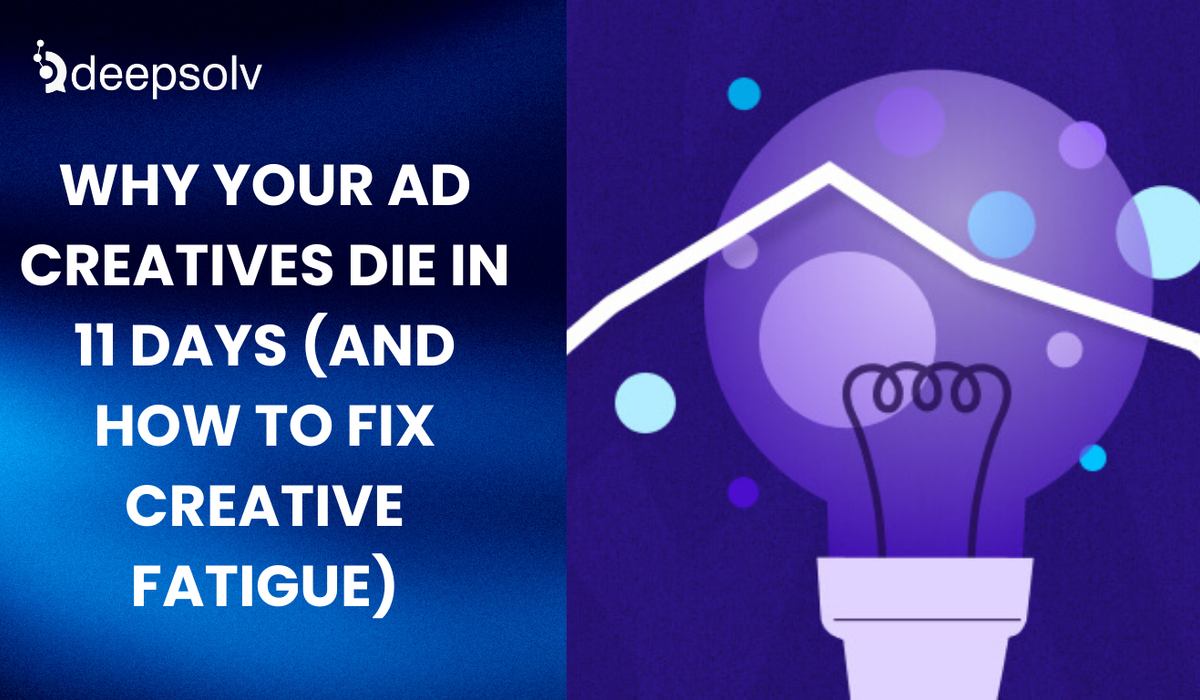
Your ads are dying faster than you think. The median Meta ad loses 50% of its original CTR by day 11 (Alison.ai study, 1,047 campaigns, 240M impressions). Creative fatigue kills performance by up to 35%, yet most advertisers don't catch it until their CPA has doubled.
The brutal truth: by the time you notice declining ROAS, creative fatigue has been draining your budget for days.
Most advertisers think their ads last 2-4 weeks. The data tells a different story.
Days 1-3: Peak Performance CTR stabilizes after learning phase (2.3% Feed, 1.9% Reels for strong performers). Frequency sits at 1.4. First-time impression ratio is 62%. This is your honeymoon period.
Days 4-7: Early Decline Frequency climbs to 2.8. First-time impression ratio drops to 46%. CTR falls to 1.6% (30% decline). Most advertisers miss this shift because overall performance still looks acceptable.
Days 8-12: The Cliff Quality Ranking drops to "Below Average." CPC rises from $0.95 to $1.28. CPA increases from $24 to $36 while landing page CVR holds at 4.1%. By day 11, you've lost half your original CTR.
Week 3+: Death Spiral Only a "consistent minority" of slow-fatigue creatives stay strong past 3 weeks—and those required strategic refreshes.
The gap between "still running" and "still performing" is where most ad budgets die.
For more on identifying creative fatigue early, Jon Loomer's diagnostic framework provides additional tactical guidance on monitoring trends over time.
Three structural shifts have accelerated creative fatigue:
Meta's Advantage+ delivery rewards what's already working and keeps pushing it until engagement drops. Once you have a winner, the algorithm concentrates delivery quickly. That efficiency is what burns it out.
Reels fatigue faster than Feed because consumption is rapid and immersive. Users recognize patterns within days.
With iOS 14+ tracking restrictions and smaller retargeting pools, your audience sees your ads more frequently. Fatigue happens faster when the same 5,000 people get hammered with the same creative.
Small creative pools force algorithms to over-serve the same assets. Once frequency climbs, CPM follows. When CPM rises without scale, fatigue is already at work.
The fundamental problem: Most teams can't produce fresh creative fast enough to match the rate at which their ads fatigue.
When Meta detects fatigue, it throttles delivery even when your budget stays the same. You're not just getting worse performance—you're getting less reach.
Meta's creative fatigue labels:
By the time you see these warnings, you've already wasted significant budget.
Rising CPC + declining CTR + algorithmic throttling = exponential cost increase. An ad that was profitable on day 5 can be underwater by day 12.
Example: A DTC brand spending ₹30L/month with a 14-day average creative lifespan loses ~₹6.5L monthly to fatigue (assuming 35% effectiveness decline in the final week before refresh).
Don't wait for Meta's "Creative Fatigue" warning. Watch for these early signals:
✅ Declining CTR: 20%+ drop from 7-day average
✅ Rising Frequency: Above 3-4 for cold audiences, 5+ for retargeting
✅ Falling First-Time Impression Ratio: Below 50% (means you're re-showing to the same people)
✅ CPM increase without scale: Higher costs but reach isn't expanding
⚠️ Rising CPC: While CTR drops (audience tuning out)
⚠️ CPA spike: 40-50% increase with stable downstream CVR
⚠️ Quality Ranking drop: Meta labels your ad "Below Average"
⚠️ Creative Fatigue label: In Ads Manager delivery column
The diagnostic test: Launch a new creative cut with the same offer and targeting. If CTR recovers and CPC drops within 24-48 hours while the control keeps sliding, it's fatigue.
The Color Swap Fallacy Changing backgrounds from blue to yellow or swapping button colors doesn't reset fatigue. These are cosmetic tweaks, not creative refreshes.
What actually works: New hooks, different angles, fresh messaging frameworks.
Example that failed:
Example that worked:
The creative concept changed, not just the visual wrapper.
Most teams respond to fatigue by launching 10 random new concepts and hoping something works. This burns budget testing ideas that never had a chance.
The gap: Testing capacity is finite. If you launch 10 ads and 7 were never going to work for your ICP, you've wasted 70% of your testing budget.
Waiting until performance crashes (day 12+) means you've already lost days of profitable spend. By the time you produce and launch new creative, you're bleeding budget.
High performers don't react to fatigue. They prevent it.
The best advertisers have a 2-week creative rotation cadence with fresh variations ready before fatigue sets in.
Workflow:
This maintains continuous novelty without rebuilding from scratch.
Angle rotation (the underlying reason someone should care) resets attention more than visual rotation (how it looks).
Example (DTC skincare):
Same product. Different psychological frame.
Build creative systems where you can swap hooks, bodies, and CTAs independently without full rebuilds.
Andrew Cussens, FilmFolk: "A core narrative with interchangeable beats allowed us to create 40+ variants from one shoot and keep performance strong for 8-12 weeks."
This modular approach is essential for maintaining creative velocity. For more tactical frameworks on building fatigue-resistant creative systems, consider establishing structured refresh cycles with varied formats and hooks.
Don't test random ideas. Test high-probability winners based on what's working in the market.
Post-launch creative analytics platforms help identify which of your existing ads are performing, but they analyze what already happened—not what to test next.
This is where most teams hit a bottleneck: How do you know which concepts to test next?
You know you need fresh creative every 10-14 days. The problem isn't production—it's knowing what to produce.
The typical workflow:
Many teams try to solve this by manually analyzing competitor ads in Meta Ads Library, but browsing ads without systematic pattern tracking doesn't reveal which concepts are trending vs. saturating.
The gaps:
❌ No systematic way to identify which concepts will resonate
❌ Testing capacity wasted on low-probability ideas
❌ Always reacting, never preventing
❌ No visibility into competitor trends or market saturation
Some advertisers turn to AI tools like ChatGPT to analyze competitor ads, which helps identify patterns faster—but AI can't tell you which patterns will work for YOUR ICP or which trends are gaining vs. losing momentum.
What high performers do differently:
They track:
Then they produce concepts with strategic conviction, not hope.
Deepsolv Adam doesn't generate creative assets (you have designers for that). Adam identifies which creative strategies to test next so you maintain velocity without burning budget on low-probability concepts.
1. Continuous Market Intelligence Adam tracks competitor creative patterns across Meta, TikTok, and YouTube automatically:
2. ICP-Angle Correlation Adam doesn't just show you what's working market-wide—it identifies which patterns will work for your specific ICP.
Example: Partnership Ads trending, but Adam identifies that tutorial-style UGC from consultants converts 3.2x better than testimonials for B2B SaaS audiences. (Read more about creative decision intelligence)
3. Production-Ready Creative Briefs When Adam identifies a high-probability concept, you get:
You brief your designer with strategic conviction, not guesses.
4. Trend Velocity Forecasting Adam tells you when to jump on a trend (early adoption = less saturation) vs. when to avoid it (everyone's testing it, fatigue imminent).
Challenge: Creative fatigue hitting every 9-11 days. Team launching 12 new ads per refresh cycle, 60% failing immediately.
Before Adam (manual workflow):
With Adam:
Result:
Track current creative lifespan:
Establish 2-week refresh cadence:
With Deepsolv Adam:
Creative fatigue isn't a "sometimes" problem. It's a structural reality of modern performance marketing.
The median ad loses 50% of its CTR by day 11. That's 11 days to extract profitable performance before the cliff.
Most teams react to fatigue. They wait for performance to crash, scramble to produce new creative, and hope something works.
High performers prevent fatigue with systematic creative velocity:
The constraint isn't production capacity—it's knowing what to produce next with confidence.
Deepsolv Adam solves this.
Instead of guessing which concepts to test, Adam identifies trending patterns, correlates them with your ICP, and generates production-ready briefs so you maintain creative velocity without burning budget on low-probability ideas.
Book a Deepsolv demo to see how creative decision intelligence keeps your ads fresh and your CPA stable.
FAQs
Frequently asked questions related to this blog post