Deepsolv Blog
Deepsolv Blog
Backed by






Creative Decision Intelligence for Meta growth teams. Know what to test next — before you spend on it.
Follow Deepsolv on InstagramFollow Deepsolv on LinkedInFollow Deepsolv on TwitterAll rights reserved © 2026 deepsolv.ai
6 min read
Published: 12/29/2025
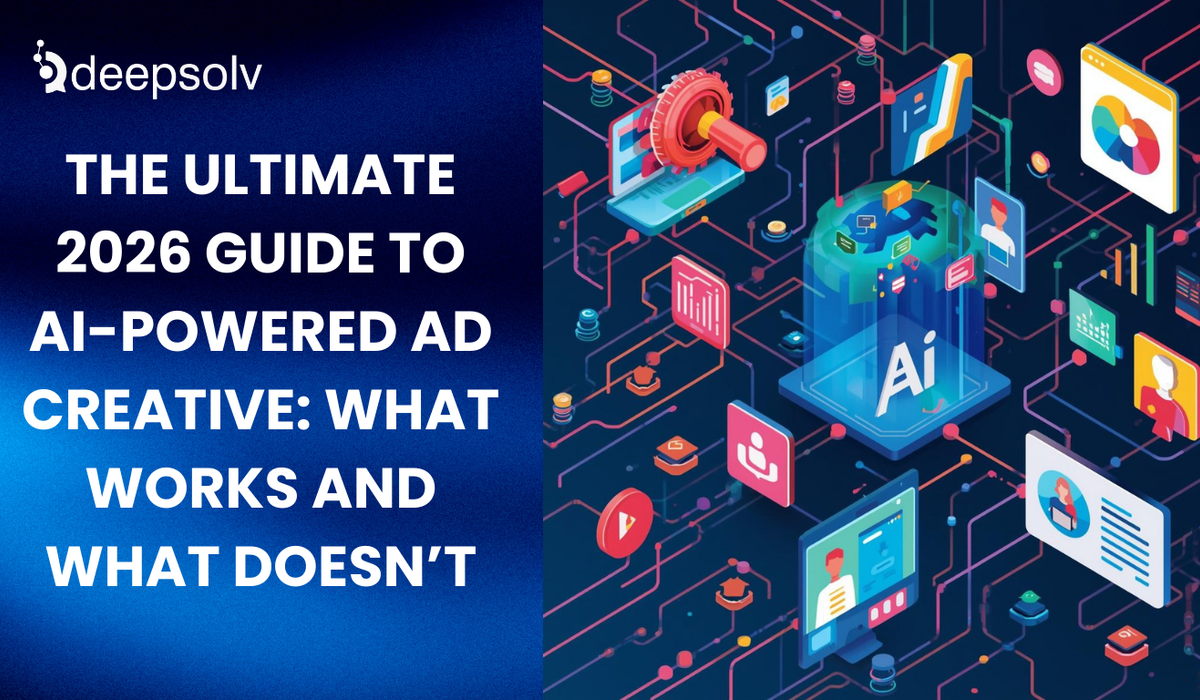
By 2026, AI-powered ad creative is no longer experimental.
It is expected.
Almost every serious marketing team now uses some form of AI creative generator to produce ads faster, test more variations, and keep up with the pace of modern platforms. Yet despite this adoption, performance gaps between brands are wider than ever.
Some teams are scaling profitably with AI ad creative. Others are burning budget faster than before.
The difference is not access to AI. It is how AI is used, where it is applied, and what humans still control.
This guide breaks down what actually works with AI-powered ad creative in 2026, what consistently fails, how real brands are adapting, and how systems like Adam by Deepsolv help teams move fast without losing strategy, relevance, or brand identity.
Advertising platforms have automated almost everything except one variable: creative.
Targeting, bidding, budget allocation, and delivery are now algorithmic. Meta, Google, and TikTok all optimize based on how users respond to creative inputs.
That puts enormous pressure on teams to:
Manual workflows cannot keep up.
AI ad creative did not rise because it was exciting. It rose because it was necessary.
Most marketers assume AI creates winners.
It does not.
AI creates volume. Performance comes from direction.
When teams treat an AI creative generator as a replacement for thinking, output becomes generic. Polished visuals and clever copy fail because they lack context.
Algorithms do not reward cleverness. They reward relevance.
The best AI ad creative in 2026 is not the most impressive. It is the most situationally aware.
Let’s break down what consistently works across high-growth brands.
High-performing brands do not ask AI “what should we say?”
They tell AI:
AI then multiplies that strategy.
Ridge Wallet rarely reinvents messaging. Their long-running ads center on durability and trust.
AI ad creative helps them:
The AI is not inventing strategy. It is scaling a validated one.
This is why Ridge can test at volume without diluting performance.
One of the biggest mistakes teams make with AI creative generators is chasing novelty.
In 2026, novelty is overrated.
Algorithms learn faster when:
Vuori’s longest-running ads share the same emotional tone: calm, comfort-led, and non-aggressive.
AI ad creative allows them to:
The result is longevity, not noise.
One of the most uncomfortable truths in AI-powered ad creative is that high production often underperforms.
AI makes it easy to generate polished assets. That does not mean audiences trust them.
User-generated, raw, imperfect content still wins in many categories.
Gymshark’s ads often feel organic because they closely resemble community content.
AI helps Gymshark-style teams:
Here, AI accelerates authenticity instead of replacing it.
Now let’s address the failures.
Many teams search for an AI creative generator or an AI ad creative tool, generate dozens of ads, and launch them blindly.
This approach fails because:
AI amplifies whatever system you already have. If your system is weak, failure accelerates.
Searching for “AI Ad Creative free” tools can be useful for experimentation, but they lack three critical elements:
They generate content in isolation.
In 2026, isolation kills performance. Markets move too fast.
Even strong AI-generated ads fail when the experience after exposure breaks.
When ads scale, engagement scales:
Most teams ignore this layer completely.
That is a silent conversion killer.
Adam by Deepsolv is not positioned as a generic AI creative generator.
Adam functions as an AI Creative Strategist.
Instead of starting from a blank prompt, Adam starts from intelligence:
Adam then converts this intelligence into:
This is how teams build AI ad creative 10x faster without sacrificing relevance.
Speed comes from clarity, not randomness.
Even the best AI-generated ads struggle if trust breaks after exposure.
Deepsolv completes the loop by automating:
This ensures AI ad creative does not collapse under its own success.
Ads attract attention. Conversations convert it.
Here is the actual workflow used by high-growth brands:
Adam handles steps 1 and 2. Deepsolv ensures steps 4 and 5 convert.
This is a system, not a tool.
AI does not replace judgment.
It replaces:
Marketers who understand psychology, positioning, and timing will outperform everyone else, faster.
Those who rely on AI without strategy will fail faster than ever.
In 2026, AI ad creative is no longer optional.
The brands that win will not be the ones generating the most ads, but the ones generating the right ads quickly, consistently, and contextually.
If you are using an AI creative generator but feel performance lacks direction, the issue is not AI.
It is missing intelligence.
Adam by Deepsolv exists to solve that gap.
Start a 7-day free trial. No credit card required. Or book a demo to see how AI-powered ad creative actually scales in real campaigns.
FAQs
Frequently asked questions related to this blog post