Deepsolv Blog
Deepsolv Blog
Backed by






Creative Decision Intelligence for Meta growth teams. Know what to test next — before you spend on it.
Follow Deepsolv on InstagramFollow Deepsolv on LinkedInFollow Deepsolv on TwitterAll rights reserved © 2026 deepsolv.ai
6 min
Published: 12/12/2025
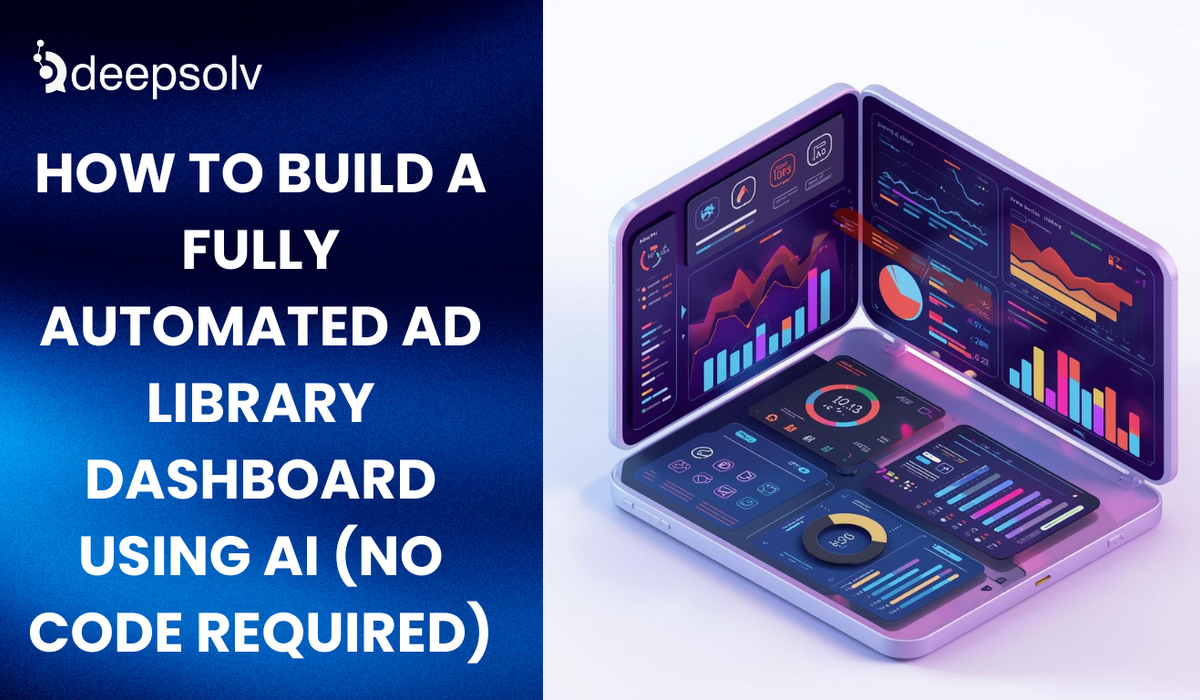
If you are still manually scrolling the Meta Ad Library, saving screenshots, and pasting links into spreadsheets, you are already behind in 2026.
The rise of Facebook Ads library automation is not a trend. It is a response to a fundamental shift in how advertising works today. Platforms like Meta, Google, and TikTok have taken control away from manual media buying. Algorithms now decide who sees your ads, when they see them, and how aggressively budgets scale.
That leaves only one variable fully in human hands: creative intelligence.
This blog explains how to build a fully automated ad library dashboard using AI and no-code tools, why traditional swipe files fail in modern auctions, how real brands extract advantage from automated ad intelligence, and how systems like Adam by Deepsolv are quietly replacing entire research and strategy workflows.
Before iOS14, performance marketing rewarded precision. Media buyers could out-optimize competitors through granular targeting, bid manipulation, and lookalike layering.
That era is over.
In 2026, platforms operate as black boxes. Advantage+, Performance Max, and broad targeting have centralized decision-making inside algorithms. The media buyer has effectively been replaced by software.
What still matters is:
This is why ad intelligence has moved from inspiration to engineering.
The best teams no longer ask, “What does this ad look like?” They ask, “Why has this ad stayed alive for 90 days?”
Most agencies and in-house teams still rely on manual workflows:
This approach fails for two structural reasons.
Algorithms test thousands of creative variations every day. Manual research cannot match this speed. By the time insights are documented, the market has already moved.
Meta’s CDN links expire. Videos disappear. Swipe files decay. What looks like a growing research archive quietly becomes useless.
This is why ad library tools that rely on manual curation are fundamentally limited. The future belongs to automated systems that ingest, preserve, and analyze continuously.
A modern ad intelligence system does not just collect ads. It interprets behavior.
At its core, automation allows you to:
Instead of static swipe files, you get a living intelligence engine.
A no-code automated dashboard works as a pipeline with four layers.
The Meta Ad Library is designed to be browsed by humans, not scraped by bots. It uses dynamic rendering, infinite scroll, and obfuscated elements.
This is why headless browser automation is essential.
Tools like Apify simulate real user behavior, enabling large-scale extraction without triggering blocks. Ads can be collected by:
Including inactive ads is critical. Failed ads tell you what did not work just as clearly as winners.
One of the most overlooked failures in DIY dashboards is reliance on Meta-hosted URLs.
Those links expire.
A proper system immediately:
This single step turns a fragile swipe file into a permanent historical record.
Raw assets are not insights.
This is where multimodal AI changes everything.
Modern AI models can analyze video directly, identifying:
Instead of watching hundreds of videos, teams can filter by:
This is how Facebook Ads library automation becomes strategic rather than mechanical.
Even the best data is useless if no one can act on it.
Tools like Airtable transform raw intelligence into:
This allows creative, performance, and leadership teams to work from the same source of truth without touching raw data.
You cannot see CTRs or ROAS inside the Meta Ad Library.
But you can see something more honest: time.
Ads that stay live are converting. No brand with algorithmic bidding keeps poor ads running.
Automated dashboards track:
This turns public transparency into a performance signal.
Ridge Wallet runs hundreds of ads, but automation reveals that only a subset survive long-term.
When filtered by ad duration, a clear pattern emerges. Fire. Crushing. Destruction.
Ridge does not explain features. It demonstrates survivability.
Automated analysis shows they vary how the product is destroyed, not what they say. This allows constant testing within a proven narrative.
Huel’s longest-running ads are not lifestyle visuals. They are equations.
Cost per meal. Nutrient comparisons. “Us vs them” breakdowns.
Automation surfaces a consistent strategy: attacking price objections head-on, especially during inflationary cycles.
This insight is invisible without longevity tracking.
Gymshark’s dashboard profile looks different.
Low production scores dominate. Influencer footage. Minimal branding.
Automation reveals sharp spikes in ad volume during launches, followed by rapid pullbacks. Scarcity plus community trust does the heavy lifting.
Gymshark does not manufacture ads. It amplifies culture algorithmically.
Many SaaS ad library tools offer clean interfaces and inspiration feeds.
But they come with tradeoffs:
A custom no-code build offers:
This is why advanced teams treat ad intelligence as infrastructure, not software.
Even with perfect insights, most brands fail at execution.
They know what works. They see competitor patterns. They launch better creatives.
Then they miss the conversion window.
Comments pile up unanswered. DMs go cold. Returning users are ignored.
Attention is created by ads. Revenue is created by conversations.
This is where Adam by Deepsolv quietly replaces entire layers of work.
Adam is an AI Creative Strategist designed to sit on top of competitive intelligence.
Instead of teams manually translating dashboards into action, Adam:
Adam does not replace dashboards. It operationalizes them.
This is the missing link between ad library tools and actual execution.
By the time a trend is obvious, CPMs are already rising.
Adam continuously scans high-performing content across industries, allowing brands to move while ideas still feel native.
In 2026, speed beats polish. Systems beat heroics.
Users do not experience your brand in silos.
They see an ad. They check comments. They watch organic posts. They return later.
Adam treats paid and organic as one system, helping brands maintain narrative consistency across touchpoints without doubling effort.
Every brand has access to the Meta Ad Library.
Not every brand builds infrastructure around it.
The gap between insight and action compounds quietly. Brands that automate research, strategy, and execution do not just move faster. They learn faster.
In 2026, the Meta Ad Library is not a website to browse.
It is a dataset to ingest.
A fully automated ad library dashboard transforms public transparency into private advantage. It replaces guesswork with pattern recognition and replaces manual labor with systems.
If you are serious about scaling creative intelligence, automation is not optional.
And if you already understand the value of Facebook Ads library automation, Adam by Deepsolv is the natural next step.
Book a demo and see how brands turn competitive intelligence into execution without friction.
FAQs
Frequently asked questions related to this blog post