Deepsolv Blog
Deepsolv Blog
Backed by






Creative Decision Intelligence for Meta growth teams. Know what to test next — before you spend on it.
Follow Deepsolv on InstagramFollow Deepsolv on LinkedInFollow Deepsolv on TwitterAll rights reserved © 2026 deepsolv.ai
6 min read
Published: 12/10/2025
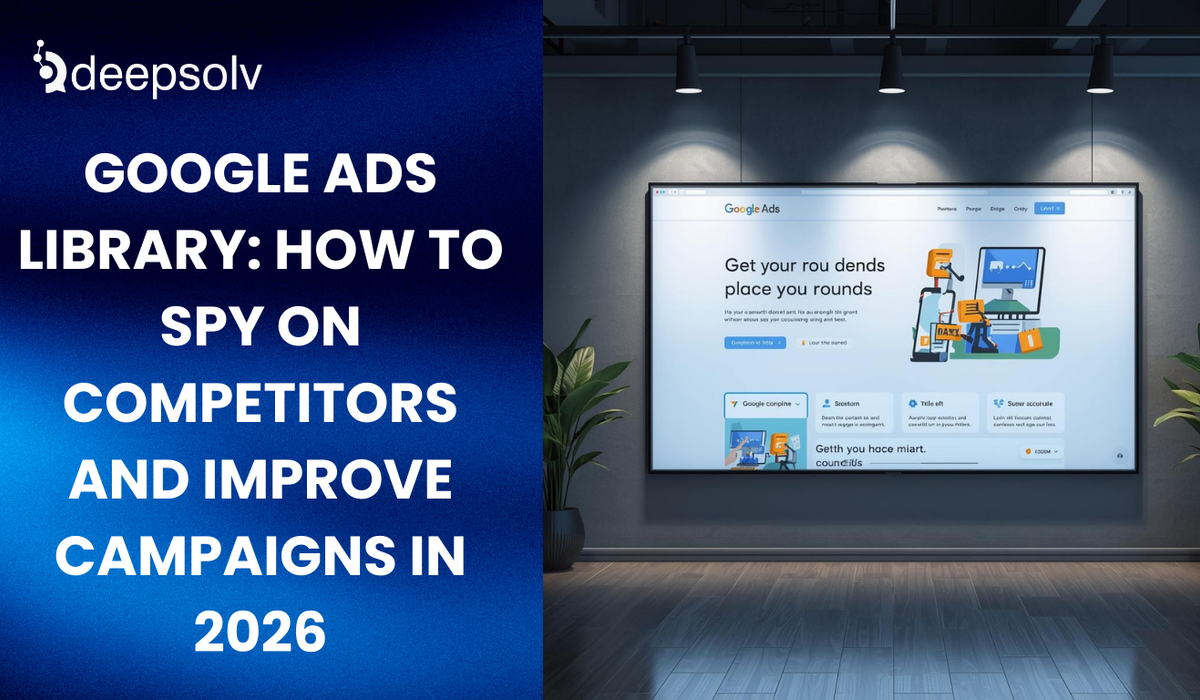
If you have spent any serious time inside the Google Ads Library or explored the Google Ads transparency center, you have probably realized something most brands still miss in 2026.
The ads you see there are not experiments. They are survivors.
In a world where Google’s algorithms now decide targeting, bidding, and delivery, no brand keeps an ad live unless it is working. That makes the Google Ads Library one of the most honest datasets available to marketers today. Not because it explains everything, but because it reveals where real money is being spent, repeatedly.
This guide breaks down how to actually use the Google Ads Library in 2026, how to extract competitive insights that go far beyond surface-level inspiration, how real brands leverage ad transparency to dominate their categories, and how forward-thinking teams convert these insights into campaigns using Adam by Deepsolv without slowing execution.
The biggest shift in advertising is not creative formats or platforms. It is control.
Manual targeting is gone. Lookalike hacking is gone. Bid tricks no longer matter the way they once did. Google’s automation systems now act as the media buyer.
What remains in human hands is narrative, creative direction, and speed of execution.
This is why the Google Ads transparency center is so valuable. It shows:
An ad that runs for weeks or months is not just good creative. It is algorithmically approved.
The most common mistake is treating the Google Ads Library like a swipe file.
Screenshots. Loose notes. A Notion board that never gets revisited.
That approach breaks down quickly because:
In 2026, inspiration is abundant. Pattern recognition is rare.
The real objective is not to copy what competitors show, but to understand why certain messages refuse to die.
Searching only competitor brands creates tunnel vision.
Many high-performing advertisers do not rely on brand recognition at all. They run problem-aware and solution-aware narratives instead.
Instead of searching just a brand, search:
For example, instead of searching a productivity tool, search “reduce team delays” or “manage remote teams better.”
This reveals agile advertisers who often innovate messaging faster than large incumbents.
The most valuable ads are rarely the flashiest.
Look for repetition:
Repetition signals confidence. Confidence usually comes from performance.
Localization is expensive. Brands only do it when ROI justifies it.
If a competitor changes messaging across regions, it tells you:
These insights rarely show up on landing pages. They live inside ads.
Ridge Wallet runs hundreds of ads at any given time, but only a fraction survive long-term.
When you analyze their ads over time in the Google Ads Library, one theme dominates: destruction.
Fire tests. Cars rolling over wallets. Crushing demonstrations.
Ridge does not obsess over feature explanations. Instead, it sells certainty. The product survives anything. That narrative is strong enough to justify sustained spend.
This insight is invisible if you only look at visuals. It becomes obvious when you track longevity.
Huel’s ads are often text-heavy and unapologetically informational.
They compare meal costs. They break down nutrition mathematically. They position themselves as a financial decision, not a lifestyle choice.
Many of these ads run for months.
Huel reframes food as efficiency. Especially during inflationary periods, this messaging scales aggressively.
The Google Ads transparency center makes this pattern unmistakable.
Gymshark’s ads often look indistinguishable from organic content.
Low production. Influencer clips. Minimal copy.
But when launches happen, the Google Ads Library reveals massive, short-lived spikes in ad volume.
Gymshark floods the feed, then disappears. Scarcity does the rest.
They do not manufacture culture. They amplify it.
Most brands stop at insight.
They improve creatives, launch ads, and then lose momentum where it matters most: interaction.
Comments go unanswered. DMs are delayed. High-intent users drop off silently.
People trust people more than ads. This is where revenue leaks quietly.
The Google Ads Library shows you what is working.
Adam by Deepsolv helps you act on it.
Adam is an AI Creative Strategist built for teams that already understand competitive intelligence but cannot afford slow, fragmented execution.
Instead of manually tracking competitors across platforms, Adam:
This is not about replacing creative thinking. It is about removing friction between insight and action.
By the time a trend becomes obvious inside the Google Ads transparency center, competition has already intensified.
Adam continuously scans high-performing content across categories like DTC, marketing, fashion, and lifestyle. This allows brands to act while ideas still feel native, not recycled.
Speed is no longer a bonus. It is the advantage.
Most teams still plan paid and organic content separately, which fractures narratives.
Adam treats them as one system.
Campaign builders help brands:
This matters because users rarely convert on the first interaction. They watch, compare, and return.
Every brand can access the Google Ads Library.
Not every brand acts quickly enough.
While some teams are still documenting insights, others are already publishing, testing, and engaging. That gap compounds quietly.
Adam exists for brands that do not want insight without execution.
In 2026, the Google Ads Library is not something you browse occasionally.
It is a living dataset that reveals:
But insight alone does not drive growth.
Execution does.
If you already use the Google Ads Library and want to turn competitive intelligence into campaign-ready content without chaos, start with Adam by Deepsolv.
Try it free for 7 days. No credit card required.Or book a demo and see how brands stay ahead instead of catching up.
FAQs
Frequently asked questions related to this blog post