Deepsolv Blog
Deepsolv Blog
Backed by









Creative Decision Intelligence for Meta growth teams. Know what to test next — before you spend on it.
Follow Deepsolv on InstagramFollow Deepsolv on LinkedInFollow Deepsolv on TwitterAll rights reserved © 2026 deepsolv.ai
5 min read
Published: 12/4/2025
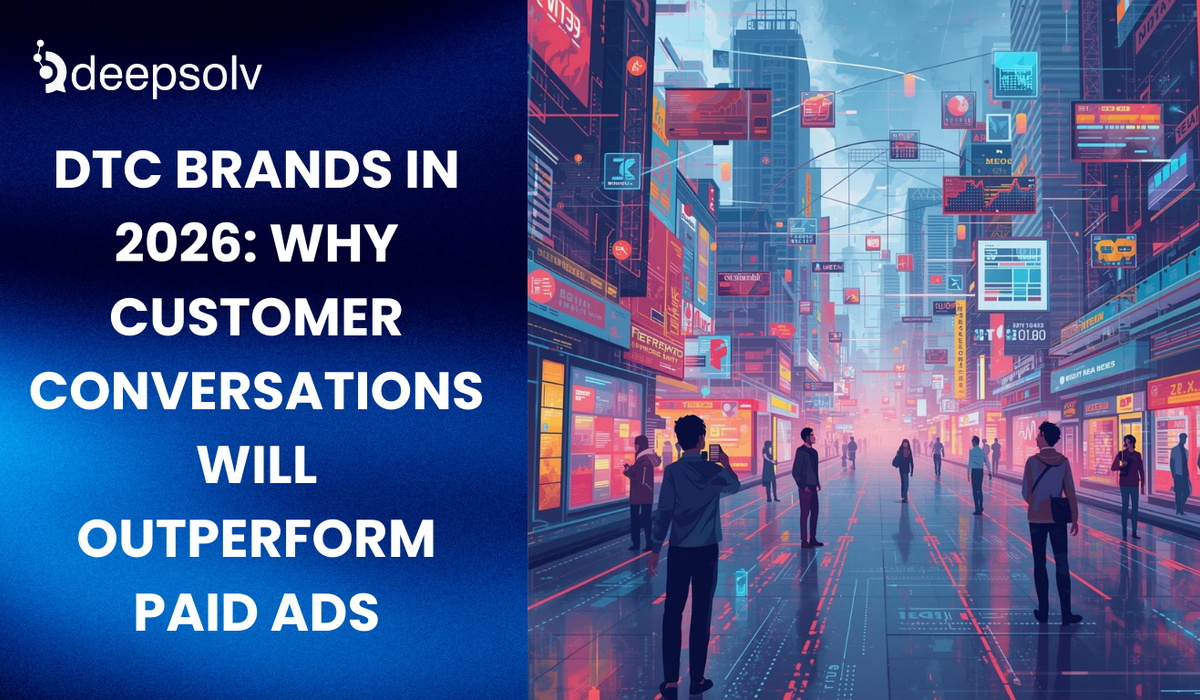
For years, DTC growth followed a familiar pattern:launch paid ads, scale spend, acquire customers, repeat.
But as we move closer to 2026, that playbook is cracking.
Customer acquisition costs are climbing. Creative fatigue is accelerating. Platforms are crowded. And even brands with “winning” ads are noticing something worrying: growth feels harder than it should.
This is not a creative problem. It’s not a media buying problem. It’s a conversation problem.
In dtc marketing 2026, the brands that win won’t be the ones with the biggest ad budgets, they’ll be the ones that build the strongest relationships after the click.
Paid ads still matter. Facebook ads, Meta ads, TikTok ads — they all remain powerful discovery engines.
But discovery is no longer the bottleneck.
Today’s bottleneck is trust.
Modern consumers don’t buy the first time they see an ad. They scroll comments. They ask questions. They DM brands. They look for signals that a brand will actually show up after the sale.
Paid ads start attention. Conversations finish decisions.
That’s why ads alone struggle to scale profitably in 2026.
Every comment and DM is a signal.
A question about sizing. A “does this work for me?” message. A comment asking about price, shipping, or alternatives.
These are not engagement metrics. They are buying intent.
Yet most DTC brands:
This gap is exactly why customer conversations outperform paid ads when handled correctly.
Instagram is no longer just a content distribution platform — especially for DTC brands.
It’s now:
Even Instagram leadership has made this direction clear.
Adam Mosseri has repeatedly emphasized that comments, replies, and DMs are core engagement signals. Instagram rewards interactions that feel human, not transactional.
For Instagram for DTC brands, this means one thing: posting and promoting is not enough- brands must participate.
Rising CPMs and creative costs have made CAC unpredictable. Brands try to compensate by:
But CAC-focused growth ignores what happens after acquisition.
Retention, loyalty, and lifetime value are now the real levers and those are built through interaction, not impressions.
That’s why dtc retention hacks are becoming more valuable than acquisition hacks.
A powerful illustration of this shift is Brandy Melville.
Brandy Melville has never relied heavily on aggressive paid advertising. Instead, it has built an intensely loyal following through:
Customers don’t just buy Brandy Melville products — they identify with the brand. That identity is reinforced through constant conversation, not constant ads.
This is exactly what retention-led DTC growth looks like in practice.
Many brands understand that conversations matter but struggle to scale them.
Manual engagement breaks down because:
By 2026, manual engagement will be a liability, not a differentiator.
Brands need systems that scale conversations without killing authenticity.
Automation has a bad reputation — often deserved.
But modern engagement automation is not about robotic replies. It’s about:
This is where platforms like Deepsolv fit naturally, not as ad tools, not as chatbots, but as conversation infrastructure for brands.
Winning funnels are no longer linear.
They look more like this:
In this loop, ads bring volume but conversations create value.
In 2026, conversations are measurable.
Brands track:
This bridges the gap between paid media and brand building, something traditional ad tools alone cannot do.
Deepsolv doesn’t replace:
It fills the gap after the click where intent lives and conversions are decided.
By helping brands:
Deepsolv enables DTC brands to grow without becoming more dependent on ads.
FAQs
Frequently asked questions related to this blog post