Deepsolv Blog
Deepsolv Blog
Backed by





Creative Decision Intelligence for Meta growth teams. Know what to test next — before you spend on it.
Follow Deepsolv on InstagramFollow Deepsolv on LinkedInFollow Deepsolv on TwitterAll rights reserved © 2026 deepsolv.ai
6 min read
Published: 11/2/2025
For years, advertisers treated paid ads as separate from conversations. You ran your Meta or TikTok ad, drove clicks to a website, and hoped your visitor made it through a landing page, form, and checkout.
But in 2025, that model is collapsing.
Consumers now expect instant connection, not redirection. They don’t want to “visit” your website — they want to talk to your brand directly inside the platform.
Meta’s own 2025 report shows:
That’s why the future of ad funnels is conversational. And automation is the key to scaling it.
In this blog, we’ll explore how ad funnel automation works — connecting your paid ads to chatbots, DMs, and personalized experiences that drive sales automatically — powered by Deepsolv’s Creative Intelligence Platform.
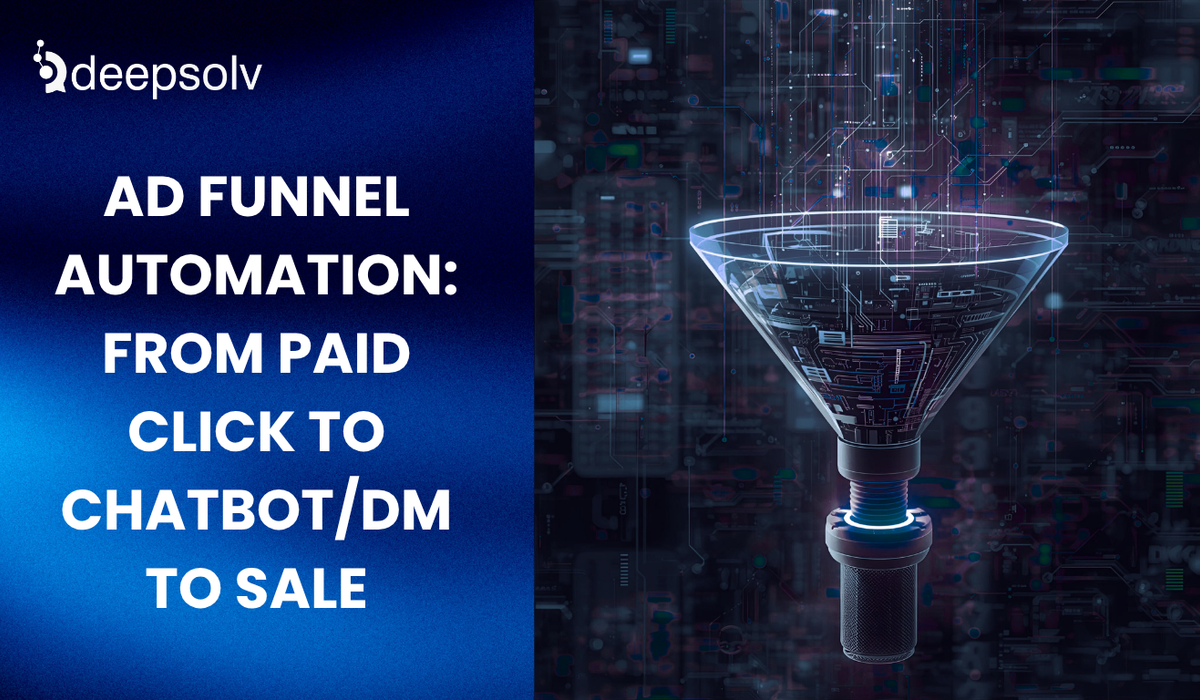
Ad Funnel Automation is the process of turning a traditional, multi-step ad funnel into a single connected journey, powered by AI.
Instead of:
Ad → Website → Product Page → Add to Cart → Checkout
You now have:
Ad → DM/Chatbot → Personalized Offer → Instant Purchase or Lead Capture
This automation connects three key systems:
Each touchpoint uses AI to personalize, respond, and convert in real time — without needing a human to intervene.
In the post-iOS, mobile-first, short-attention era, users don’t want to leave the platform they’re scrolling on. The friction between click and checkout kills your ROI.
Here’s why automated funnels are outperforming traditional ones:
| Old Funnels (2020) | Automated Funnels (2025) |
| Users redirected to website | Users stay inside the same app |
| Delayed response | Instant chat reply |
| Generic landing pages | Personalized offers in DMs |
| Manual follow-ups | Automated nurturing |
| One-size-fits-all copy | AI-personalized conversation tone |
💡 Data Insight: Meta’s 2025 Global Business Report found that businesses using Click-to-Chat campaigns saw an average 37% reduction in cost per conversion compared to link-click ads.
The goal is not just to drive clicks — it’s to start a dialogue. That means your creative, copy, and CTA should be optimized for curiosity and response.
Best Formats for Chat Funnels:
💡 Pro Tip: Always frame the ad around a question or choice — it gives users a reason to message.
Once someone clicks your ad, they enter your automated DM flow. This is where the magic begins.
Your chatbot should:
Example (Fitness Brand Flow):
“Hey 👋 Thanks for checking us out! Are you looking for a home workout plan or gym-based one?” → [Home] → [Gym] → [I’m not sure yet]
This creates an interactive, two-way buying experience instead of a passive landing page.
💡 Powered by Deepsolv’s Brandy: The AI Engagement Strategist automatically detects tone and urgency in responses — identifying whether someone’s curious, hesitant, or ready to buy — and adapts the tone in real time.
Once intent is clear, automation takes over. For instance:
This ensures instant gratification, not “we’ll get back to you soon.”
Example (DTC Brand):
“Got it! Since you’re in Mumbai, you can get same-day delivery for our starter kit — tap below to order now 🛒”
The key is merging speed, personalization, and locality — three conversion triggers that drive Tier-2/3 market success too.
Every message becomes first-party data.
Your funnel automation should capture:
That data then syncs with:
Once captured, you can retarget these users with relevant creatives or reopen the chat later with new offers — all automatically.
💡 Example: A skincare brand uses Deepsolv’s data intelligence to tag users who mentioned “acne.” When their new acne-control serum launched, they automatically triggered personalized DM campaigns to those leads — achieving 3.7x ROI on launch day.
Most conversions don’t happen on the first message — but timely follow-ups convert 40–60% more leads.
Instead of manually chasing every chat, use automation to:
Example (Automated Message):
“Hey again! We saved your offer — still interested in the Home Fitness Kit? 🎁 Get 10% off today only. Tap below to complete your order.”
💡 Pro Tip: Use AI-driven emotional triggers — urgency (“today only”), reassurance (“risk-free trial”), and validation (“bestseller”) — to rekindle buying intent.
Cost Efficiency Automated DMs have 3–5x higher ROI than traditional landing page funnels (Meta Business Report, 2025).
❌ Over-automation without warmth – Always maintain tone consistency and brand personality.
❌ No creative-persona match – Your ad’s emotion should match your DM tone.
❌ Ignoring follow-up timing – Too early feels pushy, too late loses interest.
❌ Not syncing data – Leads go cold if not captured or categorized instantly.
❌ Manual testing delays – Use AI platforms like Deepsolv to analyze creative response in real time.
The modern ad funnel isn’t about chasing clicks anymore — it’s about creating connected experiences that move users seamlessly from awareness to purchase within a single conversation.
Automation doesn’t replace the human touch — it scales it. With Deepsolv’s AI Strategists (Adam & Brandy), brands can merge ad performance, creative emotion, and conversational commerce into one self-learning loop that keeps improving every day.
In 2025, every DM can be a sale — if your funnel knows how to listen.
Want to turn your paid clicks into real conversations and conversions? Schedule a free strategy call with Deepsolv’s AI team — we’ll analyze your ad-to-DM flow, emotional triggers, and automation gaps to design a funnel that sells even while you sleep.
⏳ Free slots are limited this month — secure yours before your next campaign goes live.
FAQs
Frequently asked questions related to this blog post