Deepsolv Blog
Deepsolv Blog
Backed by







Creative Decision Intelligence for Meta growth teams. Know what to test next — before you spend on it.
Follow Deepsolv on InstagramFollow Deepsolv on LinkedInFollow Deepsolv on TwitterAll rights reserved © 2026 deepsolv.ai
6 min read
Published: 10/14/2025
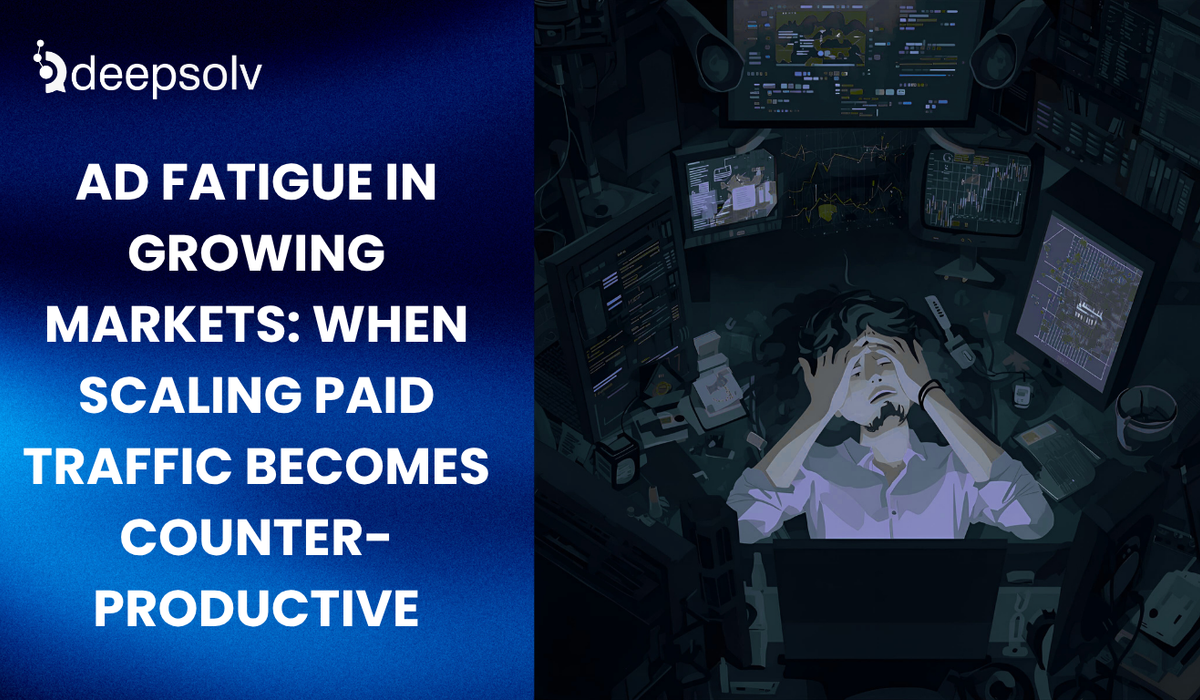
Every growth marketer dreams of scale- doubling budgets, tripling reach, and watching conversions climb.
But in growing markets like India, Indonesia, and Brazil, there’s a paradox most brands discover too late: scaling your ads can actually start killing performance.
What begins as momentum quickly turns into diminishing returns — rising CPMs, falling click-throughs, and engagement graphs that curve down no matter how much you spend.
The culprit? Ad fatigue: a psychological and algorithmic burnout that happens when audiences see the same creative story too often, too fast.
In 2025’s hyper-connected markets, this fatigue doesn’t take months to form. It happens in days, fueled by algorithmic repetition, compressed attention spans, and over-optimized delivery systems.
This article explores why ad fatigue hits harder in growing markets, how it silently eats into ROI, and how Creative Intelligence Platforms like Deepsolv help brands scale sustainably through data-driven creative optimization instead of blind ad spend.
Ad fatigue occurs when users become desensitized to your campaigns because they’ve seen the same creative repeatedly.
The audience may not consciously dislike your brand, they simply scroll faster, click less, and emotionally disengage.
In measurable terms: ➡️ CTRs fall. ➡️ CPC and CPM rise. ➡️ Conversions slow down. ➡️ Ad recall drops.
And yet, your media budget keeps flowing.
As Creative Intelligence data shows, the faster your campaign scales, the faster it fatigues unless creative and audience insight loops evolve in parallel.
Scaling is supposed to multiply growth. But if you scale the same message across the same audience, you’re not growing reach, you’re amplifying decay.
Here’s how ad fatigue quietly destroys ROI.
Meta’s ad system rewards engagement.When engagement falls, cost-per-impression rises, your ad literally becomes more expensive to show.
Brands see a paradoxical curve: the more they spend, the higher their CPC gets.
This “death spiral” typically starts when your creative frequency exceeds 3.5 and CTR drops by more than 25% week-over-week.
When the same audience sees your ad too many times, they mentally “unsubscribe.”
In growing markets where audiences are smaller or hyper-clustered (e.g., Tier 1 urban users), saturation happens fast.
For example, an Indian fintech brand scaling from ₹20L to ₹1Cr in monthly ad spend saw CTR drop 48% in just three weeks because 70% of impressions hit the same 8M users repeatedly.
Overexposure leads to irritation.Even positive brand recall starts to carry fatigue.
One Deepsolv case study found that emotional sentiment in ad comments dropped from +72% to +41% after creatives were repeated for 21 days without refresh even though performance metrics initially looked fine.
The most dangerous part: fatigued scaling costs more to maintain than it generates.
Beyond a certain threshold, incremental spend increases CPA without meaningful gain, a state we call “ROI inversion.”
If you’re paying more to sustain attention than to acquire it, your scaling has turned counter-productive.
Deepsolv’s audience intelligence data suggests fatigue can be detected up to 5 days before ROI decline if you monitor the right signals.
Here’s what to watch:
| Metric | What to Monitor | Fatigue Indicator |
| CTR (Click-Through Rate) | Drops >25% week-on-week | Early creative burnout |
| Frequency | Avg. impressions per user >3.0 | Saturation point |
| CPM / CPC | Rising despite steady reach | Algorithmic penalty |
| Engagement Rate | Likes, shares, saves drop | Audience apathy |
| Sentiment Score | Negative/neutral comments rise | Emotional fatigue |
💡 Pro Insight: AI Strategists on Deepsolv can forecast fatigue trends by mapping creative engagement decay across markets predicting when a campaign’s emotional energy will drop before the numbers do.
Scaling challenges look different in high-growth regions and so does fatigue.
In markets like India and Indonesia, high growth doesn’t mean unlimited diversity. The qualified audience segments for specific products (e.g., urban D2C shoppers or SaaS decision-makers) are small, so you hit frequency saturation fast.
A single user might see the same creative across Meta, YouTube, and local ad networks multiple times per day — creating subconscious irritation.
In high-context cultures, novelty drives attention. Repetition signals stagnation. A creative that felt fresh a week ago feels lazy two weeks later.
Meta’s Advantage+ and TikTok’s Smart Delivery optimize aggressively toward top-performing creatives, causing micro-audience exhaustion in days instead of weeks.
Sustainable scaling requires more than media management — it needs creative intelligence: systems that adapt your message and audience dynamically.
Here’s how top-performing brands maintain momentum.
Your audience data shouldn’t sit static.AI Strategists like Deepsolv’s Adam constantly learn from engagement signals — identifying which audience clusters are nearing fatigue and which creative styles are gaining traction.
This real-time loop lets you adjust creative direction before fatigue sets in, rather than reacting after performance crashes.
Instead of creating entirely new campaigns, evolve the narrative every two weeks. That might mean:
Example:A wellness brand using Adam discovered its “scientific tone” creatives fatigued after 9 days. The AI recommended switching to “testimonial-based” stories, improving CTR by 34% while maintaining the same spend.
Creative Intelligence Platforms go beyond A/B testing, they predict which ad concept will fatigue first using sentiment and velocity tracking.
By pairing human creativity with AI-driven analysis, you can rotate ads at the right time instead of guessing.
Avoid showing the same ad to cold, warm, and hot users.
This segmentation prevents emotional overexposure while improving overall efficiency.
Don’t let your audience see the same ad five times in a week.Set frequency thresholds and instruct your Creative Intelligence system to auto-rebalance once limits are hit.
In Deepsolv’s framework, this is known as Dynamic Fatigue Control where campaigns redistribute impressions automatically once fatigue probability crosses 60%.
Your best ads aren’t dead — they’re just tired. Reintroduce them 30–45 days later with refreshed visuals, new CTAs, or seasonally adapted angles.
When Nykaa scaled across Tier 1 and Tier 2 markets, it used AI-led creative refresh cycles. The result?CTR held steady across 90 days despite 4x higher impressions — because creative stories evolved every 12 days, not every 12 weeks.
A DTC brand scaling Meta ads noticed early fatigue indicators at a frequency of 3.1. Deepsolv’s Adam predicted creative decay within 72 hours and auto-suggested new UGC-based visuals emphasizing transformation stories. Result:
Instead of running static discount creatives, Zomato alternates emotional hooks — humor, celebration, and local cultural cues. This rotation keeps the brand emotionally “fresh,” maintaining engagement even at mass scale.
There’s a point where scaling stops increasing ROI and starts inflating costs — we call it the Efficiency Plateau.
You’ve hit it when:
At this stage, you’re paying not for growth — but for noise.
Deepsolv helps brands avoid this trap by connecting three powerful systems:
The result:You scale smarter — maintaining emotional freshness and ROI consistency even at 10x ad volume.
In growing markets, scaling isn’t just about spend — it’s about staying relevant.
Ad fatigue isn’t a creative problem. It’s a feedback problem — a sign that your audience insight loop isn’t evolving as fast as your delivery.
With a Creative Intelligence Platform like Deepsolv, you can balance automation with human storytelling — scaling your reach without dulling your brand’s emotional edge.
If your ad performance feels “stuck” despite higher budgets, it’s likely creative fatigue — not poor targeting.
Our AI Strategists will audit your campaigns, detect early fatigue signals, and design a data-driven creative optimization plan to restore performance and momentum.
⏳ Limited consultations this month — book your free audit today before your next scale cycle hits saturation.
FAQs
Frequently asked questions related to this blog post