Deepsolv Blog
Deepsolv Blog
Backed by









Creative Decision Intelligence for Meta growth teams. Know what to test next — before you spend on it.
Follow Deepsolv on InstagramFollow Deepsolv on LinkedInFollow Deepsolv on TwitterAll rights reserved © 2026 deepsolv.ai
6 min read
Published: 11/5/2025
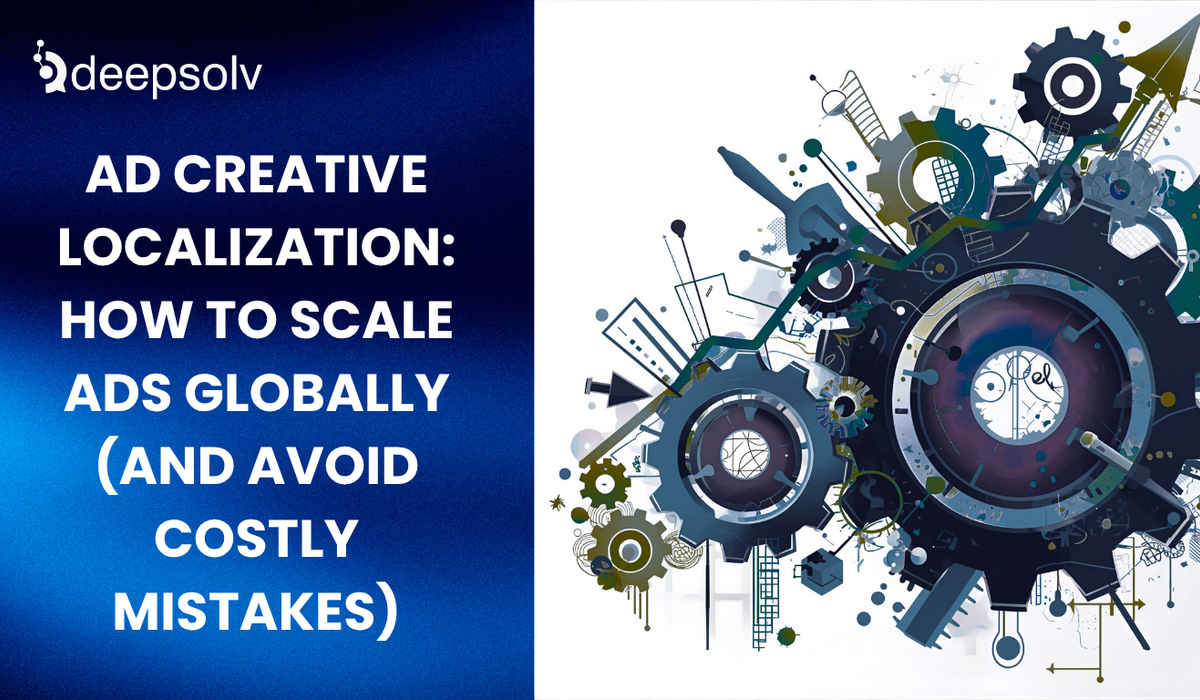
In 2025, global advertising doesn’t fail because of bad targeting or weak products, it fails because the creative doesn’t travel well.
You’ve seen it happen: A U.S. campaign that crushed on Meta gets recycled in Southeast Asia and suddenly flops. A brand’s witty English ad becomes awkward in translation. Or a creative that performed brilliantly in Berlin gets ignored in Bangkok.
This is the creative localization gap — the silent killer of global ROAS.
Scaling ads across markets isn’t about simply translating text or resizing visuals. It’s about localizing emotion with the tone, symbols, behaviors, and motivations that make people click for their reasons, not yours.
In this blog, we’ll break down what ad creative localization really means in 2025, the costly mistakes brands still make, and how Creative Intelligence Platforms like Deepsolv are changing how global advertisers scale creative impact across borders.
Ad creative localization is the process of adapting your creative assets — not just your language to fit the cultural, emotional, and behavioral context of each local audience.
It’s not:
It is:
In short, localization ≠ translation.It’s cultural resonance engineered at scale.
Global ad costs are rising.Competition is fierce.But here’s what’s fascinating, according to Meta’s 2025 Global Creative Benchmark:
“Localized creatives deliver 3.3x higher engagement and 2.1x higher conversion than global templates reused across regions.”
In the same report, 70% of global brands said their biggest challenge wasn’t media buying — it was “creating locally relevant content fast enough.”
That’s where creative intelligence and automation step in.
With AI, you can now analyze audience behavior, cultural nuances, and emotional response patterns in real time and adapt your creatives instantly.
Platforms like Deepsolv’s Adam (AI Creative Strategist) are doing exactly that using emotional and visual intelligence to help brands localize their ad stories across regions without losing brand identity.
When localization fails, it doesn’t just hurt CTR. It damages trust.
In the 1960s, Pepsi translated its U.S. slogan “Come Alive! You’re in the Pepsi Generation!” for the Chinese market.Unfortunately, it read as “Pepsi brings your ancestors back from the dead.”
Result? Viral mockery, brand backlash, and cultural embarrassment.Even decades later, it’s a cautionary tale about careless translation.
Coors’ slogan “Turn it loose” was translated into Spanish as “Suffer from diarrhea.”Enough said.
These may sound like historical mistakes but similar versions still happen in the digital era every day.An emoji, hand gesture, or tone that seems friendly in one region can be offensive or confusing in another.
That’s why localization is not a task for translators, it’s a strategy for marketers who understand culture as performance data.
Every market responds to three layers of communication:
| Layer | What It Means | Example |
| Culture | Shared values, taboos, identity | India: community & family pride; Japan: harmony & subtlety |
| Context | Visual cues, tone, and symbolism | Red = prosperity in China, danger in the West |
| Conversion | The action motivator in that culture | U.S.: individuality; Middle East: trust & reputation |
A brand that misses any of these three layers risks being “visible but irrelevant.”
💡 Example:A European fashion brand ran “Own Your Style” Meta ads in Southeast Asia but the campaign underperformed.Why? Because the tone felt “too individualistic.”When localized to highlight “confidence with community approval” — the same product saw 74% higher engagement and 2.3x ROAS in the same region.
Manually localizing hundreds of creatives across languages and markets is nearly impossible at scale. That’s where AI-powered Creative Intelligence changes everything.
Deepsolv’s Adam scans audience responses (comments, DMs, reactions) to detect which emotions — curiosity, pride, trust, aspiration are driving conversions in each market. Then, it guides creative teams on how to tailor tone, imagery, and pacing accordingly.
Example: For a beauty brand, “confidence” was the emotional driver in U.S. markets, but “self-care” performed 2x better in Vietnam. Adam automatically flagged this insight, prompting localized creative versions for each.
AI systems can now identify which colors, settings, or visual metaphors resonate locally. For example:
Deepsolv uses image analysis to optimize visual cues for each market ensuring brand consistency without cultural mismatch.
Instead of direct translation, Deepsolv’s language intelligence model adapts copy tone based on emotion + intent.
For example:
English: “Ready to conquer your goals?” Indonesia: “Siap capai impian kamu?” (Ready to reach your dreams?)
The second feels warmer, aspirational, and locally authentic driving higher engagement.
Spotify’s annual Wrapped campaign scales globally yet feels personal in every market. In India, it showcased regional languages and genres (“Your Bhojpuri Top Hits”), while in Latin America, it tapped into humor and community memes.
Result: 156M+ shares globally, with record engagement in Tier-2/3 cities. It’s localization through identity, not translation.
McDonald’s tailors everything from taglines to menu visuals based on local preference data. In Japan, ads focus on harmony and craftsmanship; in India, on spice and community. Their Meta campaigns are localized not only by region but even by state emotion clusters (yes, spicy humor works better in the South).
Outcome: 2.5x higher CTR in regionally customized ads compared to global templates.
A global D2C tech brand used Deepsolv’s Creative Intelligence Platform to scale ad creatives across India, Southeast Asia, and MENA.
Challenge: Their English-only video ads performed well in metros but underwhelmed in emerging markets.
Solution: Adam analyzed engagement tone and discovered that audiences in Tier-2 markets responded best to humor + trust narratives. Localized creatives featuring native-language humor and real customer reactions were auto-generated by the AI system.
Results:
Localization + AI = performance that feels human.
The biggest mistake global brands make? They assume localization means reinventing the brand for every market.
The goal isn’t to dilute your identity — it’s to translate your brand’s emotion into local context.
Your brand is the melody. Localization is how you change the instruments so each culture feels the same song differently.
Deepsolv’s Creative Intelligence ensures this by analyzing what emotional chords your brand plays globally and how to tune them locally without losing rhythm.
Before translating anything, identify what emotion your top-performing creatives evoke — curiosity, trust, excitement, nostalgia.
Deepsolv’s Adam can analyze engagement comments, click data, and dwell time to pinpoint your brand’s emotional signature.
Instead of demographic segmentation, use cultural motivators:
These clusters guide your tone and design.
Write for intent, not words. Avoid literal translation. Rewrite for local humor, rhythm, and motivation.
Adapt visuals: faces, textures, environments, gestures. Even something subtle like eye contact can signal trust differently across markets.
Instead of running endless A/B tests manually, use AI feedback loops. Deepsolv’s Adam monitors emotional response and recommends creative adjustments automatically (e.g., “Replace humor with empathy for this market segment.”)
Use tools like Deepsolv’s Brandy, the AI Engagement Strategist, to handle DMs and comments in regional languages. Brandy doesn’t just translate replies — it mirrors local conversational tone and empathy, building instant trust.
❌ Literal translation without emotional adaptation
❌ Ignoring color or cultural taboos
❌ Over-localizing and losing brand consistency
❌ Using stock imagery with no regional authenticity
❌ Skipping emotional testing per market
Localization isn’t about making every market feel different, it’s about making every audience feel understood.
As global advertising moves toward AI-first creative ecosystems, localization will no longer be a manual chore — it’ll be a real-time intelligence layer.
Deepsolv is already powering this transformation:
This is how global brands in 2025 scale locally with data-driven empathy, not guesswork.
In an age where audiences scroll fast and think local, brands that scale globally without cultural nuance will burn budget — fast.
But those that invest in creative localization and emotional intelligence will win attention, trust, and long-term ROI.
Global performance in 2025 won’t be defined by who spends more, it’ll be defined by who understands better.
And that’s what Deepsolv’s Creative Intelligence Platform delivers — a global creative system that feels local everywhere.
Want to know how your current creatives perform emotionally across regions? Schedule a free Creative Intelligence Audit with Deepsolv’s team — we’ll decode your audience emotions, identify localization gaps, and show you how to scale impact without losing authenticity.
⏳ Limited audits available this month — secure your slot before your next global campaign launch.
FAQs
Frequently asked questions related to this blog post