


TL;DR
At Deepsolv, we treat Meta ad comments as creative evidence when they reveal repeated objections, questions, confusion, desired outcomes, proof requests, comparisons, or specific praise. We show our paid-social teams how to collect feedback with ad context, filter noise, map themes to copy and concepts, protect private messages, and validate each hypothesis against conversion results.
Paid-social comments look immediate, but the people who write them are selective and their language can be ambiguous. A review of 727 studies found that domain and dataset mismatch can limit how reliably feedback-analysis systems generalize.
The Meta ad comments most useful for creative strategy contain repeated objections, unanswered questions, misunderstood claims, desired outcomes, comparison language, and customers’ own descriptions of the problem. Sentiment alone is insufficient. We group feedback by strategic meaning, preserve representative language, connect each theme to its originating ad, and validate proposed changes against conversion data.
Below, we show what counts as signal, what should be filtered out, and how we turn a theme into a testable decision. We also separate public comments from private DMs so our creative research stays useful and responsible.
Which Meta Ad Comments Matter for Creative Strategy?
The useful cut is not positive versus negative. We use creative angle tracking to connect comments to the specific claim, visual, or offer a person actually saw.
| Comment Category | What Counts As Signal | Creative Decision |
|---|---|---|
| Objection | Repeated friction about price, fit, risk, effort, or trust | Pre-empt the concern with a hook, reassurance, or offer |
| Question | Recurring questions about use, compatibility, delivery, or terms | Answer early in copy, a demo, or an FAQ |
| Message Confusion | Misunderstood claims, mechanisms, audiences, or offers | Simplify the claim or show the mechanism visually |
| Desired Outcome | Customer language describing a job, result, or relief sought | Build outcome-led hooks and headlines |
| Proof Request | Requests for evidence, reviews, demonstrations, or credentials | Add substantiated proof to the ad or landing page |
| Comparison Language | Tradeoffs with alternatives or current solutions | Position against category pain without unsupported claims |
| Creative Praise | Specific praise for the demo, creator, hook, or explanation | Reuse the praised creative device in a fresh angle |
What Should We Exclude?
We do not let generic praise, abuse, bot spam, copied replies, or off-topic support requests steer a creative brief. A single loud comment can be important for customer care, but it is not necessarily a creative insight.
We also flag sarcasm and inspect the surrounding thread before classifying it. Sarcasm research shows that conversation context can change how social-language intent is interpreted, which is why isolated replies deserve caution.
For a wider method on filtering and grouping feedback, see our comment-analysis guide.
How Are Eligible Facebook and Instagram Ad Comments Collected?
We start by preserving provenance. Every eligible comment needs a platform, comment ID, timestamp, reply context, post ID, ad ID, creative ID, campaign, placement, and a defined performance window.
That join prevents a common failure: treating a comment as feedback on an entire account when it actually reacted to one visual, one claim, or one offer. Meta’s creative API fields include identifiers that help connect an ad creative to its underlying post or Instagram media.
What We Keep with Each Comment
We retain the ad preview or creative description alongside the comment, then attach spend, impressions, clicks, conversions, CPA, or ROAS where available. That gives our creative team enough context to distinguish a useful objection on a high-spend ad from a stray comment on a low-delivery variant.
Instagram comment access depends on authorized business assets and the appropriate permissions. Meta’s Instagram access rules describe professional-account, Page, and comment-management requirements, so we only analyze data our team is authorized to access.
For teams evaluating collection and routing options, our feedback analysis tools explain the strategic criteria we use.
How Do We Classify Comments Beyond Sentiment?
Sentiment can be a supporting clue, but “negative” does not tell us whether we should clarify a claim, add proof, change an offer, or avoid a misleading angle. We classify comments by the strategic decision they could inform.
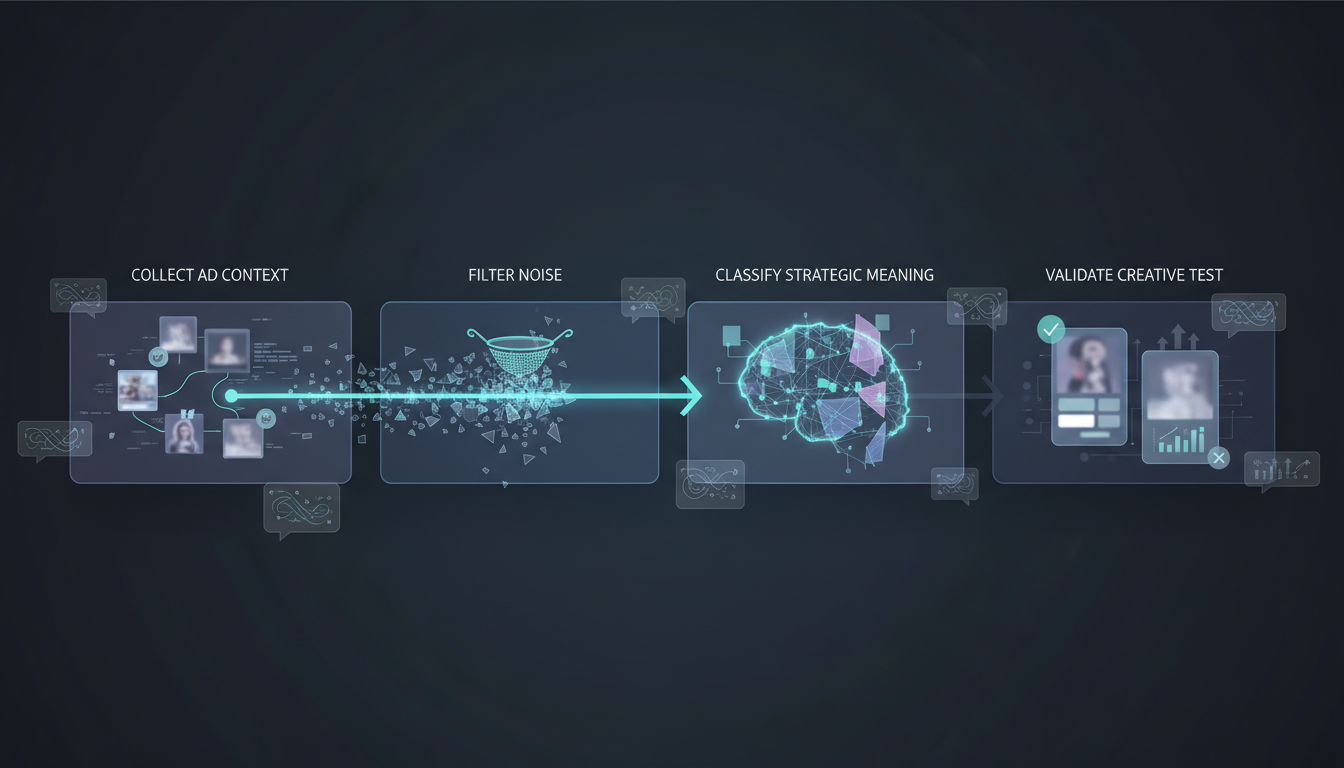
Our workflow has four steps: collect comments with creative context, normalize duplicates and moderation artifacts, assign a strategic category with a confidence level, then human-review ambiguous or high-impact findings. This keeps a model from turning every emotional remark into a recommendation.
Comments Versus DMs
Public comments and private DMs should not share one denominator or one reporting lane. Comments reveal visible discussion around an ad, while DMs can contain sensitive details, account issues, or private purchase context.
| Channel | Best Use In Creative Research | Handling Rule |
|---|---|---|
| Public Comments | Repeated objections, questions, creative praise, and language patterns | Preserve ad context and redact unnecessary identifiers |
| Private DMs | Deeper intent, support friction, and private objections | Restrict access, minimize retention, and human-review sensitive material |
We keep private feedback separate because access and privacy expectations differ. Meta Business Suite can organize comments and business messages, including messages sent in response to an ad, but our feedback-to-test workflow keeps the resulting insight streams distinct.
How Do Meta Ad Comments for Creative Strategy Become Creative Decisions?
A useful theme has to become an explicit action. We do not hand a creative team a sentiment chart and ask them to guess what to make next.
How We Map Themes to Actions
| Theme | Possible Ad Response | Possible Site Response |
|---|---|---|
| “Will this work for me?” | Compatibility hook or demonstration | FAQ and eligibility clarification |
| “Why does it cost this much?” | Value framing or risk-reversal copy | Pricing explanation or guarantee detail |
| “I do not understand how it works” | Mechanism visual or simpler opening claim | Explainer block or product walkthrough |
| “Can you prove that?” | Demonstration, substantiated testimonial, or credential | Evidence section or case-study proof |
| “This is exactly the outcome I need” | Outcome-led headline using customer language | Landing-page value proposition |
What Our Output Brief Includes
We give the creative team a compact brief: the theme, category, de-duplicated evidence, originating ads, representative wording, hypothesis, proposed test, substantiation guardrail, and owner. That format makes it clear whether we are changing a hook, proof asset, primary text, offer, FAQ, or landing page.
We also preserve what did not work. Our concept prioritization framework helps us rank a repeated proof request differently from a one-off complaint, and prevents recycled concepts from returning without new evidence.
What We Do Not Infer
We do not assume an active comment thread caused conversion performance. We treat comments as evidence of how people interpreted an ad, then test whether addressing that interpretation improves outcomes.
How Should We Validate Comment-Led Creative Findings?
We compare themes across winning and losing ads only to generate hypotheses. We look for patterns within comparable periods, placements, audiences, formats, and spend ranges, rather than declaring that one comment category caused a result.
The next step is a controlled creative test. We hold the offer, audience, and landing page steady where possible, change one decision such as the hook or proof asset, and judge the variation against conversion performance. Meta’s measurement guidance emphasizes connecting measurement across the customer journey, which is more useful than declaring victory because sentiment improved.
When a Theme Is Ready to Test
A theme is ready when it repeats across relevant ads, uses specific language, survives filtering, and suggests a clear creative change. Low-volume themes stay on a watchlist until more evidence arrives.
We use a defined decision framework to determine whether a test deserves another iteration or whether the team should move to a stronger hypothesis.
How Can Deepsolv Turn Comments into Creative Decisions?
At Deepsolv, our creative intelligence software helps paid-social teams turn scattered market signals into decisions a creative team can execute. We bring the evidence chain together so a strategist can see the source ad, the customer language, the relevant performance window, and the proposed next test without treating every remark as a verdict. That makes weekly reviews more useful: teams can separate repeated objections from support noise, preserve proof requests, and prioritize concepts with a visible rationale.
We built this page around the same discipline. Use it to replace disconnected feedback reviews with a repeatable creative decision system. Start with a defined taxonomy, keep comments and DMs in separate lanes, ask a human to review ambiguous findings, and use conversion results to decide whether a theme deserves another iteration. If you want a clearer way to connect creative research, feedback, and outcomes, book a demo.
FAQs on Meta Ad Comments for Creative Strategy
Can Meta Ad Comments Show Why an Ad Converts?
No. We use comments to form hypotheses, compare comparable ads, then test a proposed copy or concept change against conversion outcomes over a defined performance window.
Should We Use Sentiment as the Main Dashboard?
Sentiment can flag audience mood, but it does not identify the precise claim, proof gap, customer question, or desired outcome we should change in creative.
How Many Comments Make a Theme Actionable?
We keep a pattern on a watchlist until it repeats across relevant ads, uses specific language, and survives spam, duplicate, sarcasm, and moderation review by us.
Can We Analyze DMs with Ad Comments?
We keep DMs separate from public comments, restrict access, remove unnecessary identifiers, set retention rules, and human-review sensitive or ambiguous themes before creative use internally.
Do Comment Themes Need A/B Tests?
Yes, when a repeated theme drives a material creative change. We hold other variables steady where possible and judge the variation using conversion performance over time.