


TL;DR
We turn permitted Meta comments and business messages into evidence for paid-social tests, not a standalone sentiment score. This guide separates accessible feedback from private data, compares tool categories, shows our seven-step validation workflow, and maps verified themes to creative, landing-page, and moderation actions.
Meta Ad Comment Analysis Tools for Paid-Social Tests
Meta ad comment analysis tools turn permitted public comments and business messages into campaign evidence by finding repeated objections, questions, desired outcomes, proof requests, and purchase intent. We link each validated theme to its source language, ad, audience context, spend, and conversion data so creative teams can turn feedback into a defensible test.
Below, we compare tool categories, clarify what feedback can be analyzed, show a seven-step workflow, and map validated themes to creative, landing-page, and moderation actions.
What Do Meta Ad Comment Analysis Tools Actually Do?
We use these tools to turn a large, messy set of replies into a smaller set of decisions. The useful output is not “62% positive.” It is a documented finding such as, “People seeing this prospecting video repeatedly ask whether the product works with a specific use case, so test that answer in the opening five seconds.”
A capable workflow keeps the evidence attached. That means the original wording, its source, the ad that prompted it, the surrounding thread where relevant, and the performance context that tells us whether the pattern deserves attention.
| Tool Category | Data Sources | DMs | Comments | Sentiment And Themes | Languages | Moderation | Integrations | Best Fit |
|---|---|---|---|---|---|---|---|---|
| Native Business Inbox | Connected business assets | Authorized inboxes | Connected Page and professional-account threads | Mostly manual | Interface-supported | Strong | Native tools | Fast response and triage |
| Export And Analysis Workspace | Authorized exports | Connection-dependent | Connection-dependent | AI-assisted or manual | Model-dependent | Limited | CSV and BI | Periodic reviews |
| Social Listening Or Voice-Of-Customer Platform | Public and authorized sources | Usually limited | Connection-dependent | Strong clustering | Vendor-dependent | Varies | CRM and BI | Broad theme discovery |
| Approved API Workflow | Authorized business assets | Permission-dependent | Permission-dependent | Configurable | Must be tested | Optional | Ads data and warehouse | Governed analysis at scale |
| Creative-Intelligence Workflow | Feedback plus campaign context | Permission-dependent | Permission-dependent | Themes linked to tests | Must be tested | Routes noise | Performance and creative records | Weekly paid-social decisions |
We separate sentiment from insight. Sentiment tells us whether language appears favorable, neutral, or unfavorable. Insight explains the reason, identifies the affected creative, and proposes an action with evidence behind it. Our comment-and-DM workflow is built around that distinction.
What Meta Feedback Can We Analyze?
Visibility is not authorization. A public-looking comment, a Page inbox message, an Instagram mention, and a private person-to-person conversation are different data types with different access rules and different privacy expectations.
Meta’s Conversations API documentation requires advanced access for many business conversations and notes that inactive Instagram Requests-folder conversations beyond 30 days are not returned. We treat current permissions, connected assets, and historical availability as checks to confirm before analysis begins.
Public Comments Are Not a Universal Dataset
We analyze comments tied to business assets that a team owns or is authorized to manage. That can include public comments under connected Facebook Page content or connected professional Instagram content, subject to the available connection and permissions.
Public visibility does not mean a team should collect every possible interaction indefinitely. We keep only the fields needed to understand the feedback, link it to an ad, and support a specific creative or operational decision.
Business Messages Need a Narrower Rule
Business messages can contain high-intent questions about fit, delivery, compatibility, returns, or price. They can also contain personal details that do not belong in a creative brief. We limit analysis to approved business inbox conversations and redact unnecessary identifying information before wider team review.
| Source | Appropriate Analysis Scope | Access Condition | Historical Caveat | Exclude |
|---|---|---|---|---|
| Facebook Page Or Ad Comments | Comments on authorized business assets | Page access and current permissions | Confirm endpoint and backfill scope | Unapproved assets |
| Instagram Comments | Connected professional-account content | Linked business setup and permissions | Confirm paid-placement coverage | Consumer-account access |
| Messenger Page Messages | Business-to-person threads | Approved messaging access | Confirm retention and export scope | Personal Messenger threads |
| Instagram Messages | Professional-account conversations | Approved business and messaging access | Requests inactive beyond 30 days may be unavailable | Private conversations outside the business thread |
| Mentions | Connected professional-account mention data | Connection-specific access | Do not treat mentions as ad comments | Private mentions |
| Private Data | None | No advertising-research basis | Not applicable | Personal conversations and unrelated records |
Mentions and Private Data Need Separate Buckets
A mention may reveal useful market language, but it is not automatically evidence about a paid ad. We label it separately so a creative team does not mistake organic discussion for ad-specific feedback.
We never treat private conversations between people, inboxes outside the connected business asset, or unrelated customer records as inputs to paid-social research. For a practical sorting method, use our comment decision framework.
How Do We Turn Raw Feedback into Evidence?
Raw feedback becomes useful only when the team can explain how it was collected, cleaned, interpreted, and approved. We make the workflow auditable because a vivid isolated comment can otherwise outweigh a quiet pattern repeated across many people.
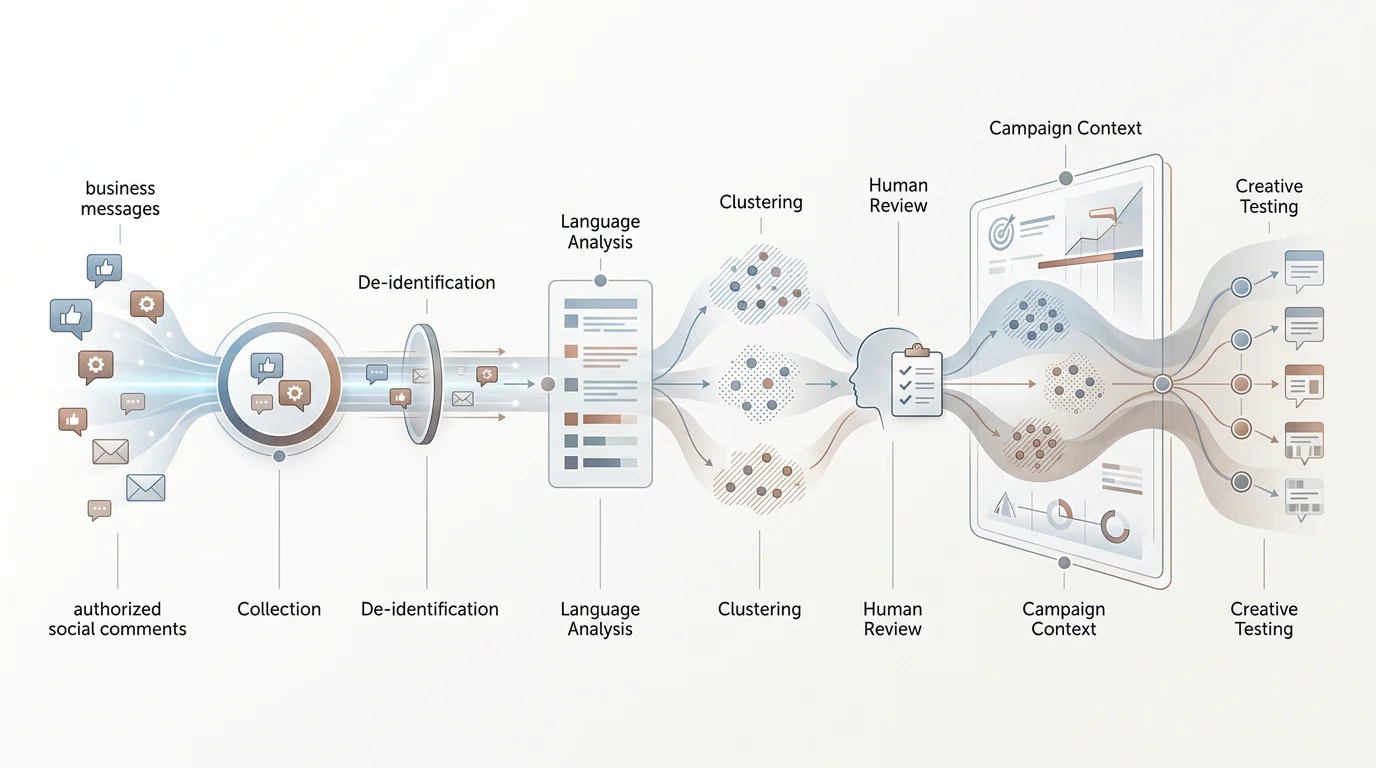
Connect and Capture Context
Start with authorized assets, then preserve the fields that make later interpretation possible.
- Connect approved Facebook Pages, Instagram professional accounts, and business inboxes.
- Capture source, timestamp, thread or comment ID, ad ID, campaign, ad set, placement, creative version, and available performance context.
Clean, Classify, and Cluster
The next stage separates meaningful customer language from operational noise. We deduplicate repeated text, tag obvious spam or support-only cases, detect language, and redact unnecessary personal information.
- Deduplicate replies and label spam, bot activity, unrelated promotions, and moderation noise.
- Classify sentiment plus objections, desired outcomes, confusion, proof requests, feature language, and purchase intent.
- Cluster similar language while retaining source examples and campaign context.
Review and Hand Off a Decision
A 2023 meta-analysis covering 272 datasets and 12 million labeled documents found that sentiment models can perform differently across contexts. That is why we use model output to organize review, not to replace it.
- Score recurrence, source quality, campaign concentration, and commercial relevance with human review for ambiguity or sarcasm.
- Link approved themes to spend, delivery, conversions, and creative records, then assign a test owner and success metric.
| Evidence Grade | Decision Rule | Treatment |
|---|---|---|
| Strong | Repeats across at least three unique people and two ad contexts | Eligible for a test brief |
| Directional | Repeats but remains concentrated in one creative or limited delivery | Investigate before generalizing |
| Anecdotal | One substantive comment or message | Preserve as a research lead |
| Ambiguous | Sarcasm, slang, mixed intent, or uncertain translation | Send to human review |
| Noise | Spam, duplicates, scams, or unrelated promotions | Exclude from strategy counts |
Those thresholds are operating rules, not universal benchmarks. Teams should adjust them for reach, category risk, and the amount of feedback available. Our complete analysis guide explains how to preserve that context without turning every comment into a claim.
Which Tool Category Fits Our Paid-Social Workflow?
The right category depends on the decision your team needs to make. A small team that needs to answer customers quickly may prioritize inbox routing and moderation. A growth team planning new concepts needs evidence that connects feedback to specific ads, audiences, spend, and conversion outcomes.
Meta’s Marketing API fields include ad, campaign, ad-set, spend, actions, action values, and conversion-related reporting. We use that context to avoid broad conclusions such as “customers dislike the price” when the feedback may be concentrated in one offer, one placement, or one retargeting segment.
When evaluating a tool, ask whether it can show representative source language, separate comments from messages and mentions, support exports, document permissions, and preserve reviewer corrections. Also ask whether it can show why a theme matters commercially, rather than simply displaying a theme cloud. Our creative intelligence software focuses on that decision layer.
How Do Validated Themes Become Better Ads?
Validated themes should become specific work, not a dashboard artifact. We translate each finding into one proposed creative action, one adjacent on-site or support action where useful, and one metric that determines whether the response improved the outcome.
| Validated Theme | Evidence To Retain | Paid-Social Output | Adjacent Action |
|---|---|---|---|
| Price Objection | Customer wording, recurrence, affected ads | Value-framing hook or proof-led script | Pricing FAQ or comparison block |
| Desired Outcome | Desired result in customer language | Outcome-led opening or creator prompt | Landing-page headline |
| Confusion | Repeated “how does this work?” questions | Demonstration or explainer creative | Simplify product-page sequence |
| Proof Request | Requests for reviews, ingredients, guarantees, or results | Testimonial or substantiation creative | Evidence and returns section |
| Feature Language | Customers’ own nouns and verbs | Copy vocabulary and search-angle test | Product-page wording refresh |
| Purchase Intent | Shipping, fit, availability, or compatibility questions | Objection-handling retargeting creative | Fast-response support route |
Every recommendation should include its source excerpts, affected ads, confidence grade, proposed owner, and success measure. We then phrase the hypothesis plainly: for this audience and context, lead with this validated language because the evidence shows this repeated concern, measured against a defined control.
That makes creative iteration easier to defend. Instead of asking a team to “make new price ads,” we can ask it to test a specific proof point against a specific baseline. Our creative test control guide helps keep that comparison fair.
How Deepsolv Turns Feedback into Paid-Social Decisions
At Deepsolv, we built our workflow for teams that need an answer to a practical paid-social question: what should we test next, and why? We help you keep authorized feedback tied to the ads, audiences, delivery periods, and performance context that created it. Instead of passing a vague mood score into a creative meeting, we help your team preserve source language, separate repeatable customer signals from moderation noise, and turn each approved theme into a clear owner, test hypothesis, and success measure.
That gives media buyers, creative leads, support teams, and analysts a shared record of what customers said, which evidence supported the decision, and what changed after the test. Our approach keeps decisions explainable when budgets and creative calendars move quickly. If your team needs a governed route from feedback to the next creative decision, see how we work and book a demo.
FAQs on Meta Ad Comment Analysis Tools
Can We Analyze Every Meta Ad Comment?
Only comments attached to assets your business is authorized to access should enter the workflow. Platform permissions, account setup, and available historical records still determine coverage.
Can We Analyze Facebook and Instagram DMs?
We analyze business conversations only when the connected asset, permissions, and approved access allow it. We do not treat personal conversations as advertising research material.
Is Sentiment Analysis Enough to Change an Ad?
Not by itself. A useful decision needs repeated source language, campaign context, noise checks, and human review, then a measurable hypothesis against a defined creative control.
How Many Comments Make a Theme Actionable?
We use recurrence across unique people and multiple ad contexts as a starting gate, then adjust for reach, intent, language quality, and business risk before acting on it.
How Do We Turn a Theme into a Test?
Keep customer wording, affected ads, confidence grade, and proposed action together. Our paid-social test prioritization process assigns an owner, metric, and review date for each hypothesis.