
Marpipe Pricing: Is It Worth It for Catalog Ads?
Compare Marpipe pricing, SKU limits and feed costs. Use a catalog-ad checklist to decide when it fits and when Meta testing needs another workflow.

Marpipe’s published plans are Free at $0/month, Startup at $199/month, and Enterprise at $999/month. Marpipe is worth the cost when your growth constraint is turning a changing product feed into better catalog ads at scale, not when your team still cannot decide which message, hook, or objection deserves the next Meta test.
Use the checklist below before booking a demo. It tells you whether to start with catalog automation, expand a catalog workflow, or add a separate creative-testing decision layer.
Use This Catalog-Ad Fit Checklist
Check each statement that describes your current program.
Feed Complexity
- Our product feed needs fields cleaned, grouped, or segmented into product sets.
- Prices, stock, promotions, or category rules change often.
- We need catalog creative to update without rebuilding assets manually.
- We need more than one output or location feed.
What the result means: If you checked three or four boxes, your bottleneck is operational. Marpipe’s pricing includes feed-field management and product sets. Its additional location feeds cost $299/month per feed.
SKU Volume
- We counted every product variant, not only parent products.
- Our initial test fits within 500 SKUs.
- We know how fast our variant count grows during promotions.
- We need a plan for more than 500 SKUs before launching.
What the result means: Startup costs $199/month for up to 500 SKUs. Marpipe counts variants as SKUs. Its pricing page lists an additional 200 SKUs at $100, or a move to a higher tier.
Worked cost arithmetic: At 500 counted SKUs, Startup costs $199 per month, or $0.398 per SKU per month. At 700 SKUs, adding one 200-SKU block brings that planning example to $299 per month, or $0.427 per SKU per month.
Creative Variation
- Three live catalog designs are enough for our first test.
- We need different treatments by product category, offer, or inventory state.
- We need catalog video, not only static product imagery.
- We need multiple channels or markets from one catalog workflow.
What the result means: Startup includes one channel, one market, and three live designs. Enterprise is $999/month and adds unlimited channels, unlimited live designs, and product-level video.
Measurement
- We can keep our current catalog treatment as a control.
- We can name one primary outcome before changing creative.
- We can test one catalog treatment at a time.
- We will record why a treatment won or lost.
What the result means: A catalog tool is only valuable when your team can read the result. Marpipe reports an average lift for enriched catalogs, but also says it cannot guarantee performance. Treat the subscription as a production and testing investment, not as a promised return.
Non-Catalog Testing Needs
- Our next question is which hook, offer, or objection should enter production.
- We need customer comments, reviews, and ad results to shape a creative brief.
- We run meaningful Meta tests beyond product-feed ads.
- We need a record of prior tests and their outcomes.
What the result means: Two or more checks point to a creative-decision problem alongside the catalog-production problem. Use catalog automation to produce feed-based variants, then use a testing workflow to decide which broader concepts deserve budget.
Our rule of thumb: choose Marpipe first when the first three sections produce the strongest score. Add broader creative decision support when the final section produces two or more checks.
What Marpipe Pricing Includes
Marpipe’s public prices are clear at the entry level. The final bill changes with SKU count, output requirements, and whether you add managed feed support.
| Plan or Add-On | Published Price | Concrete Limit or Inclusion |
|---|---|---|
| Free | $0/month | DPA launch and design previews |
| Startup | $199/month | 500 SKUs, 3 live designs |
| Enterprise | $999/month | Unlimited channels and designs |
| Extra SKU block | $100 | 200 additional SKUs |
| Location feed | $299/month | One additional location feed |
| White Glove feed management | $0.05/SKU | $400 minimum |
The table makes the buying decision simpler. Startup is a clean test for a catalog at 500 variants or fewer. Enterprise becomes relevant when live-design, channel, video, or SKU requirements exceed that test.
White Glove feed management has its own arithmetic. At 500 SKUs, the $400 minimum applies because 500 × $0.05 equals $25. At 10,000 SKUs, the listed rate equals $500 per month.
When Marpipe Is Worth the Price
Marpipe earns its price when a team already knows what it wants its catalog ads to say. The team then needs a reliable way to apply that treatment across many products, prices, categories, and placements.
A strong Marpipe use case looks like this:
- A retailer has hundreds of variants and frequent promotional changes.
- The retailer needs a sale badge only on eligible products.
- The retailer needs separate creative rules for clearance, new arrivals, and best sellers.
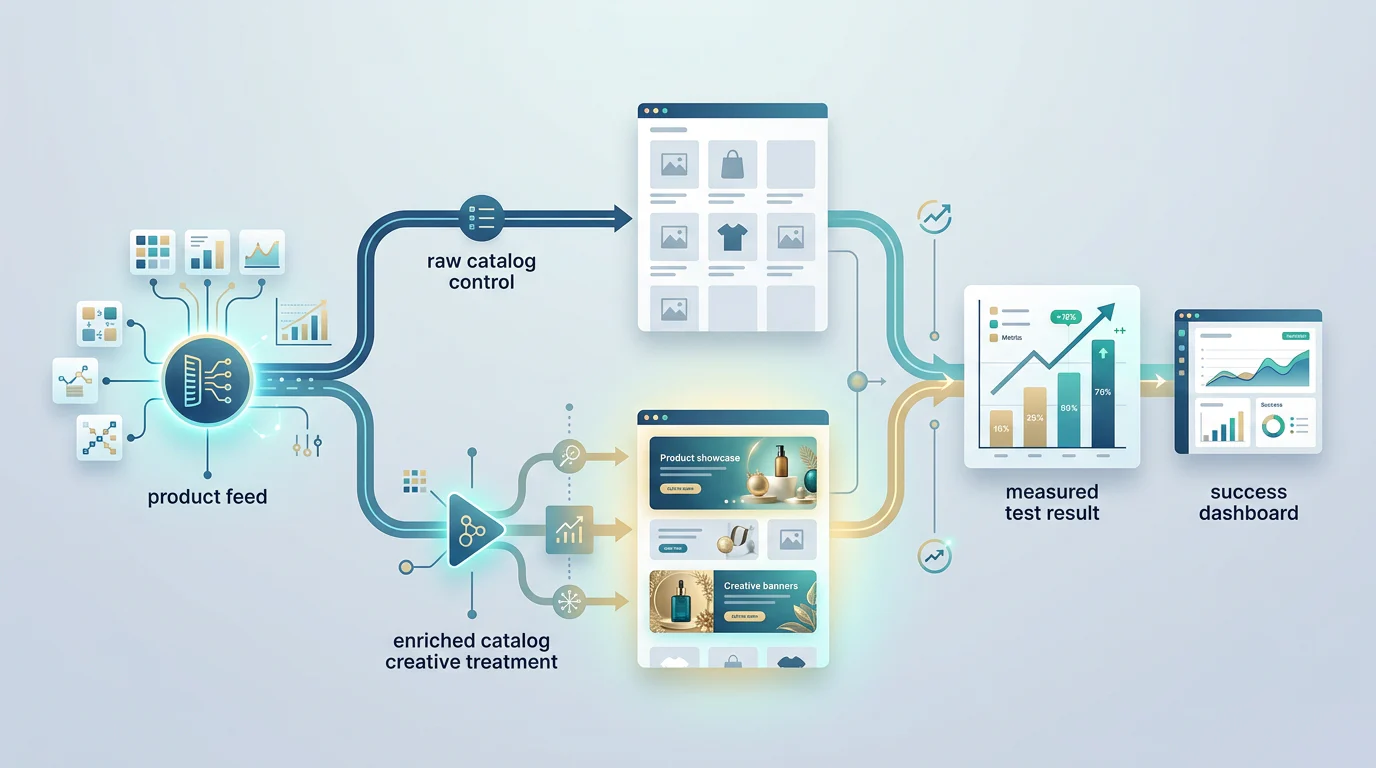
- The retailer wants to test the enriched catalog treatment against its current raw catalog.
- The retailer has a clear owner for feed quality and test results.
Marpipe’s product scope supports catalog creative, product-level video, generative catalogs, SKU optimization, and feed management. Its product page also lists catalog-ad support across Meta, Google, TikTok, Pinterest, Snapchat, Reddit, and other dynamic-product-ad platforms.
The price is harder to justify when a team has a small, stable catalog and only needs an occasional price badge. That team should first calculate the actual hours spent on feed edits and catalog refreshes. If the work takes minutes each month, automation will not remove a meaningful constraint.
How to Run a Marpipe Pilot That Produces an Answer
Start with one product set and one treatment. A broad redesign makes the result impossible to interpret.
- Choose one product set. Pick a category with enough active products and consistent stock.
- Keep the current catalog as control. Do not change audience, offer, landing page, and creative treatment together.
- Name one variable. Test a sale badge, a product-image treatment, a value proposition, or a video format.
- Set the outcome. Choose the metric your team already uses to judge catalog performance.
- Record the result. Note the treatment, eligible SKUs, dates, spend, outcome, and next action.
A fair control matters more than a large number of variants. Use our guide to choose a creative-test control ad when the current catalog setup needs a defensible benchmark.
What Catalog Automation Does Not Decide
Catalog automation answers a production question: how should a known treatment appear across eligible products?
It does not answer a strategy question: should your next Meta ad lead with price relief, product proof, a customer objection, a comparison, or a new use case? A product feed can populate a badge. It cannot establish which claim deserves the badge.
That distinction becomes important after your catalog workflow runs smoothly. At that point, more templates may not improve the next test. The team may instead need better evidence about which angle has earned a production slot.
Track that evidence at the angle level, not only at the ad level, with creative angle performance tracking.
When You Need Broader Meta Creative Testing Support
Use a broader decision workflow when your team has more concepts than it can responsibly produce and fund. The input should include your own ad performance, customer language, past experiments, and observable market activity.
At Deepsolv, we turn competitor activity, customer signals, ad performance, and past experiments into a ranked weekly plan for what to test, improve, or stop. Our workflow produces decision-ready briefs and follow-up tracking for Meta growth teams. Our current product features describe that workflow.
Deepsolv fits beside catalog automation. Marpipe can help your team produce a feed-based treatment across many SKUs. Deepsolv helps your team choose whether the next treatment should emphasize an objection, promise, hook, offer, or format before production begins.
Public competitor ads are useful market context, but they do not reveal a competitor’s revenue, profit, or causal performance. Your own connected account data and test results supply the evidence for a decision about your brand. Learn how to separate those inputs in our guide to owned performance and competitor signals.
Which Workflow Fits Your Next Constraint?
The three options below solve different jobs. Choose the job that currently delays your next profitable action.
| Option | Best For | Published Price |
|---|---|---|
| Marpipe | Catalog creative at scale | Startup, $199/month |
| CustomPix | Shopify catalog image templates | Pro, $19/month |
| Deepsolv | Ranked Meta test decisions | Tailored workflow pricing |
CustomPix suits Shopify merchants who need product-image selection, dynamic templates, price overlays, discount overlays, and badges. Its public plans are Pro at $19/month for up to 1,000 variants, Pro 10k at $39/month for up to 10,000 variants, and Pro 50k at $89/month for up to 50,000 variants. CustomPix pricing also includes a seven-day trial.
Marpipe suits teams that need a larger catalog-creative and feed workflow. Deepsolv suits Meta teams that need a ranked decision about what to test next. Many growing ecommerce teams need both categories, but at different points in their workflow.
FAQs
Does Marpipe Charge a Percentage of Ad Spend?
No. Marpipe says its pricing does not use a percentage of ad spend, revenue, or usage pricing. Its published plans use monthly prices and SKU-related add-ons instead. See Marpipe’s pricing terms.
Can Marpipe Create Product-level Video Without Existing Videos?
Yes. Marpipe says its Product Level Video tool can create custom videos for each SKU without requiring the team to supply existing videos. Product-level video is listed with Enterprise capabilities. See the product-level video FAQ.
Does Marpipe Only Work with Meta Catalog Ads?
No. Marpipe says it works with ad platforms that support catalog ads or dynamic product ads, including TikTok, Snap, Pinterest, and Reddit. Your team should still define the specific output feed and placement requirements before building the treatment. See Marpipe’s platform FAQ.
For a Meta team whose bottleneck is deciding what creative deserves the next test, explore Deepsolv’s creative intelligence workflow. We connect market, customer, performance, and experiment signals into a ranked weekly plan, then help teams preserve the learning from each result.