
5 Best Music-to-Video Generator Tools for Musicians in 2026: Automated Creative Brief Tools

TL;DR
Daily Business published a five-tool music-to-video ranking on 17 August 2026. We found that its market context is broadly supportable, but its winner and product-level claims are not independently benchmarked. We rank five practical workflows and show how automated creative brief tools can convert audio, rights, and performance signals into measurable paid-social tests.
Music releases now compete in a much larger video economy. U.S. digital-video ad spending is projected to exceed US$80 billion in 2026, which makes repeatable creative production more important than a one-off polished video.
Daily Business published its five-tool music-to-video ranking on 17 August 2026. Our review finds that the ranking is a publisher’s comparison, not an independent benchmark. The practical response for musicians and paid-social teams is to use automated creative brief tools to turn audio and audience signals into rights-checked, testable vertical-video concepts.
We cover what the ranking actually established, the five workflows worth comparing, and how we would connect each video decision to measurable creative learning.
What Happened in the Daily Business Ranking
Daily Business did not report a new industry standard, product launch, or independently audited benchmark. It published a commercial comparison intended to help musicians choose a music-to-video workflow, then selected one product as its overall winner.
The ranking article was published on 17 August 2026. It describes a fictional 32-second, 120 BPM test track, a shared visual brief, a vertical export requirement, and five named commercial products, but it does not publish the generated outputs, scoring records, prompt history, total revision cost, or a reproducible test protocol.
That distinction is useful for our audience. A tool demo can establish that a workflow is possible, but it cannot establish that the workflow will produce an efficient creative test for a specific brand, audience, offer, and channel. We would move from a market signal to an action using a documented signal-to-action workflow, rather than treating a generic rank as a media decision.
Our 2026 Ranking: Five Music-to-Video Tool Workflows
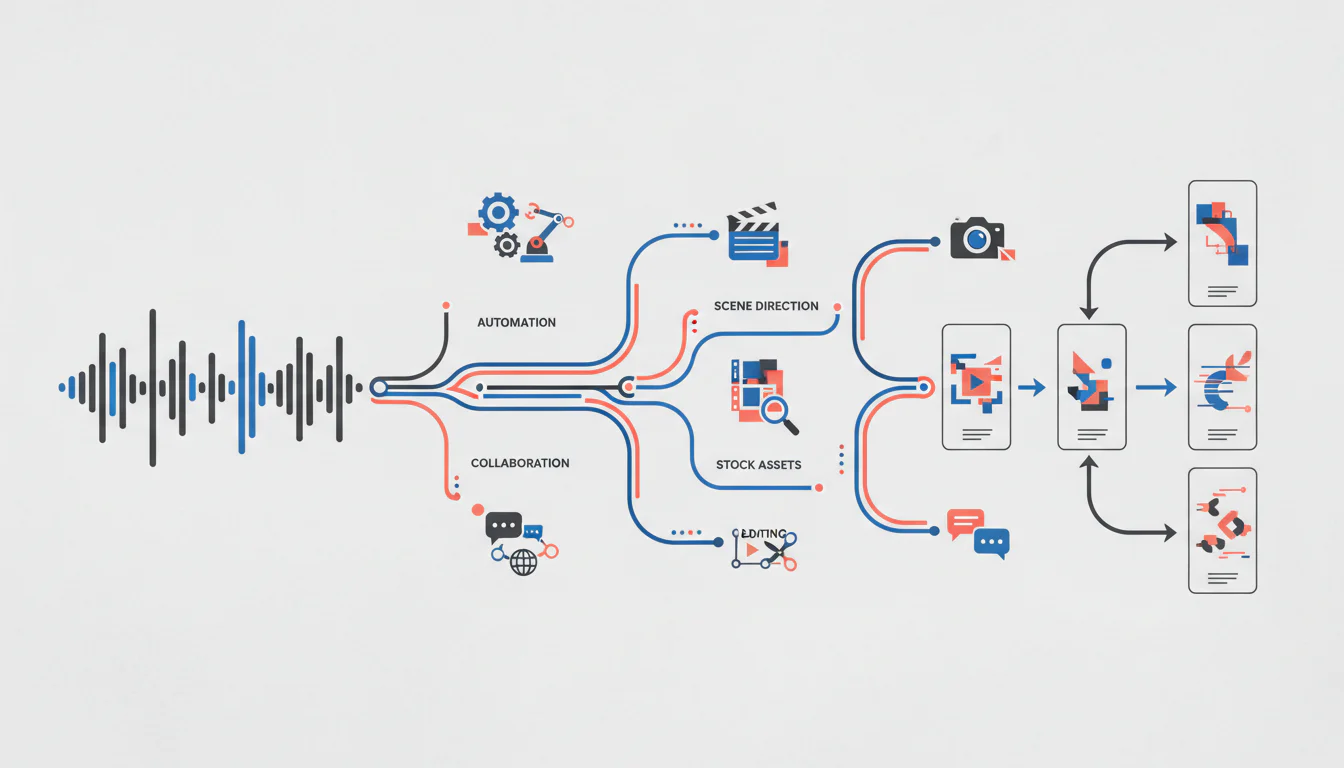
We rank workflows, not named products, because an overall product winner would overstate the evidence available. The most useful music-to-video tool depends on what an artist already owns, how much visual control they need, and whether the finished work must create learning beyond the release itself.
Global recorded-music revenue reached US$31.7 billion in 2025, according to the global report. That scale explains the demand for more visual output, but it does not make faster generation synonymous with better creative.
| Rank | Tool Workflow | Best Fit | What We Would Verify |
|---|---|---|---|
| 1 | Music-first generation | Finished track with limited existing footage | Beat response, section changes, usable revisions, and rights terms |
| 2 | Scene-first generation | Artists with a clear visual narrative | Character continuity, shot control, retries, and total production time |
| 3 | Licensed-asset assembly | Fast, predictable promotional output | Asset licenses, uniqueness, edit flexibility, and format fit |
| 4 | Timeline-led finishing | Artists with performance footage or approved visuals | Precise timing, caption control, exports, and manual labor required |
| 5 | Collaborative repurposing | Teams producing several social cutdowns | Approvals, version history, reuse, and handoff quality |
Music-First Generation
Music-first generation earns the top workflow rank when the song is the strongest asset and the team needs a first visual direction quickly. We would test whether cuts respond to an intro, vocal entry, energy shift, and final beat, rather than accepting decorative movement as meaningful synchronization.
The important output is not the first render. It is a revision path that lets us replace a weak scene without rebuilding the whole sequence and preserve the resulting learning in creative testing memory.
Scene-First Generation
Scene-first workflows suit artists who want each section to have its own prompt, camera direction, or visual mood. They create more control, but they also transfer more responsibility to the human reviewer, particularly for continuity across faces, wardrobe, lighting, and movement.
We would use this workflow when distinct scenes express a clear creative angle. It is weaker when a team needs high-volume output but cannot afford repeated generation, close visual review, and detailed handoffs.
Asset-First, Timeline-Led, and Collaborative Workflows
Licensed-asset assembly offers predictability, while timeline-led editors provide the highest degree of manual timing control. Collaborative workflows are strongest when a musician, manager, editor, and media buyer need to create several versions without losing track of what changed.
None is inherently inferior. The selection depends on whether the brief requires original imagery, exact scene timing, dependable rights, rapid cutdowns, or coordinated approvals.
What Automated Creative Brief Tools Must Capture
Automated creative brief tools should not simply turn a song into an attractive prompt. We use them to convert evidence into an explicit hypothesis: which audience tension the video addresses, what visual opening earns attention, how the music supports the message, and what outcome would prove the idea useful.
Nearly two in three buyers now use generative AI for digital-video creative, according to IAB research. That makes the quality of the decision trail more valuable, not less, because more variations create more opportunities to mistake novelty for a result.
Capture Evidence Before Generating
We would begin with the audience signal, product truth, campaign objective, approved asset rights, and prior creative outcomes. That input prevents an attractive video from becoming an isolated asset with no reason to exist in the test plan.
Our concept prioritization framework is built around that discipline. A brief should show why an idea belongs in the queue before it explains how the footage should look.
Turn the Track into a Test
A music-led concept needs a clear opening, a single promise, a proof moment, an edit rhythm, and a call to action. The creative brief should identify which variable will change across versions, such as the hook, visual treatment, offer framing, or audience tension.
We would connect these choices to paid-social performance records so the team can compare concepts against outcomes instead of only reviewing exports side by side.
Keep an Audit Trail
A useful system records what entered the brief, what the team approved, what the production process changed, and what happened after delivery. It also keeps rights status and human review visible, which matters when generated imagery, music, and platform rules intersect.
| Brief Field | What We Record | Why It Matters |
|---|---|---|
| Audience signal | Comment, customer insight, search theme, or performance pattern | Keeps the concept tied to a real demand |
| Creative hypothesis | Hook, promise, proof, and expected response | Makes the test falsifiable |
| Production choice | Workflow, source assets, edits, and approvals | Explains why versions differ |
| Rights status | Music, visuals, likenesses, and license limits | Reduces publishing risk |
| Result | Delivery, conversion, and qualitative feedback | Turns output into reusable learning |

Test the Video, Not the Demo
A polished demo is not proof that a music-led video will improve attention, conversion, or retention for a specific campaign. We would test the approved creative hypothesis in a controlled way, then compare what changed against the outcome the team chose before launch.
That requires patience when a promising visual concept does not perform. It also requires a clear endpoint, because endless creative iteration can disguise indecision as experimentation. Our creative test stop rules help teams decide whether to scale, revise, or retire an idea.
- Holdout: Compare the music-led version against an appropriate existing creative, not only against another new variation.
- Decision Rule: Set the outcome and minimum evidence threshold before reviewing results.
- Revision Log: Record whether a change affected the hook, proof, pacing, caption, offer, or call to action.
- Stop Condition: End a test when the evidence supports a next decision, not when the team runs out of new visual effects.
Rights, Publishing, and Measurement Checks
Format still matters. Meta reports that vertical video with audio and key creative elements in safe zones produced a 34.5% lower cost per result than image ads in a Meta analysis, although the cited test set ran from May 2022 through April 2023 and should not be treated as a universal performance guarantee.
We would review every output before publication for visual accuracy, captions, safe zones, brand claims, and the permissions behind each source asset. A finished render is only publish-ready when the team can explain who owns the recording, composition, footage, likeness, and generated elements.
| Check | Question We Would Ask | Decision |
|---|---|---|
| Music rights | Do we control the recording and composition for this use? | Clear, replace, or license |
| Visual rights | Can we use every source image, clip, face, and location? | Approve or remove |
| Platform fit | Is the video correctly framed and safe for the intended placement? | Export or revise |
| Human authorship | Did people make meaningful creative selections and modifications? | Document contribution |
| Measurement | Does the variation have a defined outcome and test record? | Launch or hold |
In the United States, the Copyright Office says that prompts alone do not establish human authorship for copyright purposes. We would therefore keep human selection, arrangement, and modification visible in the production record rather than assuming an AI-assisted output is automatically protected.
Distribution adds another check. YouTube’s Content ID system scans uploaded videos against rights-holder references, and a match may lead to tracking, monetization, or blocking. We would treat that as a release-planning issue, not an after-publication surprise.
When audience feedback arrives, it should also inform the next iteration. A documented feedback-to-test workflow helps our teams distinguish a genuine objection or desire from a comment that merely attracts attention.
Deepsolv: Turn Signals into Better Briefs
At Deepsolv, we help paid-social teams keep the learning loop intact when new video formats create more possible variations than humans can track. We connect market signals, comments, creative history, and conversion outcomes so a brief begins with evidence instead of a blank page. Our workflow makes the decision trail visible: why a concept entered the queue, which audience signal supported it, what changed in the execution, and when the test should end. That means your team can use music-led video ideas without mistaking faster production for better strategy. We help you prioritize the next concept, preserve the result, and turn valid learning into the next brief. We also make the rationale available to everyone responsible for creative, media, and reporting. Start with a working session built around live decisions, then book a demo.
FAQs on Automated Creative Brief Tools
These answers focus on decisions teams make before and after publication. Our angle tracking guide shows how to connect those decisions to conversion evidence.
Was the Ranking a Verified Product Launch?
A publisher released a five-product comparison on 17 August 2026. It was a ranking, not an independently verified product launch, benchmark, or industry-wide standard for musicians.
Can Automated Creative Brief Tools Select the Best Video Workflow?
No. We use them to rank concepts and test priorities from evidence, then record the human decision, rights status, production constraints, and conversion result for each video.
What Must We Check Before Publishing an AI-Assisted Music Video?
Confirm rights to recordings, compositions, footage, likenesses, and generated assets. Then review captions, safe zones, brand claims, and platform policy before approving the final version.
How Should We Measure a Music-Led Creative Test?
Set one outcome before launch, compare variations fairly, and retain the decision history. Use those records to decide whether to scale, revise, or retire the concept.