
Is Your Meta Creative Data Ready for AI Test Planning?
Choose the answer that best matches your current Meta creative workflow. Each answer scores 0 to 3 points, where higher points mean your evidence is more ready for AI test planning.
Question 1 of 6
How easily can the team access creative-level Meta performance data?
Pick an answer to continue. Your result appears after question 6.

By Sachit Sharma, CEO & Founder · Reviewed 26 Sept 2026
In brief
AI test planning becomes reliable when creative-level performance, documented tests, customer signals and a named decision owner can be connected. Score six checks from 0 to 3 for a total of 0 to 18: 0–6 needs a baseline, 7–12 needs stronger links between records, and 13–18 can support a structured test queue.
Score the operating system, not the ads
This assessment measures whether your team can turn existing evidence into a testable decision. It does not score creative quality, predict a winning ad, or treat a competitor observation as proof of revenue.
From inputs to a test decision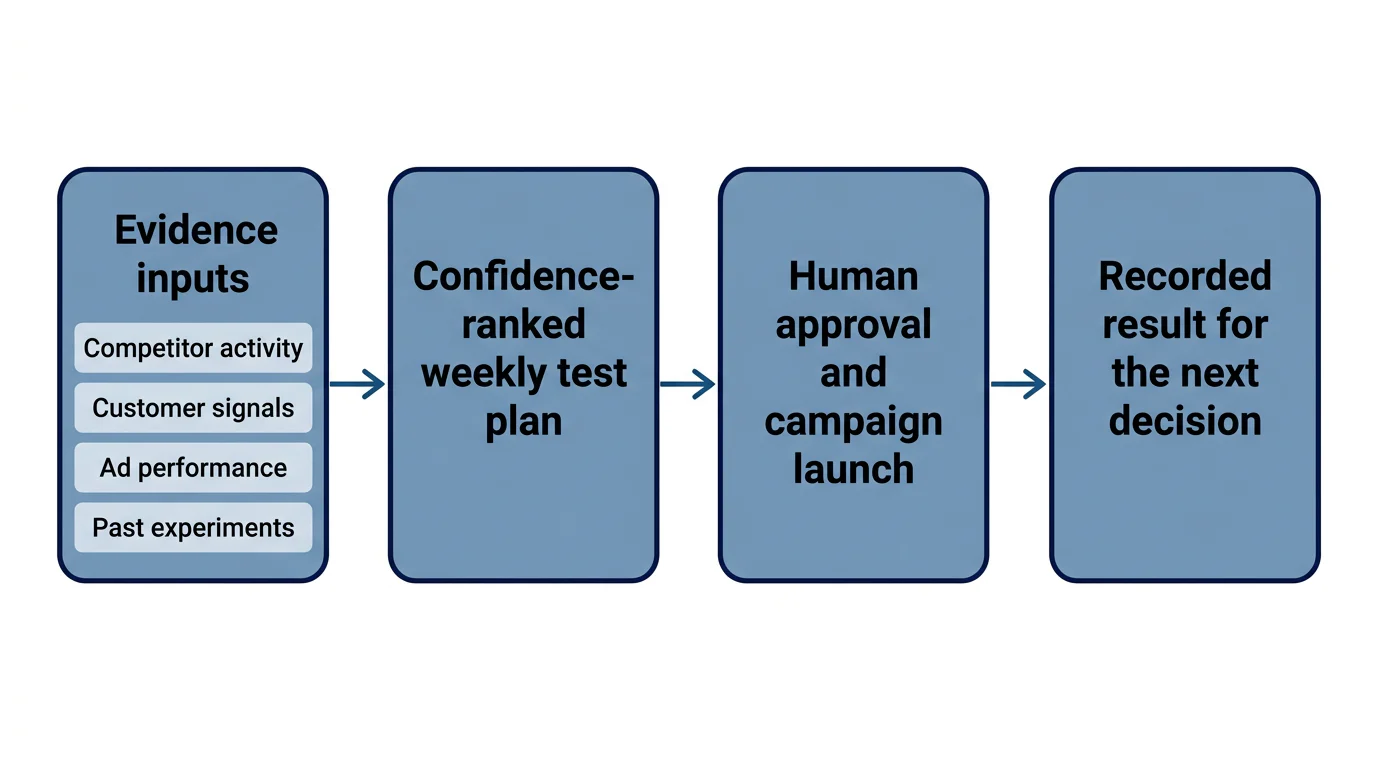
How to read the result
Each answer is worth 0 to 3 points. Higher points always mean the same thing: the evidence is easier to connect, review and reuse.
- 0–6 points, baseline needed: establish a repeatable performance report, a naming rule and a place to record test outcomes before relying on AI planning.
- 7–12 points, partially connected: strengthen the link between performance, the creative variables tested, customer evidence and ownership.
- 13–18 points, ready for a structured queue: use the records to prioritise hypotheses, set a control and capture the next result as future evidence.
Meta’s reporting guidance confirms that Ads Manager can use customised columns, creative-asset breakdowns and reports. That makes access different from simply being able to log in and view campaigns.
Meta Ad Library can help you research currently running competitor ads. Use those observations as context, then use your own account evidence and a fair creative-test control to decide what deserves spend.
What a higher score changes
A higher score means an AI planner has clearer inputs to rank a hypothesis and explain why it belongs in the queue. A lower score does not mean the team lacks ideas. It means the next useful task is to make the evidence identifiable, attributable and owned before turning it into a recommendation.
What this assessment asks
6 questions. Each answer carries points; your total picks the result band below.
01How easily can the team access creative-level Meta performance data?
- A current report with identifiable creative-level performance is readily available.
- We can view campaigns in Ads Manager, but regular reporting is difficult.
- We work mainly from screenshots or cannot access the account data.
- We can export or review performance reports when a review is needed.
02How consistently can you identify the creative idea behind a result?
- We use a naming convention, but it is applied unevenly.
- Names do not reliably identify the creative or test.
- Names consistently identify the test, creative variable and relevant context.
- Campaigns have names, but creative variations are difficult to distinguish.
03What happens to the learning after a creative test ends?
- Some tests are recorded with results and notes.
- The outcome is mostly remembered informally or lost.
- Each test records its hypothesis, variable, outcome and next action.
- Assets and reports exist, but they are disconnected from the original hypothesis.
04How does customer feedback reach creative planning?
- We review one feedback source periodically.
- Customer feedback is not used in creative planning.
- Reviews, comments, direct messages or audience discussions are gathered regularly and traceable to source.
- Feedback appears as anecdotes in meetings.
05Who owns the decision after evidence is reviewed?
- A named person runs reviews, but follow-up ownership is unclear.
- No one owns the next-test decision.
- A named owner records the decision, assigns the next test and captures the outcome.
- Creative and media teams review results separately.
06How well does the evidence survive a handoff to the people who make and launch ads?
- We can share a report, but creative identifiers or context are often lost.
- The handoff is mainly screenshots, chat messages or memory.
- A shared report or export preserves creative identifiers, dates, metrics and source context.
- Someone manually rebuilds the evidence for each review.
How to read your score
| Score | Result | What it means |
|---|---|---|
| 0–6 | Baseline needed | Your team has useful signals, but they are not yet connected well enough for a dependable AI test queue. Start by choosing one repeatable performance report, one naming rule and one place to record every test outcome. |
| 7–12 | Partially connected | Your team can review some evidence, but important links are still fragile. Connect each creative result to its hypothesis, variable, customer evidence and accountable owner before using AI to prioritise the next test. |
| 13–18 | Ready for a structured test queue | Your records can support a reviewable AI planning workflow. Use the next review to rank hypotheses, retain a clear control and record the outcome so the next recommendation starts with evidence rather than memory. |
Keep reading



Frequently asked
This assessment measures six operating checks for Meta creative test planning: data access, naming consistency, historical test records, customer-feedback sources, decision ownership and handoff quality. It measures whether those records can support a reviewable next-test decision.
A score of 13 to 18 means the team has the core conditions for a structured AI test queue. It does not predict that a creative will win. It means the team can connect evidence, approve a hypothesis, run a test and preserve the result for the next decision.
No. The assessment scores the quality and connectedness of the records your team already uses, rather than the number of tools in the stack. A team can improve its score by clarifying ownership, naming tests consistently and recording outcomes in a repeatable format.
Competitor ads can supply context about observable messaging, formats, offers and patterns. They cannot establish another advertiser’s private profitability, return on ad spend or causal lift. Your own controlled test is the evidence that can support a decision about your brand.
Turn a ready score into a ranked next test
We can walk through the signals, account connections and workflow needed to turn your evidence into a confidence-ranked weekly test plan.
Talk to our founders