
Beyond the Auction, Meta Ads Cost in 2026 Needs a Full Plan
As of September 2026, use this guide to turn a desired Meta result into a full cost plan that separates auction media from the work required to make, test and measure creative.
5 chapters · Updated Sep 23, 2026 · By Sachit Sharma
- 12%
- Year-over-year increase in Meta's average price per ad in Q2 2026, across its Family of Apps
- 14 days
- Minimum test duration in Meta's published Audience Network A/B-testing guidance
- 34.5%
- Lower cost per result in Meta's specified Reels creative split-test analysis
Meta Q2 2026 results, 2026
In brief
Meta ads cost cannot be reduced to one CPC, CPM or CPA benchmark. Build a budget from your defined result and account-specific cost-per-result assumption, then add creative production, test-read spend, tooling, measurement and decision labour. Meta's platform-wide average price per ad rose 12% year over year in Q2 2026, which makes transparent assumptions more useful than a universal rate.
A benchmark is context, not your budget
The direct answer to “how much do Meta ads cost?” is that the auction price is only one part of the cost. Meta defines CPM as the average cost for 1,000 impressions, CPC as average cost per link click, and cost per result as the average cost for the selected performance goal. A result can change with the objective and settings, so a lead result and a purchase result do not describe the same unit of value.
That is why a universal CPC, CPM or CPA is a weak planning input. The campaign must first name the outcome it is buying, then identify a range from its own recent comparable campaigns. Meta's Q2 2026 results reported a 12% year-over-year increase in average price per ad across the Family of Apps, while ad impressions increased 14%. That is useful market context, but it is not a forecast for a particular account, country, objective or audience.
A cost benchmark can start a conversation. Account-specific evidence must set the budget decision.
Media cost is an input, not a complete budget
A practical plan begins with two editable assumptions: the target number of results and the cost per result that the account can reasonably test. Planned media is then target results multiplied by the chosen cost-per-result assumption. Use a low, base and high assumption from comparable account history when uncertainty is material, and show the resulting range to the budget owner before launch.
That media figure still does not cover the work needed to make the advertising useful. Separate production costs for each approved creative variant from test-read media, then keep tooling, measurement and decision or management labour visible. The distinction matters because reducing production cost can reduce the number or quality of variants, while reducing test-read spend can leave the team unable to interpret the result.
A transparent model makes each assumption challengeable. It also prevents a low CPM or CPC from being mistaken for a low total cost when the campaign requires creator work, editing, reporting or a new measurement workflow.
A Meta budget is a portfolio of costs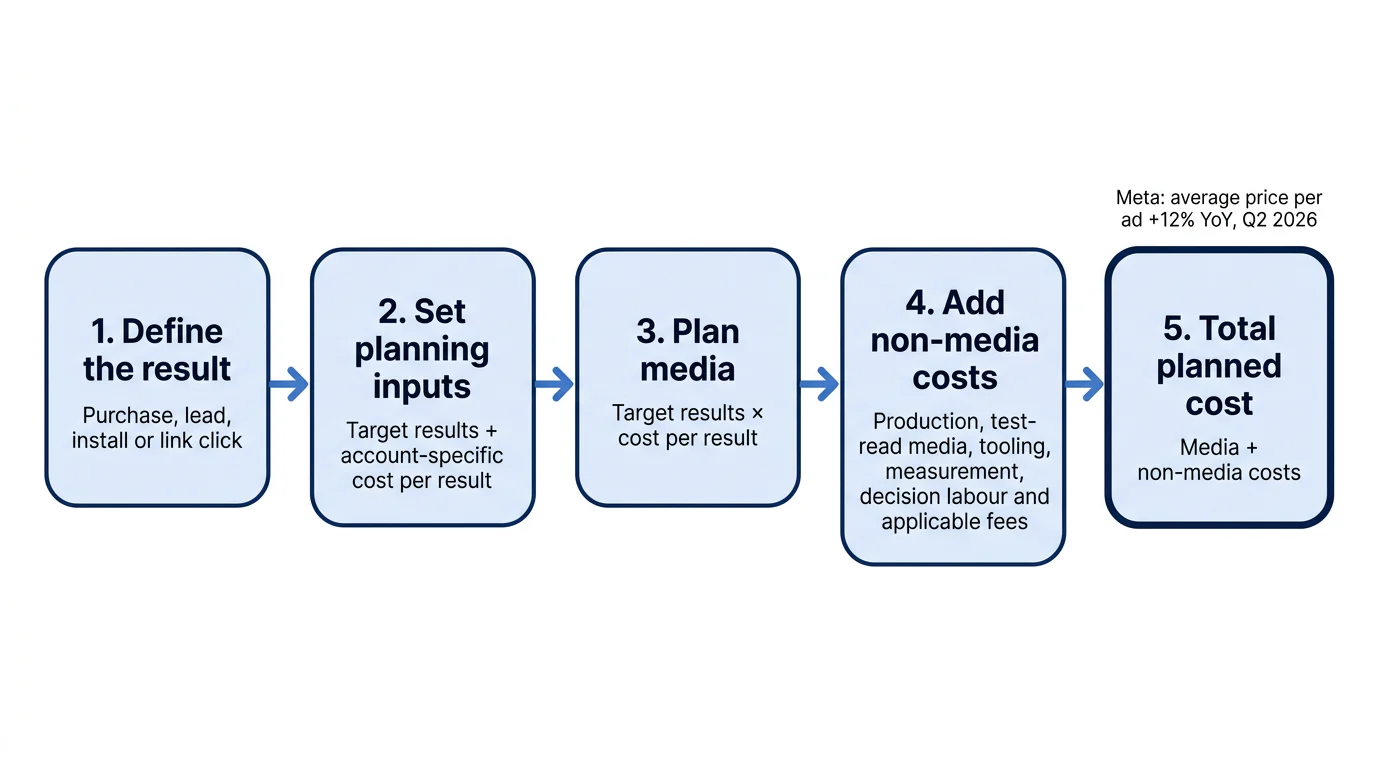
Creative tests need a funded reading period
Testing spend is not a spare-media line. It is the budget reserved to learn whether a defined change is worth continuing. Meta's Audience Network testing guidance recommends keeping all aspects constant except the variable under test, limiting simultaneous tests, and allowing at least 14 days for sufficient data. The source concerns publisher testing, so it should guide disciplined planning rather than become a universal claim about every Meta Ads Manager campaign.
The same caution applies to learning-phase shorthand. Meta's app-campaign documentation says that a bid set too low can prevent collection of the minimum 50 events over seven days needed to exit learning in that documented workflow. That is not evidence that every campaign requires the same event count or budget.
Define the control, the variable, the result that matters, the evidence window and the decision date before production begins. A fair test is better supported by a deliberate control ad and a documented testing framework than by adding variants without a decision rule.
Production is a cost of learning, not just a cost of assets
Creative production deserves its own budget line because the question being tested determines what must be made. A hook test, offer test, format test and visual-treatment test can require different writing, editing, creator, design and approval work. Treating all variants as interchangeable makes it difficult to see whether the media cost or the production decision created the expense.
Meta's published Reels analysis offers a useful example of why format-specific work should be visible. In a global analysis of 15 Reels-only split tests, 9:16 video with audio and key elements in safe zones had 34.5% lower cost per result than image ads in the specified test setup. The study covered ecommerce, retail and consumer packaged goods, and reported 99.9% confidence. Meta's study description is evidence for that setup, not a promise that every vertical or account will achieve the same result.
Use such findings to form a hypothesis, then cost the assets required to test it. A production-first workflow is useful when output volume is the constraint. It is less useful when the team has many assets but no clear explanation of which variable to test next.
Measurement makes a spend line into a business decision
Measurement cost includes the people, tools and process used to confirm what the selected result means. Meta says cost per result varies by performance goal, so a number cannot be judged until the team confirms whether the campaign is optimising for purchases, leads, installs, link clicks or another outcome. Keep the reporting window and objective consistent when comparing a control and variant.
The decision record should retain the hypothesis, the control, what changed, the budget guardrail, the result observed and the next action. That record stops a visible pattern from becoming an unsupported conclusion. It also separates a creative signal from possible changes in audience, offer, landing-page performance, auction conditions or measurement.
Deepsolv fits after the measurement layer has produced evidence: it combines performance, competitor activity, customer signals and past experiments into a ranked weekly creative test plan. It is designed to help a team decide what to test, improve or stop, not to replace the campaign's media controls. Teams can use Meta creative intelligence when the bottleneck is converting scattered evidence into a production decision.
Go deeper
Frequently asked
Start with the result the campaign must produce, the number of those results required, and an account-specific cost-per-result range. Then add creative production, test-read media, tooling, measurement and management costs. A universal Meta budget is not verifiable because results, objectives and auction conditions differ.
Cost per result is Meta's average cost for the outcome selected in the campaign objective and settings. It can represent a purchase, lead, install or another result, so it only works as a CPA-style comparison when the underlying result is the same across the campaigns being compared.
Meta's Audience Network guidance recommends changing one variable at a time and allowing at least 14 days for sufficient data. That guidance applies to its publisher-testing context, so use it as a planning guardrail rather than claiming every Ads Manager test follows the same rule.
No. A visible competitor ad can support a creative hypothesis, but it does not prove that the advertiser is profitable, scaling spend or achieving your target result. Use competitor observations to shape a test brief, then validate the decision with your own account results and measurement setup.
Yes. Media is only the auction purchase. A usable cost plan also separates the cash and team effort required to make variants, give a test a fair read, use supporting tools, measure the selected outcome and decide what to test, improve or stop next.
Turn the next Meta budget into a ranked test decision
Talk to Deepsolv's founders about connecting performance, customer and market signals to the next creative test.
Talk to Founders