
Comparison
Deepsolv vs Pencil AI: Pricing and Credit Costs
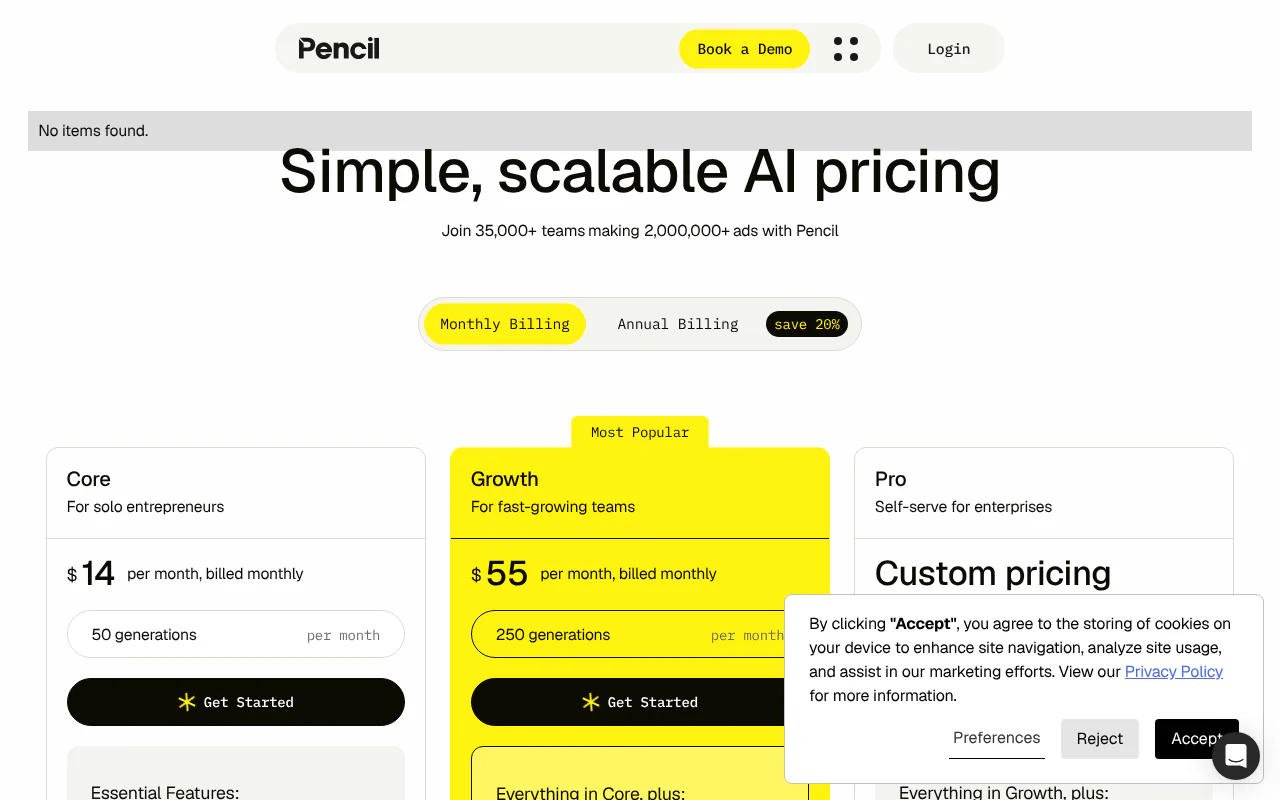
Pencil AI pricing starts at $14 a month for 50 credits, but each AI interaction spends credits, so the cost per finished ad depends on the model and the asset.

By Sachit Sharma, CEO & Founder · Updated 6 Nov 2026
Deepsolv
Creative intelligence platform for Meta advertising teams
Best for: Meta advertisers deciding which ads to test next
Pencil
AI ad asset generator with credit-based plans
Best for: Teams that already know what to make and need volume
On this page
- 01At a glance
- 02How each looks
- 03Which to choose
- 04Detailed comparison
- 05Introduction
- 06Key takeaways
- 07How much does Pencil AI pricing cost in 2026?
- 08What does one Pencil credit actually buy?
- 09How many credits will your weekly ad testing use?
- 10Can the two jobs work together?
- 11Which five checks should you run before paying for either?
- 12How we compared
- 13Frequently asked
The short answer
Pencil costs $14 a month for 50 credits on Core and $55 a month for 250 credits on Growth, with Pro custom-priced. A 15-second 1080p video costs $2.94 to $27.30 on Core's monthly credit rate, so size a plan from a weekly credit budget. For Meta advertisers deciding which ads to make next, we recommend Deepsolv, which delivers ranked weekly test plans before you spend on production.
At a glance
Main job
- Deepsolv
- Decides which Meta ads to make next
- Pencil
- Generates ad assets with AI models
Starts from
- Deepsolv
- Ad-performance data, competitor activity, customer signals and past ad learnings
- Pencil
- Your interactions with AI models for text, images, video and audio
Output
- Deepsolv
- Ranked weekly creative test plans and execution-ready creative briefs
- Pencil
- Generated creative and variations
Price basis
- Deepsolv
- Tailored quote scoped to the team and workflow
- Pencil
- Credits per AI interaction, with a monthly cap on Core and Growth
Entry price
- Deepsolv
- Quote through a personalized demo
- Pencil
- $14 a month on Core ($11 on annual billing)
Data handling
- Deepsolv
- Customer data kept for the subscription plus 6 months after contract termination by default
- Pencil
- No-train terms and data ring-fencing on Pro
Source: Both companies' websites, Nov 2026
How each looks
Which should you choose?
Choose Deepsolv if
- Your open question is what to test, not how to make it
- You want a ranked weekly creative test plan rather than credit-metered generation
- You want briefs built from ad-performance data, competitor activity, customer signals and past ad learnings
- You want a quote scoped to your brands, team and agency clients rather than a plan name
- You want a clear data term: customer data kept for the active subscription plus 6 months after contract termination by default
Choose Pencil if
- You already know what to make and need volume, using feed variations at 1 credit each and Auto Resize at 1 credit per format
- You want to try AI generation at a low entry price
- You need contractual IP assignment, no-train terms, data ring-fencing and a managed-service SLA, which Pencil Pro includes
Deepsolv vs Pencil, point by point
A check marks the stronger side on that point. Points without a check are even, or depend on what you need.
| What matters | Deepsolv | Pencil |
|---|---|---|
| What you get | ||
| Decision before production | Stronger hereRanked weekly test plan tells you which ideas deserve the budget | A standard feed variation costs 1 credit and a custom automatic score costs 1 credit per run |
| Competitor analysis | Stronger hereAnalyzes hooks, messaging, offers, formats and visuals of competitor ads | Auto Resize converts an ad into a new format for 1 credit per new format |
| Production | Execution-ready briefs your designers, editors or an AI production tool can work from | Images cost 0.1 to 3.2 credits each, video 0.7 to 6.5 credits per second at 1080p, audio 0.1 to 2.1 credits per minute |
| Buying terms | ||
| Pricing scope | Quote scoped to your brands, team and agency clients | Core for solo entrepreneurs, Growth for fast-growing teams, Pro for enterprises |
| Usage limits | Stronger herePriced to scope, not metered per AI interaction | Core and Growth cannot exceed the monthly allocation and unused credits expire each month; Pro is charged overage past its quota |
| Cancellation | Terms agreed in writing in your quote | Cancel any time with charges stopping at the end of the billing period; no refunds on fees after a paid plan upgrade |
What you get
Decision before production
- DeepsolvStronger here
- Ranked weekly test plan tells you which ideas deserve the budget
- Pencil
- A standard feed variation costs 1 credit and a custom automatic score costs 1 credit per run
Competitor analysis
- DeepsolvStronger here
- Analyzes hooks, messaging, offers, formats and visuals of competitor ads
- Pencil
- Auto Resize converts an ad into a new format for 1 credit per new format
Production
- Deepsolv
- Execution-ready briefs your designers, editors or an AI production tool can work from
- Pencil
- Images cost 0.1 to 3.2 credits each, video 0.7 to 6.5 credits per second at 1080p, audio 0.1 to 2.1 credits per minute
Buying terms
Pricing scope
- Deepsolv
- Quote scoped to your brands, team and agency clients
- Pencil
- Core for solo entrepreneurs, Growth for fast-growing teams, Pro for enterprises
Usage limits
- DeepsolvStronger here
- Priced to scope, not metered per AI interaction
- Pencil
- Core and Growth cannot exceed the monthly allocation and unused credits expire each month; Pro is charged overage past its quota
Cancellation
- Deepsolv
- Terms agreed in writing in your quote
- Pencil
- Cancel any time with charges stopping at the end of the billing period; no refunds on fees after a paid plan upgrade
Introduction
The same 50 credits can pay for about 500 images at Pencil's lowest image rate of 0.1 credit each (50 ÷ 0.1), or four 15-second 1080p videos at its lowest video rate of 0.7 credits per second (50 ÷ 10.5, rounded down), per Pencil's credit rules. Those two outcomes sit on one $14 plan.
That spread is why a headline price tells a buyer little. A plan that looks cheap for images can be spent on a handful of clips, and neither number says whether the ads you make are the ones worth testing.
The sections below turn Pencil's published rates into a cost grid and a weekly credit worksheet, so you can check your own volume before you pay. They then set Pencil against Deepsolv, which publishes this page and is one of the two tools compared. We rank which Meta ads to test next, and Pencil generates the assets, so the real question is which of those jobs you are paying for.
Key takeaways
- Pencil's plans are Core at $14 a month (50 credits), Growth at $55 a month (250 credits) and custom-priced Pro. The cost per finished ad depends on the model, because every AI interaction spends credits.
- On Pencil's published rates, a 15-second 1080p video costs between 10.5 and 97.5 credits. On Core's monthly rate of $0.28 a credit, that is $2.94 to $27.30.
- Size a Pencil plan from a weekly credit budget, not from the headline price, because every AI interaction spends credits.
- For Meta advertisers who need to know which ads to make next, we recommend Deepsolv. We deliver ranked weekly test plans and execution-ready creative briefs, so you decide before you spend on production.
How much does Pencil AI pricing cost in 2026?
As of November 2026, Pencil sells three plans: Core at $14 a month, Growth at $55 a month, and Pro at custom prices. Annual billing lowers Core to $11 a month and Growth to $44 a month, per Pencil's pricing page. Pro has unlimited generations on committed consumption pricing.
Committed consumption pricing means a Pro buyer agrees a usage commitment in advance. Pencil renamed "generations" to "credits" on 23 September 2026 with no change to balances, so the two words mean the same thing on its credit-counting help page.
Core and Growth cannot exceed the monthly allocation, and unused credits expire each month. Pro is charged overage if it passes its quota. Pencil describes Core as for solo entrepreneurs, Growth as for fast-growing teams and Pro as for enterprises, per its Pencil vs Pencil Pro article.
- Plan
- Core
- Monthly price
- $14
- Annual billing (per month)
- $11
- Monthly allowance (credits, called generations on Pencil's pricing page)
- 50 credits
- Plan
- Growth
- Monthly price
- $55
- Annual billing (per month)
- $44
- Monthly allowance (credits, called generations on Pencil's pricing page)
- 250 credits
What does one Pencil credit actually buy?
In most cases, one Pencil credit buys one interaction with an AI model, and the cost ranges from 0.1 credit for a cheap image to 6.5 credits per second of video. Pencil states: "In most cases, a credit is every time you interact with an AI model to generate something.", per its credit-counting help page.
The published rates, all from that help page:
- Images: 0.1 to 3.2 credits each, depending on the model.
- Video: 0.7 to 6.5 credits per second at 1080p.
- Audio: 0.1 to 2.1 credits per minute.
- A standard feed variation costs 1 credit. A feed variation is one finished version of an ad template built from one row of a product feed.
- A custom automatic score costs 1 credit per run.
- Auto Resize, which converts an ad into a new format, costs 1 credit per new format.
Dividing each plan's price by its allowance gives the price of a credit. Applying that to Pencil's lowest and highest published rates gives the table below. This is our calculation from Pencil's published prices and rates as of November 2026, and it assumes you use every credit. Your real cost per credit is higher if you use fewer.
Working: Core $14 ÷ 50 = $0.28 and $11 ÷ 50 = $0.22. Growth $55 ÷ 250 = $0.22 and $44 ÷ 250 = $0.176. A 15-second video is 15 × 0.7 = 10.5 credits at the low rate and 15 × 6.5 = 97.5 credits at the high rate.
Within one asset type, the model choice moves the cost a lot: images vary 32-fold (0.1 to 3.2 credits) and video about 9-fold (0.7 to 6.5 credits per second).
Core on its monthly price also runs out fast. 50 credits covers four 15-second videos at the lowest rate (50 ÷ 10.5 = 4.8, rounded down). At the highest rate it covers about 7.7 seconds of video (50 ÷ 6.5), less than one 15-second clip. Growth's 250 credits cover 23 such videos at the lowest rate and 2 at the highest. These counts assume no re-rolls (regenerating a weak result), which also spend credits.
- Plan
- Price per credit
- Core, monthly
- $0.28
- Core, annual
- $0.22
- Growth, monthly
- $0.22
- Growth, annual
- $0.176
- Plan
- Image, lowest (0.1)
- Core, monthly
- $0.03
- Core, annual
- $0.02
- Growth, monthly
- $0.02
- Growth, annual
- $0.02
- Plan
- Image, highest (3.2)
- Core, monthly
- $0.90
- Core, annual
- $0.70
- Growth, monthly
- $0.70
- Growth, annual
- $0.56
- Plan
- 15-second video, lowest (10.5)
- Core, monthly
- $2.94
- Core, annual
- $2.31
- Growth, monthly
- $2.31
- Growth, annual
- $1.85
- Plan
- 15-second video, highest (97.5)
- Core, monthly
- $27.30
- Core, annual
- $21.45
- Growth, monthly
- $21.45
- Growth, annual
- $17.16
How many credits will your weekly ad testing use?
A test week of 3 concepts, each with 4 feed variations and one resize, uses 15 credits, or about 65 credits a month, which is more than Core's 50. Work out your own week, then multiply by 4.3. That is Deepsolv's model, not a typical week.
Our model for one test week, using Pencil's published rates:
- Feed variations: concepts × variants × 1 credit.
- Resizes: one credit per new format, per concept resized. AI Auto-Resize is in beta. A standard feed variation costs 1 credit regardless of how many formats it renders in, so skip step 2 if you resize through feed variations.
- Re-rolls: your own allowance for regenerating a weak result.
- Media: seconds of video × credits per second, plus images × credits per image.
- Monthly total: weekly total × 4.3.
Worked example, which is our assumption and not a Pencil figure: 3 concepts × 4 feed variations = 12 credits, plus 3 resizes (each concept resized once) = 15 credits a week. Then 15 × 4.3 = 64.5, about 65 credits a month. That is already over Core's 50. It is about 26% of Growth's 250 (64.5 ÷ 250), and it excludes re-rolls, images and video.
Check yourself against a simple test. Pass: your monthly total is at most 80% of the plan allowance. That is our recommendation, to leave headroom for re-rolls. Fail: it is above 80%, so step up a plan or lower the volume.
Can the two jobs work together?
The two jobs can also sit together: we decide the test, and a production tool makes the assets. Our comparison with another AI ad generator is in Deepsolv vs AdCreative.ai.
On the Deepsolv side, we analyze the creative elements of competitor ads, such as hooks, messaging, offers, formats and visuals. What competitor ad volume actually tells you explains how to read that activity without over-reading it. See what a winning ad costs and who makes it for the production side.
Which five checks should you run before paying for either?
Run these five checks, each with a pass or a fail, before you sign for either tool.
- Can you state your monthly volume in credits? Pass: you have a number from the worksheet above. Fail: you only have a plan name.
- Does the cheapest plan hold your busiest month? Pass: the total is within 80% of the allowance. Fail: you would need to buy the next plan mid-month.
- Do you know the decision before you spend? Pass: every asset you generate traces to a written hypothesis. Fail: you are generating first and deciding later. A/B test hypothesis for Meta ads gives a template.
- Do you have the cancellation and refund terms in writing? Pass: you can state the notice period and whether a mid-term upgrade is refundable, and you have them in writing before paying. Fail: you are relying on the plan name.
- Is the price scoped to your real setup? Pass: the quote names your brands, team and workflow. Fail: the quote is a plan name only. For Deepsolv, our pricing explanation covers what a quote is scoped to.
Our verdict
Choose Deepsolv if you are a Meta advertiser who needs to know which ads to make next, because a ranked weekly test plan settles the decision before you spend credits on production.
How we compared
We compared Pencil's published plans, credit rules and rates with Deepsolv's published pricing and data terms, checking Pencil's pricing page and help center as of November 2026. Cost-per-credit figures are our calculations from Pencil's published prices and rates, assuming every credit is used. We did not compare output quality or test either product.
This page is published by Deepsolv. If anything here is out of date, tell us and we will correct it.
Sources
- 1.Pencil pricing page, Pencil, November 2026
- 2.How are credits counted?, Pencil help center, 23 September 2026
- 3.What is the difference between Pencil and Pencil Pro?, Pencil help center